Kamal Ayeesha Kamran, Taj Fawad, Junaidi Babar, Rasheed Asif, Zaidi Moazzam, Murtaza Muhammed, Iqbal Naved, Hashmat Fahad, Alam Syed Vaqas, Saleem Uzma, Waheed Shahan, Bansari Lajpat, Shah Nabi, Samuel Maria, Yameen Madiha, Naz Sobia, Khan Farrukh Shahab, Ahmed Naveeduddin, Mahmood Khalid, Sheikh Niaz, Makki Karim Ullah, Ahmed Muhammad Masroor, Memon Abdul Rauf, Wasay Mohammad, Syed Nadir Ali, Khealani Bhojo, Frossard Philippe M, Saleheen Danish
Stroke Service, Division of Neurology, Department of Medicine, Aga Khan University Hospital, Stadium Road, Karachi-74800, Pakistan.
BMC Neurol. 2009 Jul 15;9:31. doi: 10.1186/1471-2377-9-31.
Intracranial stenosis is the most common cause of stroke among Asians. It has a poor prognosis with a high rate of recurrence. No effective medical or surgical treatment modality has been developed for the treatment of stroke due to intracranial stenosis. We aim to identify risk factors and biomarkers for intracranial stenosis and to develop techniques such as use of transcranial doppler to help diagnose intracranial stenosis in a cost-effective manner.
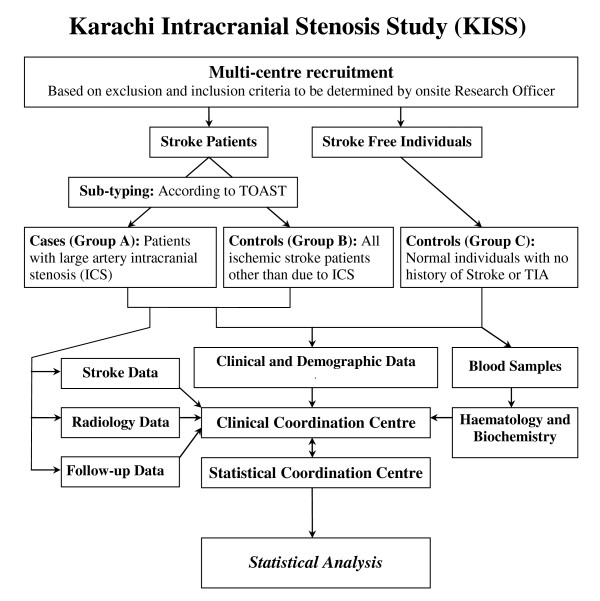
METHODS/DESIGN: The Karachi Intracranial Stenosis Study (KISS) is a prospective, observational, case-control study to describe the clinical features and determine the risk factors of patients with stroke due to intracranial stenosis and compare them to those with stroke due to other etiologies as well as to unaffected individuals. We plan to recruit 200 patients with stroke due to intracranial stenosis and two control groups each of 150 matched individuals. The first set of controls will include patients with ischemic stroke that is due to other atherosclerotic mechanisms specifically lacunar and cardioembolic strokes. The second group will consist of stroke free individuals. Standardized interviews will be conducted to determine demographic, medical, social, and behavioral variables along with baseline medications. Mandatory procedures for inclusion in the study are clinical confirmation of stroke by a healthcare professional within 72 hours of onset, 12 lead electrocardiogram, and neuroimaging. In addition, lipid profile, serum glucose, creatinine and HbA1C will be measured in all participants. Ancillary tests will include carotid ultrasound, transcranial doppler and magnetic resonance or computed tomography angiogram to rule out concurrent carotid disease. Echocardiogram and other additional investigations will be performed at these centers at the discretion of the regional physicians.
The results of this study will help inform locally relevant clinical guidelines and effective public health and individual interventions.
颅内狭窄是亚洲人中风最常见的原因。其预后较差,复发率高。目前尚未开发出有效的药物或手术治疗方法来治疗颅内狭窄所致的中风。我们旨在确定颅内狭窄的危险因素和生物标志物,并开发诸如使用经颅多普勒等技术,以经济有效的方式帮助诊断颅内狭窄。
方法/设计:卡拉奇颅内狭窄研究(KISS)是一项前瞻性、观察性病例对照研究,旨在描述临床特征,确定颅内狭窄所致中风患者的危险因素,并将其与其他病因所致中风患者以及未受影响个体进行比较。我们计划招募200例颅内狭窄所致中风患者和两个对照组,每组150名匹配个体。第一组对照组将包括因其他动脉粥样硬化机制(特别是腔隙性和心源性栓塞性中风)导致缺血性中风的患者。第二组将由无中风个体组成。将进行标准化访谈,以确定人口统计学、医学、社会和行为变量以及基线用药情况。纳入研究的强制性程序包括在发病72小时内由医疗专业人员进行中风的临床确认、12导联心电图和神经影像学检查。此外,将对所有参与者测量血脂、血糖、肌酐和糖化血红蛋白。辅助检查将包括颈动脉超声、经颅多普勒以及磁共振或计算机断层血管造影,以排除并发的颈动脉疾病。超声心动图和其他额外检查将由地区医生酌情在这些中心进行。
本研究结果将有助于为当地相关临床指南以及有效的公共卫生和个体干预提供信息。