Barreiro Luis B, Ben-Ali Meriem, Quach Hélène, Laval Guillaume, Patin Etienne, Pickrell Joseph K, Bouchier Christiane, Tichit Magali, Neyrolles Olivier, Gicquel Brigitte, Kidd Judith R, Kidd Kenneth K, Alcaïs Alexandre, Ragimbeau Josiane, Pellegrini Sandra, Abel Laurent, Casanova Jean-Laurent, Quintana-Murci Lluís
Institut Pasteur, Human Evolutionary Genetics, CNRS, URA3012, Paris, France.
PLoS Genet. 2009 Jul;5(7):e1000562. doi: 10.1371/journal.pgen.1000562. Epub 2009 Jul 17.
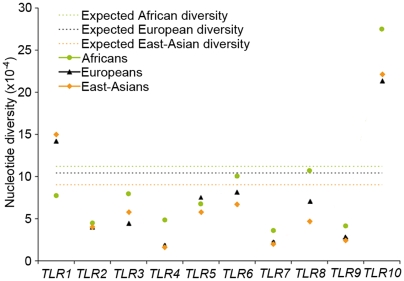
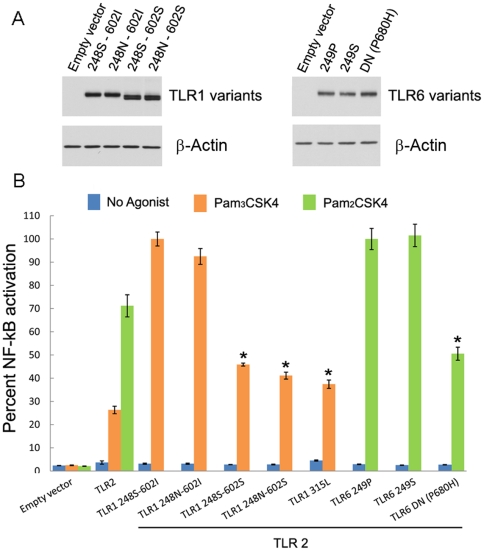
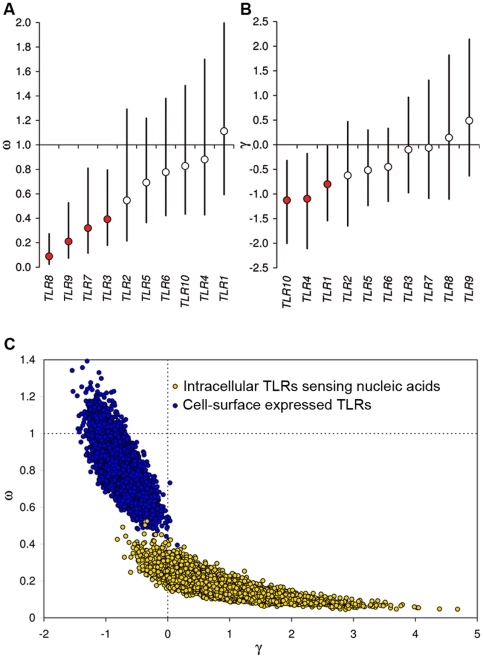
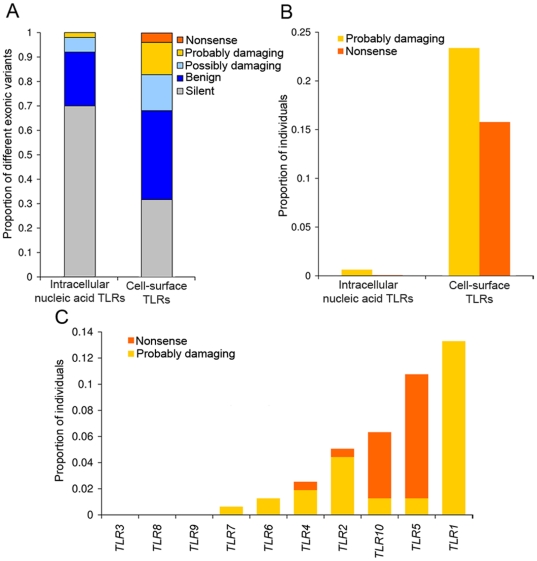
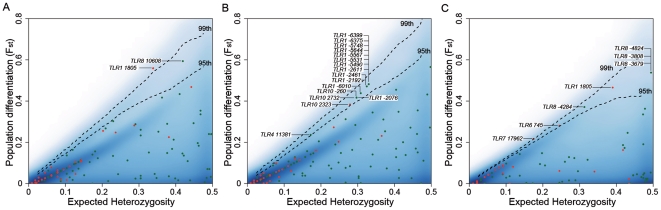
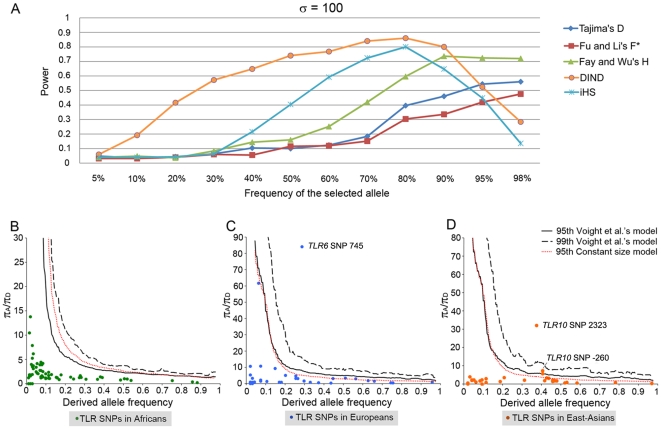
Infectious diseases have been paramount among the threats to health and survival throughout human evolutionary history. Natural selection is therefore expected to act strongly on host defense genes, particularly on innate immunity genes whose products mediate the direct interaction between the host and the microbial environment. In insects and mammals, the Toll-like receptors (TLRs) appear to play a major role in initiating innate immune responses against microbes. In humans, however, it has been speculated that the set of TLRs could be redundant for protective immunity. We investigated how natural selection has acted upon human TLRs, as an approach to assess their level of biological redundancy. We sequenced the ten human TLRs in a panel of 158 individuals from various populations worldwide and found that the intracellular TLRs -- activated by nucleic acids and particularly specialized in viral recognition -- have evolved under strong purifying selection, indicating their essential non-redundant role in host survival. Conversely, the selective constraints on the TLRs expressed on the cell surface -- activated by compounds other than nucleic acids -- have been much more relaxed, with higher rates of damaging nonsynonymous and stop mutations tolerated, suggesting their higher redundancy. Finally, we tested whether TLRs have experienced spatially-varying selection in human populations and found that the region encompassing TLR10-TLR1-TLR6 has been the target of recent positive selection among non-Africans. Our findings indicate that the different TLRs differ in their immunological redundancy, reflecting their distinct contributions to host defense. The insights gained in this study foster new hypotheses to be tested in clinical and epidemiological genetics of infectious disease.
在人类进化史上,传染病一直是对健康和生存的主要威胁之一。因此,自然选择预计会对宿主防御基因产生强烈作用,尤其是对那些其产物介导宿主与微生物环境直接相互作用的先天免疫基因。在昆虫和哺乳动物中,Toll样受体(TLR)似乎在启动针对微生物的先天免疫反应中起主要作用。然而,在人类中,有人推测TLR的集合对于保护性免疫可能是多余的。我们研究了自然选择如何作用于人类TLR,以此来评估它们的生物学冗余水平。我们对来自全球不同人群的158名个体的10种人类TLR进行了测序,发现细胞内TLR——由核酸激活且特别擅长病毒识别——在强烈的纯化选择下进化,这表明它们在宿主生存中具有必不可少的非冗余作用。相反,对细胞表面表达的TLR——由核酸以外的化合物激活——的选择限制则宽松得多,容忍更高比例的有害非同义突变和终止突变,这表明它们具有更高的冗余性。最后,我们测试了TLR在人类群体中是否经历了空间变化选择,发现包含TLR10 - TLR1 - TLR6的区域是非非洲人中近期正选择的目标。我们的研究结果表明,不同的TLR在免疫冗余方面存在差异,这反映了它们对宿主防御的不同贡献。本研究中获得的见解催生了新的假设,有待在传染病的临床和流行病学遗传学中进行检验。