Singh Shailesh, Singh Rajesh, Singh Udai P, Rai Shesh N, Novakovic Kristian R, Chung Leland W K, Didier Peter J, Grizzle William E, Lillard James W
Department of Microbiology and Immunology, James Graham Brown Cancer Center, University of Louisville School of Medicine, Louisville, KY 40202, USA.
Int J Cancer. 2009 Nov 15;125(10):2288-95. doi: 10.1002/ijc.24574.
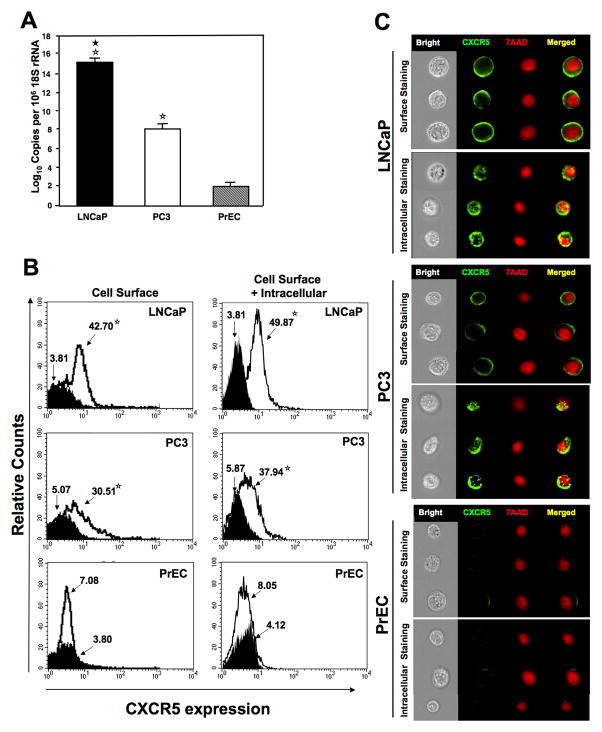
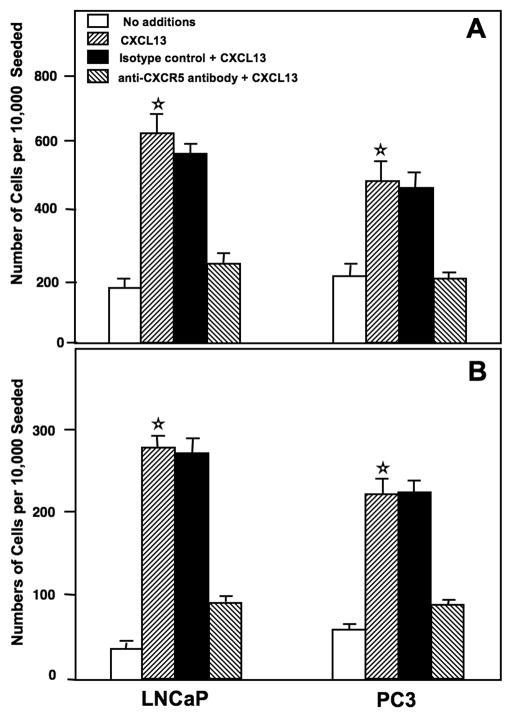
Chemokines and chemokine receptors have been shown to be involved in metastatic process of prostate cancer (PCa). In this study, we show primary PCa tissues and cell lines (LNCaP and PC3) express CXCR5, a specific chemokine receptor for CXCL13. Expression of CXCR5 was significantly higher (p < 0.001) in PCa cases than compared to normal match (NM) tissues. CXCR5 intensity correlated (R(2) = 0.97) with Gleason score. While prostate tumor tissues with Gleason scores >or= 7, displayed predominantly nuclear CXCR5 expression patterns, PCa specimens with Gleason scores <or= 6 showed predominantly membrane and cytoplasmic expression patterns that were comparable to benign prostatic hyperplasia (BPH). Similar to tissue expression, PCa cell lines expressed significantly more CXCR5 than normal prostatic epithelial cells (PrECs), and CXCR5 expression was distributed among intracellular and extracellular compartments. Functional in vitro assays showed higher migratory and invasive potentials toward CXCL13, an effect that was mediated by CXCR5. In both PCa cell lines, CXCL13 treatment increased the expression of collagenase-1 or matrix metalloproteinase-1 (MMP-1), collagenase-3 (MMP-13), stromelysin-1 (MMP-3), stromelysin-2 (MMP-10) and stromelysin-3 (MMP-11). These data demonstrate the clinical and biological relevance of the CXCL13-CXCR5 pathway and its role in PCa cell invasion and migration.
趋化因子和趋化因子受体已被证明参与前列腺癌(PCa)的转移过程。在本研究中,我们发现原发性PCa组织和细胞系(LNCaP和PC3)表达CXCR5,即CXCL13的特异性趋化因子受体。与正常对照(NM)组织相比,PCa病例中CXCR5的表达显著更高(p < 0.001)。CXCR5强度与Gleason评分相关(R(2) = 0.97)。Gleason评分≥7的前列腺肿瘤组织主要显示核CXCR5表达模式,而Gleason评分≤6的PCa标本主要显示与良性前列腺增生(BPH)相当的膜和细胞质表达模式。与组织表达相似,PCa细胞系表达的CXCR5明显多于正常前列腺上皮细胞(PrECs),且CXCR5表达分布于细胞内和细胞外区室。体外功能试验显示,对CXCL13具有更高迁移和侵袭潜能,这一效应由CXCR5介导。在两种PCa细胞系中,CXCL13处理均增加了胶原酶-1或基质金属蛋白酶-1(MMP-1)、胶原酶-3(MMP-13)、基质溶解素-1(MMP-3)、基质溶解素-2(MMP-10)和基质溶解素-3(MMP-11)的表达。这些数据证明了CXCL-13-CXCR5途径的临床和生物学相关性及其在PCa细胞侵袭和迁移中的作用。