Endocrinology Unit, Centre for Cardiovascular Science, University of Edinburgh, Queen's Medical Research Institute, Edinburgh, Scotland.
Eur J Neurosci. 2009 Jul;30(2):299-306. doi: 10.1111/j.1460-9568.2009.06831.x. Epub 2009 Jul 15.
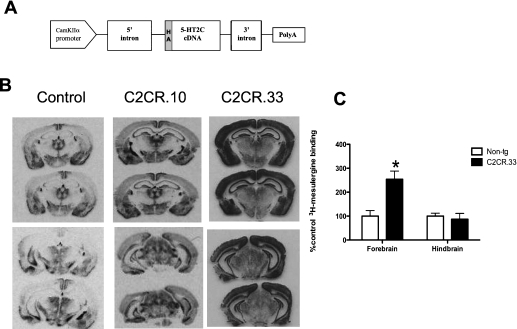
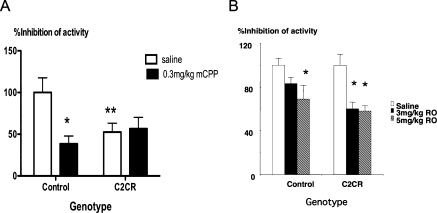
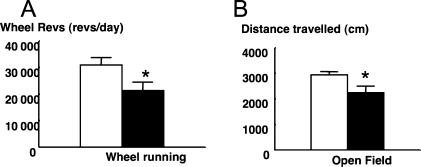
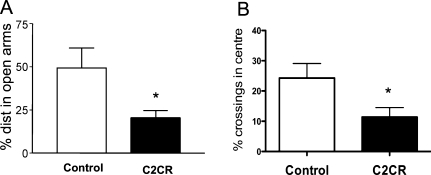
The 5-HT(2C) receptor has been implicated in mood and eating disorders. In general, it is accepted that 5-HT(2C) receptor agonists increase anxiety behaviours and induce hypophagia. However, pharmacological analysis of the roles of these receptors is hampered by the lack of selective ligands and the complex regulation of receptor isoforms and expression levels. Therefore, the exact role of 5-HT(2C) receptors in mood disorders remain controversial, some suggesting agonists and others suggesting antagonists may be efficacious antidepressants, while there is general agreement that antagonists are beneficial anxiolytics. In order to test the hypothesis that increased 5-HT(2C) receptor expression, and thus increased 5-HT(2C) receptor signalling, is causative in mood disorders, we have undertaken a transgenic approach, directly altering the 5-HT(2C) receptor number in the forebrain and evaluating the consequences on behaviour. Transgenic mice overexpressing 5-HT(2C) receptors under the control of the CaMKIIalpha promoter (C2CR mice) have elevated 5-HT(2C) receptor mRNA levels in cerebral cortex and limbic areas (including the hippocampus and amygdala), but normal levels in the hypothalamus, resulting in > 100% increase in the number of 5-HT(2C) ligand binding sites in the forebrain. The C2CR mice show increased anxiety-like behaviour in the elevated plus-maze, decreased wheel-running behaviour and reduced activity in a novel environment. These behaviours were observed in the C2CR mice without stimulation by exogenous ligands. Our findings support a role for 5-HT(2C) receptor signalling in anxiety disorders. The C2CR mouse model offers a novel and effective approach for studying disorders associated with 5-HT(2C) receptors.
5-HT(2C)受体与情绪和进食障碍有关。一般来说,人们认为 5-HT(2C)受体激动剂会增加焦虑行为并引起摄食量减少。然而,由于缺乏选择性配体以及受体同工型和表达水平的复杂调节,对这些受体的药理学分析受到了阻碍。因此,5-HT(2C)受体在情绪障碍中的确切作用仍存在争议,一些人认为激动剂,而另一些人则认为拮抗剂可能是有效的抗抑郁药,而一般认为拮抗剂是有益的抗焦虑药。为了检验这样一个假说,即增加 5-HT(2C)受体表达,从而增加 5-HT(2C)受体信号,是导致情绪障碍的原因,我们采用了转基因方法,直接改变大脑前脑的 5-HT(2C)受体数量,并评估其对行为的影响。在 CaMKIIalpha 启动子的控制下过表达 5-HT(2C)受体的转基因小鼠(C2CR 小鼠)在大脑皮层和边缘区域(包括海马体和杏仁核)中具有升高的 5-HT(2C)受体 mRNA 水平,但在下丘脑中正常,导致前脑中 5-HT(2C)配体结合位点的数量增加了>100%。C2CR 小鼠在高架十字迷宫中表现出焦虑样行为增加,轮跑行为减少,在新环境中活动减少。这些行为在 C2CR 小鼠中没有外源性配体刺激时就观察到了。我们的研究结果支持 5-HT(2C)受体信号在焦虑障碍中的作用。C2CR 小鼠模型为研究与 5-HT(2C)受体相关的疾病提供了一种新的、有效的方法。