Pacific Biosciences Research Center, University of Hawaii at Manoa, Honolulu, HI, United States.
Behav Brain Res. 2009 Dec 14;205(1):138-45. doi: 10.1016/j.bbr.2009.07.007. Epub 2009 Jul 16.
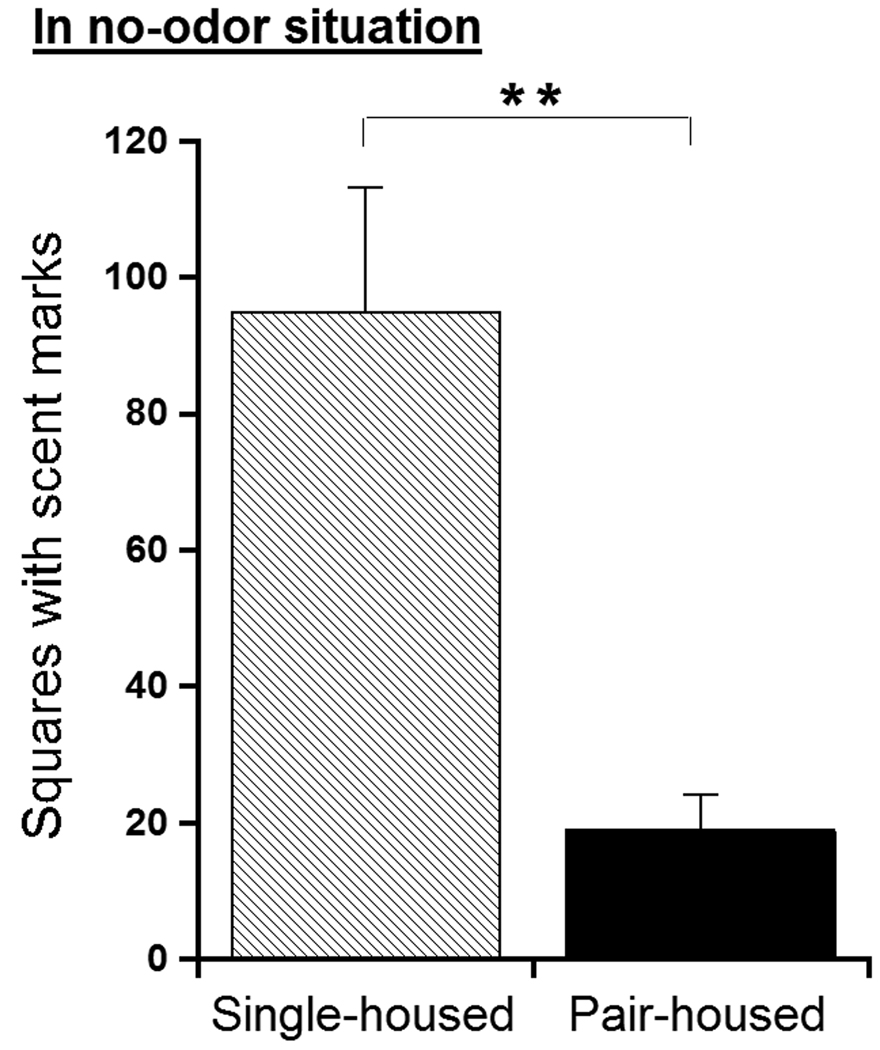
Territorial male mice can form familiarity-dependent amicable relationships, suggesting that they manage their territorial aggressiveness based on individual recognition, which may be mediated by olfactory signals. The present study demonstrated modulatory effect of odorant cues from mice of different social/housing groups on territorial scent marking by C57BL/6J males. Pair-housed males deposited few scent marks in a novel situation without mouse odors, while singly-housed males marked more in the same situation (Experiment 1). However, when confronted by a conspecific, singly-housed males made fewer marks to pair-housed than to singly-housed stimulus males, while pair-housed males showed few marks to either stimulus animal (Experiment 2). Reduction in scent marking in singly-housed males was also seen on exposure to urine scent alone from a pair-housed male, indicating that the inhibitory cue is mediated by urinary odor (Experiment 3). This inhibitory odor was effective even when singly-housed males were placed in a no-odor environment following exposure to soiled bedding used by pair-housed males (Experiment 4). When singly-housed males were exposed to scent from subordinate males, they showed less marking than when the stimulus scent was from dominants or singly-housed males (Experiment 5). Scent marking was not influenced by the total amount of urine scent marks deposited on the substrates (Experiment 6), suggesting that it is a particular component in urinary odor rather than the magnitude of the odor, that plays a significant role in recipient behavior. Together, these experiments indicate that conspecific male odor signals modulate territorial scent marking behavior in mice.
领地性雄性小鼠可以形成依赖熟悉度的友好关系,这表明它们基于个体识别来管理领地攻击性,这种识别可能是通过嗅觉信号介导的。本研究表明,来自不同社交/居住群体的小鼠气味线索对 C57BL/6J 雄性的领地气味标记具有调节作用。在没有老鼠气味的新环境中,成对饲养的雄性很少标记气味,而独居雄性则在相同环境中标记更多(实验 1)。然而,当面对同种动物时,独居雄性对成对饲养的刺激雄性的标记次数少于对独居雄性的标记次数,而成对饲养的雄性对任何刺激动物的标记次数都很少(实验 2)。在单独接触成对饲养雄性的尿液气味时,独居雄性的气味标记也减少了,这表明抑制线索是由尿液气味介导的(实验 3)。即使在单独饲养的雄性暴露于成对饲养雄性使用过的脏垫料后被放置在无气味环境中,这种抑制气味仍然有效(实验 4)。当单独饲养的雄性接触到从属雄性的气味时,它们的标记比接触到优势雄性或单独饲养的雄性的气味时要少(实验 5)。气味标记不受在基质上沉积的尿液气味标记总量的影响(实验 6),这表明在尿液气味中发挥重要作用的是特定成分,而不是气味的强度。综上所述,这些实验表明,同种雄性气味信号调节了小鼠的领地气味标记行为。