Department of Urology and The Landon Center on Aging, University of Kansas, 3901 Rainbow Boulevard, Kansas City, KS 66160, USA.
Int J Clin Pract. 2009 Aug;63(8):1198-204. doi: 10.1111/j.1742-1241.2009.02108.x.
To investigate the tolerability of tolterodine extended release (ER) in older subjects with overactive bladder (OAB).
This was a retrospective analysis of pooled data from five large, randomised, double-blind, placebo-controlled trials. Subjects with OAB symptoms, including urinary frequency and urgency (and nocturia in two studies) with or without urgency urinary incontinence, received qd treatment with tolterodine ER (4 mg) or placebo for 8-12 weeks. Data were stratified post hoc by age group: < 65 (n = 2531), 65-74 (n = 1059) and > or = 75 years (n = 573). Tolerability was assessed by evaluating the occurrence of adverse events (AEs). AE occurrences from each study were mapped to the MedDRA coding dictionary of preferred terms.
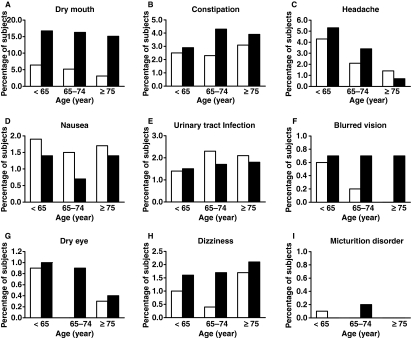
Discontinuation rates were slightly higher among subjects > or = 75 years of age vs. those < 65 years of age; however, this was observed in subjects treated with placebo as well as tolterodine ER. Overall, there were no significant differences in the occurrence of dry mouth, headache, constipation, nausea, urinary tract infection, blurred vision, dry eye, dizziness and micturition disorder in older (65-74 or > or = 75 years) vs. younger (< 65 years) subjects treated with tolterodine ER relative to placebo (treatment x age; all p > 0.1). Dry mouth was the only AE consistently associated with tolterodine ER treatment (< 65 years, 17%; 65-74 years, 16%; > or = 75 years, 15%). The occurrence of all other AEs was < or = 5% in most age and treatment cohorts. Most AEs were mild or moderate in all age and treatment cohorts.
The nature and frequency of AEs associated with tolterodine ER treatment were similar across age groups in subjects with OAB, suggesting that tolterodine ER was not associated with an increased risk of AEs in older vs. younger subjects and, thus, is a suitable first-line pharmacotherapy treatment for OAB in this population.
研究托特罗定缓释片(ER)在有膀胱过度活动症(OAB)的老年患者中的耐受性。
这是对五项大型、随机、双盲、安慰剂对照试验的汇总数据进行的回顾性分析。有 OAB 症状的患者,包括尿频和尿急(在两项研究中还包括夜尿)和/或急迫性尿失禁,接受托特罗定 ER(4mg)qd 治疗或安慰剂治疗 8-12 周。根据年龄组进行事后分层:<65 岁(n=2531)、65-74 岁(n=1059)和≥75 岁(n=573)。通过评估不良事件(AE)的发生来评估耐受性。从每项研究中发生的 AE 被映射到首选术语的 MedDRA 编码字典。
与<65 岁的患者相比,≥75 岁的患者停药率略高;然而,这种情况在安慰剂和托特罗定 ER 治疗的患者中均观察到。总体而言,与安慰剂相比,在接受托特罗定 ER 治疗的老年(65-74 岁或≥75 岁)与年轻(<65 岁)患者中,口干、头痛、便秘、恶心、尿路感染、视力模糊、干眼症、头晕和排尿障碍的发生没有显著差异(治疗×年龄;所有 p>0.1)。口干是唯一与托特罗定 ER 治疗相关的 AE(<65 岁,17%;65-74 岁,16%;≥75 岁,15%)。在大多数年龄和治疗组中,其他 AE 的发生率均<或=5%。在所有年龄和治疗组中,大多数 AE 均为轻度或中度。
在 OAB 患者中,与托特罗定 ER 治疗相关的 AE 的性质和频率在各年龄组中相似,这表明托特罗定 ER 与老年患者和年轻患者相比,AE 风险无增加,因此,对于该人群的 OAB,托特罗定 ER 是一种合适的一线药物治疗。