Henderson Ryan J, Wasan Kishor M, Leon Carlos G
Division of Pharmaceutics and Biopharmaceutics, Faculty of Pharmaceutical Sciences, The University of British Columbia, Vancouver, British Columbia V6T1Z3, Canada.
Lipids Health Dis. 2009 Jul 23;8:27. doi: 10.1186/1476-511X-8-27.
Haptoglobin is a plasma protein that scavenges haemoglobin during haemolysis. Phospholipid Transfer Protein (PLTP) transfers lipids from Low Density Lipoproteins (LDL) to High Density Lipoproteins (HDL). PLTP is involved in the pathogenesis of atherosclerosis which causes coronary artery disease, the leading cause of death in North America. It has been shown that Apolipoprotein-A1 (Apo-A1) binds and regulates PLTP activity. Haptoglobin can also bind to Apo-A1, affecting the ability of Apo-A1 to induce enzymatic activities. Thus we hypothesize that haptoglobin inhibits PLTP activity. This work tested the effect of Haptoglobin and Apo-A1 addition on PLTP activity in human plasma samples. The results will contribute to our understanding of the role of haptoglobin on modulating reverse cholesterol transport.
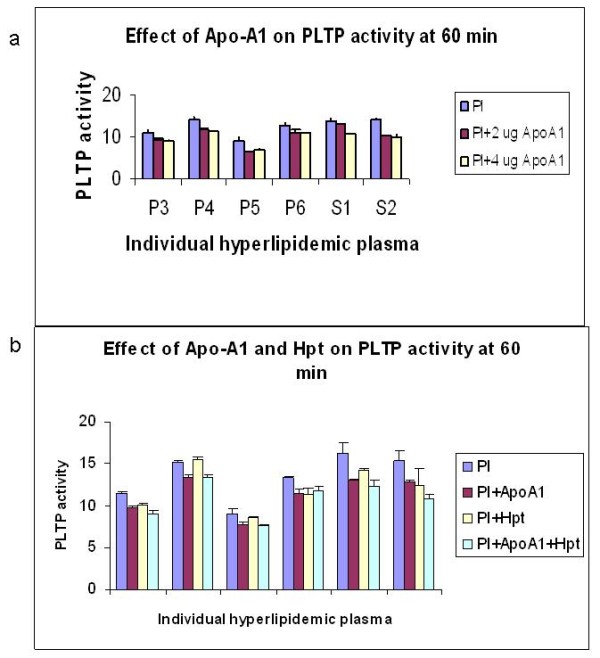
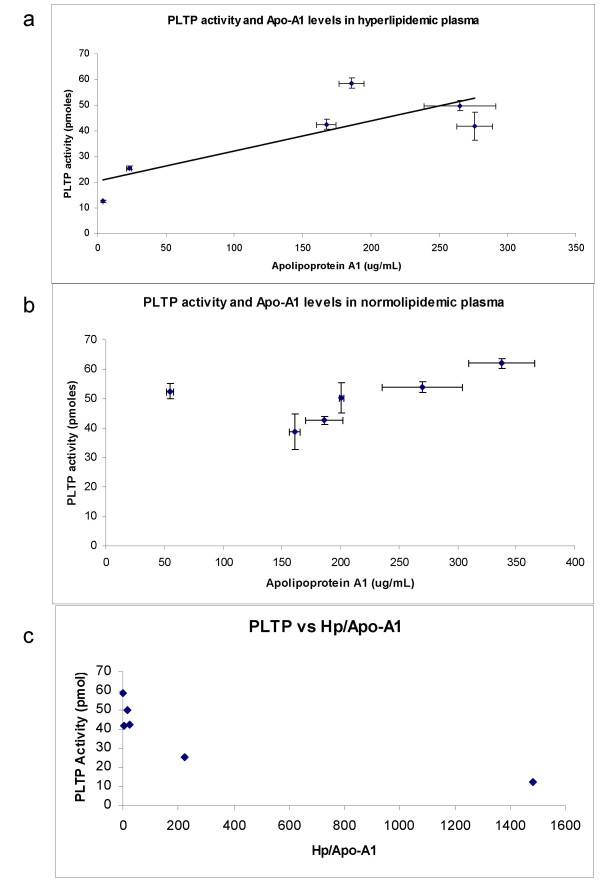
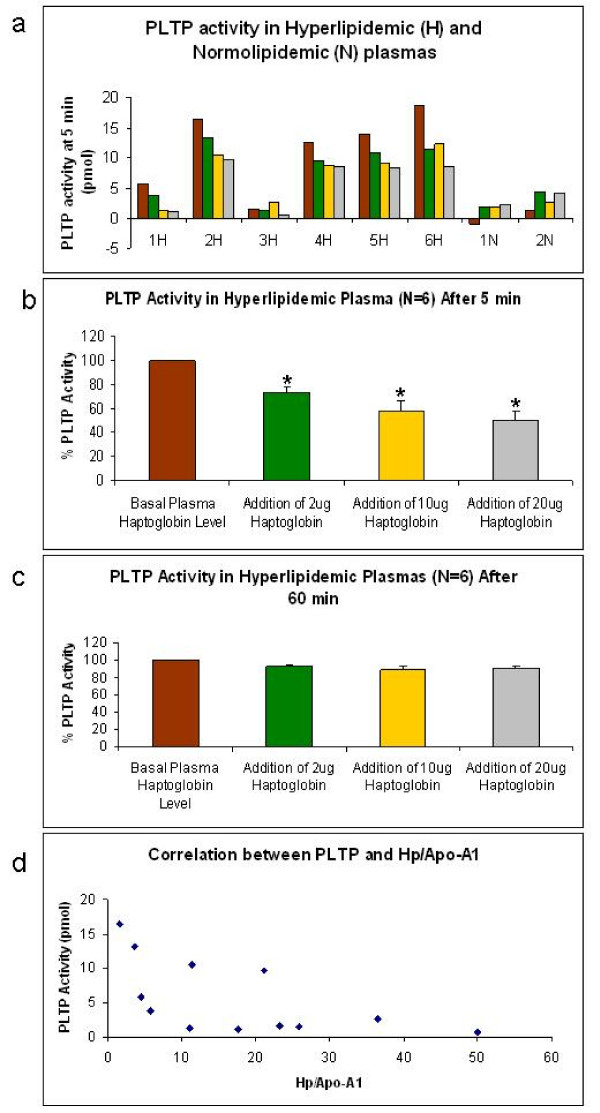
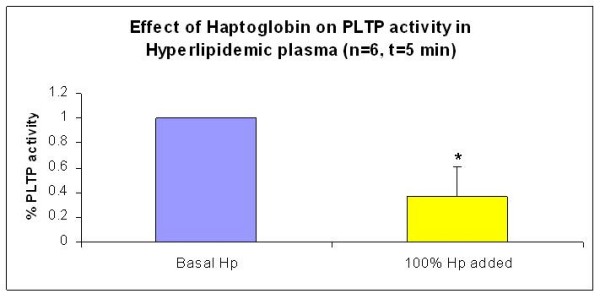
We analyzed the PLTP activity and Apo-A1 and Haptoglobin content in six hyperlipidemic and six normolipidemic plasmas. We found that Apo-A1 levels are proportional to PLTP activity in hyperlipidemic (R2 = 0.66, p < 0.05) but not in normolipidemic human plasma. Haptoglobin levels and PLTP activity are inversely proportional in hyperlipidemic plasmas (R2 = 0.57, p > 0.05). When the PLTP activity was graphed versus the Hp/Apo-A1 ratio in hyperlipidemic plasma there was a significant correlation (R2 = 0.69, p < 0.05) suggesting that PLTP activity is affected by the combined effect of Apo-A1 and haptoglobin. When haptoglobin was added to individual hyperlipidemic plasma samples there was a dose dependent decrease in PLTP activity. In these samples we also found a negative correlation (-0.59, p < 0.05) between PLTP activity and Hp/Apo-A1. When we added an amount of haptoglobin equivalent to 100% of the basal levels, we found a 64 +/- 23% decrease (p < 0.05) in PLTP activity compared to basal PLTP activity. We tested the hypothesis that additional Apo-A1 would induce PLTP activity. Interestingly we found a dose dependent decrease in PLTP activity upon Apo-A1 addition. When both Apo-A1 and Hpt were added to the plasma samples there was no further reduction in PLTP activity suggesting that they act through a common pathway.
These findings suggest an inhibitory effect of Haptoglobin over PLTP activity in hyperlipidemic plasma that may contribute to the regulation of reverse cholesterol transport.
触珠蛋白是一种血浆蛋白,在溶血过程中清除血红蛋白。磷脂转运蛋白(PLTP)将脂质从低密度脂蛋白(LDL)转移到高密度脂蛋白(HDL)。PLTP参与动脉粥样硬化的发病机制,动脉粥样硬化可导致冠状动脉疾病,这是北美主要的死亡原因。研究表明,载脂蛋白A1(Apo-A1)结合并调节PLTP活性。触珠蛋白也可与Apo-A1结合,影响Apo-A1诱导酶活性的能力。因此,我们推测触珠蛋白可抑制PLTP活性。本研究测试了添加触珠蛋白和Apo-A1对人血浆样本中PLTP活性的影响。研究结果将有助于我们理解触珠蛋白在调节胆固醇逆向转运中的作用。
我们分析了6份高脂血症血浆和6份正常血脂血浆中的PLTP活性、Apo-A1和触珠蛋白含量。我们发现,在高脂血症血浆中Apo-A1水平与PLTP活性成正比(R2 = 0.66,p < 0.05),但在正常血脂人血浆中并非如此。在高脂血症血浆中,触珠蛋白水平与PLTP活性成反比(R2 = 0.57,p > 0.05)。当绘制高脂血症血浆中PLTP活性与Hp/Apo-A1比值的关系图时,存在显著相关性(R2 = 0.69,p < 0.05),表明PLTP活性受Apo-A1和触珠蛋白的联合作用影响。当向个体高脂血症血浆样本中添加触珠蛋白时,PLTP活性呈剂量依赖性降低。在这些样本中,我们还发现PLTP活性与Hp/Apo-A1之间存在负相关(-0.59,p < 0.05)。当我们添加相当于基础水平100%的触珠蛋白量时,与基础PLTP活性相比,我们发现PLTP活性降低了64 +/- 23%(p < 0.05)。我们测试了额外添加Apo-A1会诱导PLTP活性的假设。有趣的是,我们发现添加Apo-A1后PLTP活性呈剂量依赖性降低。当同时向血浆样本中添加Apo-A1和Hpt时,PLTP活性没有进一步降低,表明它们通过共同途径发挥作用。
这些发现表明触珠蛋白对高脂血症血浆中的PLTP活性具有抑制作用,这可能有助于调节胆固醇逆向转运。