Wanat Matthew J, Willuhn Ingo, Clark Jeremy J, Phillips Paul E M
Department of Psychiatry and Behavioral Sciences and Department of Pharmacology, University of Washington, Seattle, WA 98195, USA.
Curr Drug Abuse Rev. 2009 May;2(2):195-213. doi: 10.2174/1874473710902020195.
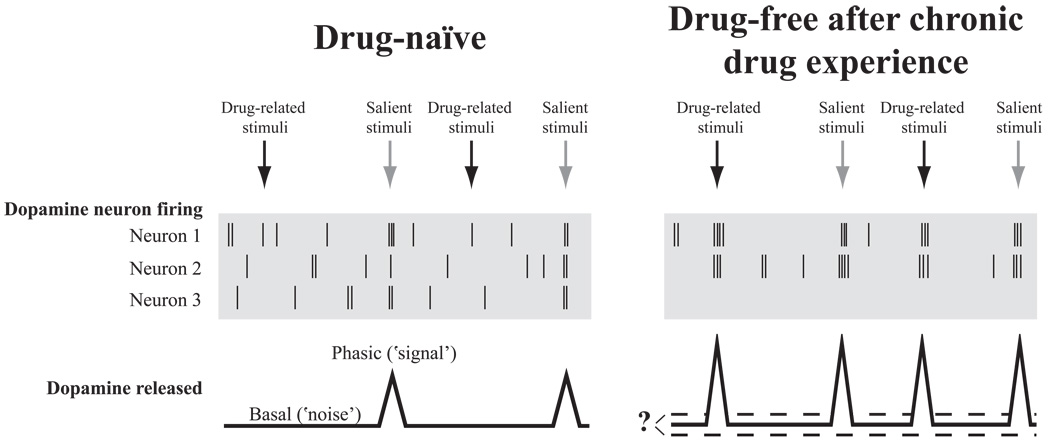
Although dopamine is implicated in the development of addiction, it is unclear how specific dopamine release patterns are involved with drug seeking. Addictive drugs increase tonic dopamine levels on the order of minutes, as well as phasic dopamine release events that occur on a subsecond time scale. Phasic dopamine release is associated with the initiation of goal-directed behaviors, and has been shown to promote drug seeking. Prior experience with addictive drugs modulates the synaptic and intrinsic properties of dopamine neurons, affects the pattern of dopamine neuron firing and release, and alters dopamine-dependent behaviors related to drug addiction. In this review, we synthesize the known drug-dependent changes to the dopamine system along with the established functions of phasic dopamine release in order to provide a framework for conceptualizing the role of phasic dopamine release in drug addiction. Because drug addiction is commonly thought to involve changes in brain circuits important for natural reinforcement, we first present the role of phasic dopamine release in appetitive and goal-directed behaviors in the context of contemporary theories regarding the function of dopamine. Next, we discuss the known drug-induced changes to dopamine neurons and phasic release in both in vitro and in vivo preparations. Finally, we offer a simple model that chronic drug experience increases the contrast, or 'signal to noise', of phasic dopamine release to basal dopamine levels in response to drug-related stimuli, which could result in aberrant associations between cues and reinforcers that contribute to the development of addiction.
尽管多巴胺与成瘾的发展有关,但尚不清楚特定的多巴胺释放模式是如何参与觅药行为的。成瘾性药物会在数分钟内使多巴胺的紧张性水平升高,同时还会引发亚秒级时间尺度上的多巴胺相位性释放事件。多巴胺相位性释放与目标导向行为的启动有关,并且已被证明会促进觅药行为。成瘾性药物的既往使用经历会调节多巴胺神经元的突触和内在特性,影响多巴胺神经元的放电和释放模式,并改变与药物成瘾相关的多巴胺依赖性行为。在本综述中,我们综合了已知的多巴胺系统药物依赖性变化以及多巴胺相位性释放的既定功能,以便为理解多巴胺相位性释放在药物成瘾中的作用提供一个概念框架。由于药物成瘾通常被认为涉及对自然强化很重要的脑回路变化,我们首先在当代关于多巴胺功能的理论背景下介绍多巴胺相位性释放在食欲和目标导向行为中的作用。接下来,我们讨论已知的药物诱导的多巴胺神经元变化以及体外和体内实验中多巴胺的相位性释放。最后,我们提出一个简单的模型,即长期药物使用经历会增加多巴胺相位性释放与基础多巴胺水平之间的对比度,即“信噪比”,以响应与药物相关的刺激,这可能导致线索与强化物之间的异常关联,从而促成成瘾的发展。