Willuhn Ingo, Wanat Matthew J, Clark Jeremy J, Phillips Paul E M
Department of Psychiatry and Behavioral Sciences, University of Washington, Seattle, WA 98195, USA.
Curr Top Behav Neurosci. 2010;3:29-71. doi: 10.1007/7854_2009_27.
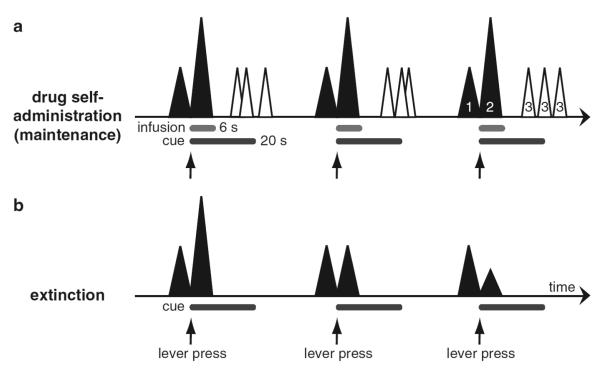
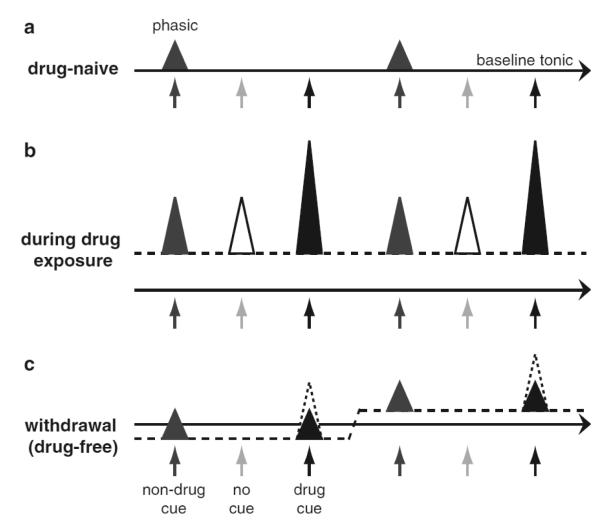
Abuse of psychoactive substances can lead to drug addiction. In animals, addiction is best modeled by drug self-administration paradigms. It has been proposed that the crucial common denominator for the development of drug addiction is the ability of drugs of abuse to increase extracellular concentrations of dopamine in the nucleus accumbens (NAcc). Studies using in vivo microdialysis and chronoamperometry in the behaving animal have demonstrated that drugs of abuse increase tonic dopamine concentrations in the NAcc. However, it is known that dopamine neurons respond to reward-related stimuli on a subsecond timescale. Thus, it is necessary to collect neurochemical information with this level of temporal resolution, as achieved with in vivo fast-scan cyclic voltammetry (FSCV), to fully understand the role of phasic dopamine release in normal behavior and drug addiction. We review studies that investigated the effects of drugs of abuse on NAcc dopamine levels in freely moving animals using in vivo microdialysis, chronoamperometry, and FSCV. After a brief introduction of dopamine signal transduction and anatomy and a section on current theories on the role of dopamine in natural goal-directed behavior, a discussion of techniques for the in vivo assessment of extracellular dopamine in behaving animals is presented. Then, we review studies using these techniques to investigate changes in phasic and tonic dopamine signaling in the NAcc during (1) response-dependent and -independent administration of abused drugs, (2) the presentation of drug-conditioned stimuli and operant behavior in self-administration paradigms, (3) drug withdrawal, and (4) cue-induced reinstatement of drug seeking. These results are then integrated with current ideas on the role of dopamine in addiction with an emphasis on a model illustrating phasic and tonic NAcc dopamine signaling during different stages of drug addiction. This model predicts that phasic dopamine release in response to drug-related stimuli will be enhanced over stimuli associated with natural reinforcers, which may result in aberrant goal-directed behaviors contributing to drug addiction.
精神活性物质的滥用会导致药物成瘾。在动物中,成瘾最好通过药物自我给药范式来模拟。有人提出,药物成瘾发展的关键共同因素是滥用药物能够增加伏隔核(NAcc)中多巴胺的细胞外浓度。在行为动物中使用体内微透析和计时电流法的研究表明,滥用药物会增加NAcc中的多巴胺张力浓度。然而,众所周知,多巴胺神经元在亚秒级时间尺度上对奖励相关刺激做出反应。因此,有必要以体内快速扫描循环伏安法(FSCV)所实现的这种时间分辨率水平来收集神经化学信息,以充分了解相位性多巴胺释放在正常行为和药物成瘾中的作用。我们回顾了使用体内微透析、计时电流法和FSCV研究滥用药物对自由活动动物伏隔核多巴胺水平影响的研究。在简要介绍多巴胺信号转导和解剖结构以及关于多巴胺在自然目标导向行为中的作用的当前理论部分之后,介绍了行为动物体内细胞外多巴胺评估技术的讨论。然后,我们回顾了使用这些技术来研究伏隔核中相位性和张力性多巴胺信号在以下过程中的变化:(1)滥用药物的反应依赖性和非依赖性给药;(2)自我给药范式中药物条件刺激的呈现和操作性行为;(3)药物戒断;(4)线索诱导的觅药行为恢复。然后将这些结果与关于多巴胺在成瘾中的作用的当前观点相结合,重点是一个说明药物成瘾不同阶段伏隔核相位性和张力性多巴胺信号的模型。该模型预测,与自然强化物相关的刺激相比,对药物相关刺激的相位性多巴胺释放将增强,这可能导致异常的目标导向行为,从而促成药物成瘾。