Department of Environmental Medicine, University of Rochester School of Medicine and Dentistry, Rochester, NY 14642, United States. deborah
Behav Brain Res. 2009 Dec 14;205(1):76-87. doi: 10.1016/j.bbr.2009.06.040. Epub 2009 Jul 22.
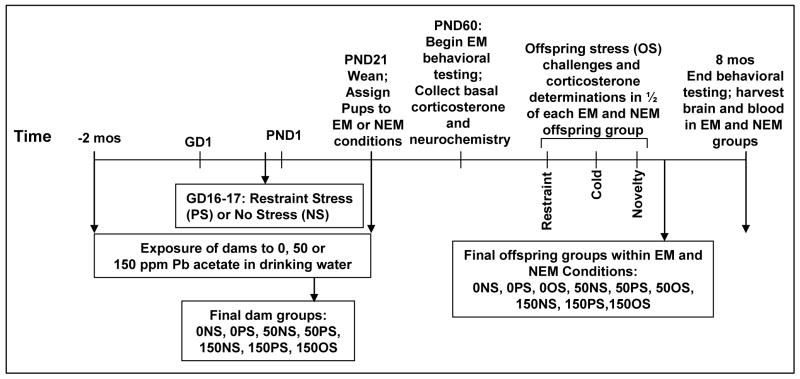
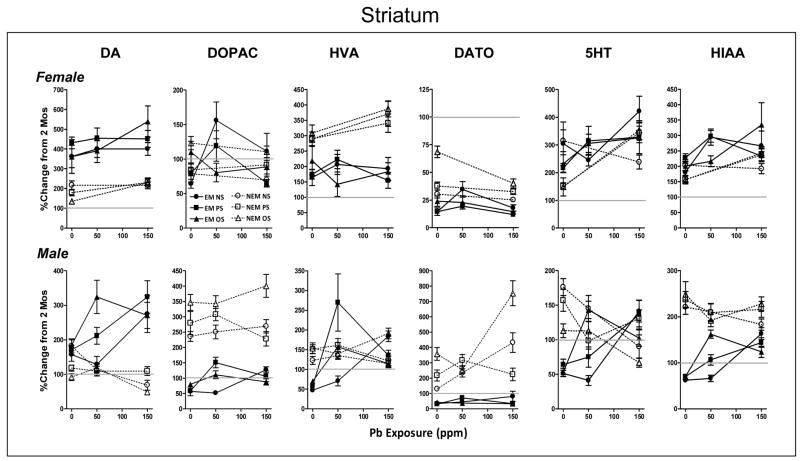
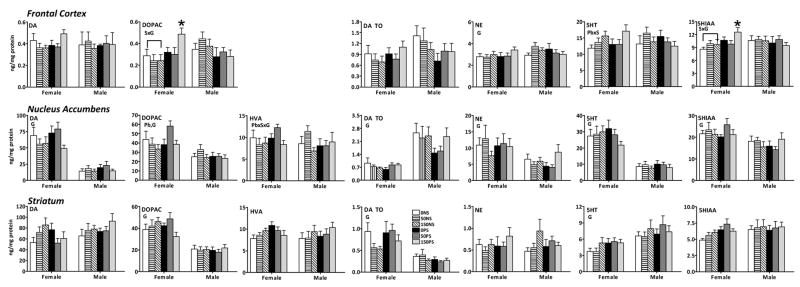
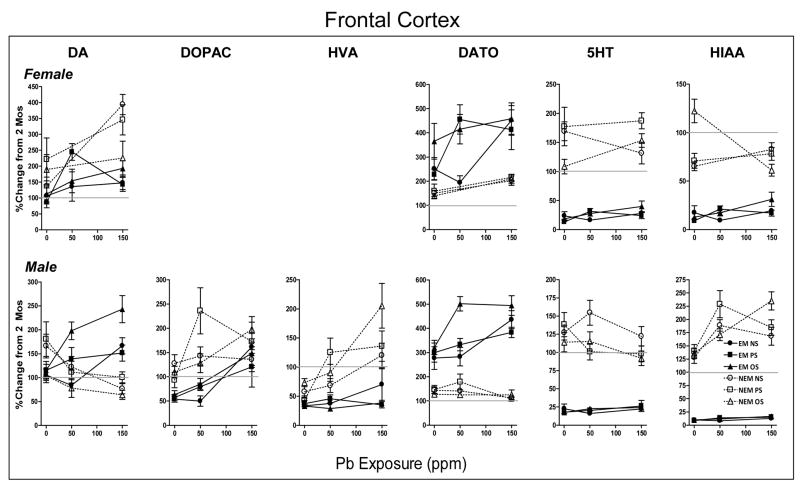
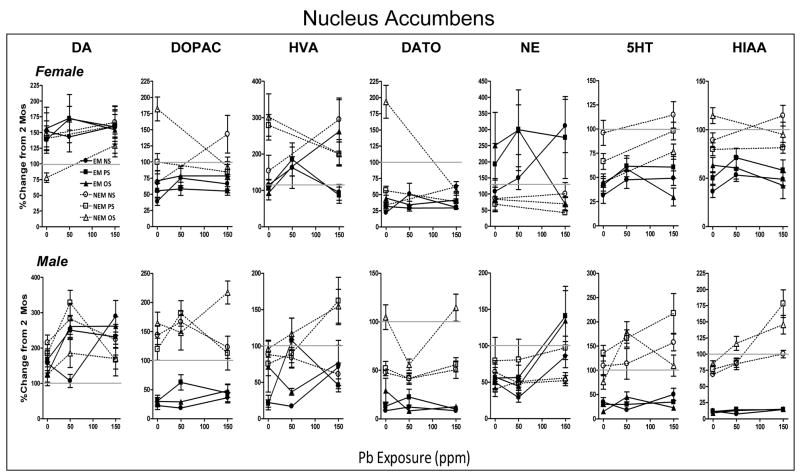
This study sought to further understand how environmental conditions influence the outcomes of early developmental insults. It compared changes in monoamine levels in frontal cortex, nucleus accumbens and striatum of male and female Long-Evans rat offspring subjected to maternal Pb exposure (0, 50 or 150ppm in drinking water from 2 months pre-breeding until pup weaning)+/-prenatal (PS) (restraint on GD16-17) or PS+offspring stress (OS; three variable stress challenges to young adults) determined at 2 months of age and at 6 months of age in littermates subsequently exposed either to experimental manipulations (EM: daily handling and performance on an operant fixed interval (FI) schedule of food reward), or to no experience (NEM; time alone). Time alone (NEM conditions), even in normal (control) animals, modified the trajectory of neurochemical changes between 2 and 6 months across brain regions and monoamines. EM significantly modified the NEM trajectories, and except NE and striatal DA, which increased, blunted the changes in monoamine levels that occurred over time alone. Pb+/-stress modified the trajectory of monoamine changes in both EM and NEM conditions, but these predominated under NEM conditions. Stress-associated modifications, occurring mainly with NEM OS groups, were fully reversed by EM procedures, while reversals of Pb+/-stress-associated modifications occurred primarily in nucleus accumbens, a region critical to mediation of FI response rates. These results extend the known environmental conditions that modify developmental Pb+/-stress insults, which is critical to ultimately understanding whether early insults lead to adaptive or maladaptive behavior and to devising behavioral therapeutic strategies. That time alone and a set of EM conditions typically used as outcome measures in intervention studies can themselves invoke neurochemical changes, moreover, has significant implications for experimental design of such studies.
本研究旨在进一步了解环境条件如何影响早期发育损伤的结果。它比较了母体 Pb 暴露(饮用水中 0、50 或 150ppm,从受孕前 2 个月到幼崽断奶)+/-产前(PS)(GD16-17 天限制)或 PS+后代应激(OS;对年轻成年动物进行三次可变应激挑战)对雄性和雌性 Long-Evans 大鼠后代额皮质、伏隔核和纹状体中单胺水平变化的影响,并在 2 个月大时和 6 个月大时在随后暴露于实验操作(EM:每天处理和在操作性固定间隔(FI)食物奖励时间表上的表现)或无经验(NEM;单独时间)的同窝仔鼠中进行了测定。单独时间(NEM 条件),即使在正常(对照)动物中,也会改变 2 至 6 个月期间神经化学变化的轨迹,跨越大脑区域和单胺类。EM 显著改变了 NEM 轨迹,除了 NE 和纹状体 DA 增加外,还使单独时间内发生的单胺水平变化变钝。Pb+/-应激在 EM 和 NEM 条件下均改变了单胺变化的轨迹,但在 NEM 条件下更为明显。应激相关的改变主要发生在 NEM OS 组中,这些改变可以通过 EM 程序完全逆转,而 Pb+/-应激相关改变的逆转主要发生在伏隔核中,伏隔核是调节 FI 反应率的关键区域。这些结果扩展了已知的环境条件,这些条件可以改变发育中的 Pb+/-应激损伤,这对于最终理解早期损伤是否导致适应性或适应性行为以及设计行为治疗策略至关重要。单独时间和一组 EM 条件通常用作干预研究中的结果测量,此外,这对这些研究的实验设计具有重要意义。