
白细胞介素1抑制剂瑞立西普治疗慢性痛风性关节炎:一项安慰剂对照、单序列交叉、非随机、单盲的初步研究结果
The interleukin 1 inhibitor rilonacept in treatment of chronic gouty arthritis: results of a placebo-controlled, monosequence crossover, non-randomised, single-blind pilot study.
作者信息
Terkeltaub R, Sundy J S, Schumacher H R, Murphy F, Bookbinder S, Biedermann S, Wu R, Mellis S, Radin A
机构信息
VAMC Rheumatology, 111K, 3350 La Jolla Village Drive, San Diego, CA 92161, USA.
出版信息
Ann Rheum Dis. 2009 Oct;68(10):1613-7. doi: 10.1136/ard.2009.108936. Epub 2009 Jul 26.
BACKGROUND
Recent studies suggest that blockade of the NLRP3 (cryopyrin) inflammasome interleukin 1beta (IL1beta) pathway may offer a new treatment strategy for gout.
OBJECTIVE
To explore the potential utility of rilonacept (IL1 Trap) in patients with chronic active gouty arthritis in a proof-of-concept study.
METHODS
This 14-week, multicentre, non-randomised, single-blind, monosequence crossover study of 10 patients with chronic active gouty arthritis included a placebo run-in (2 weeks), active rilonacept treatment (6 weeks) and a 6-week post-treatment follow-up.
RESULTS
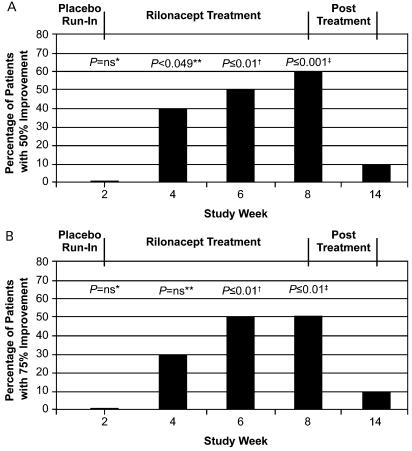
Rilonacept was generally well tolerated. No deaths and no serious adverse events occurred during the study. One patient withdrew owing to an injection-site reaction. Patients' self-reported median pain visual analogue scale scores significantly decreased from week 2 (after the placebo run-in) to week 4 (2 weeks of rilonacept) (5.0 to 2.8; p<0.049), with sustained improvement at week 8 (1.3; p<0.049); 5 of 10 patients reported at least a 75% improvement. Median symptom-adjusted and severity-adjusted joint scores were significantly decreased. High-sensitivity C-reactive protein levels fell significantly.
CONCLUSIONS
This proof-of-concept study demonstrated that rilonacept is generally well tolerated and may offer therapeutic benefit in reducing pain in patients with chronic refractory gouty arthritis, supporting the need for larger, randomised, controlled studies of IL1 antagonism such as with rilonacept for this clinical indication.
背景
近期研究表明,阻断NLRP3(冷吡啉)炎性小体白细胞介素1β(IL1β)通路可能为痛风提供一种新的治疗策略。
目的
在一项概念验证研究中探索利罗那肽(IL1 Trap)对慢性活动性痛风性关节炎患者的潜在效用。
方法
这项针对10例慢性活动性痛风性关节炎患者的为期14周的多中心、非随机、单盲、单序列交叉研究,包括安慰剂导入期(2周)、利罗那肽活性治疗期(6周)和6周的治疗后随访期。
结果
利罗那肽总体耐受性良好。研究期间未发生死亡和严重不良事件。1例患者因注射部位反应退出。患者自我报告的疼痛视觉模拟量表评分中位数从第2周(安慰剂导入期后)至第4周(利罗那肽治疗2周)显著降低(从5.0降至2.8;p<0.049),在第8周持续改善(1.3;p<0.049);10例患者中有5例报告至少改善了75%。症状调整和严重程度调整后的关节评分中位数显著降低。高敏C反应蛋白水平显著下降。
结论
这项概念验证研究表明,利罗那肽总体耐受性良好,可能对减轻慢性难治性痛风性关节炎患者的疼痛具有治疗益处,支持对IL1拮抗作用进行更大规模的随机对照研究,如针对该临床适应症使用利罗那肽。


 Zotero 插件