Maass Dirk, Arango Jacobo, Wüst Florian, Beyer Peter, Welsch Ralf
Faculty of Biology, Cell Biology, University of Freiburg, Freiburg, Germany.
PLoS One. 2009 Jul 28;4(7):e6373. doi: 10.1371/journal.pone.0006373.
As the first pathway-specific enzyme in carotenoid biosynthesis, phytoene synthase (PSY) is a prime regulatory target. This includes a number of biotechnological approaches that have successfully increased the carotenoid content in agronomically relevant non-green plant tissues through tissue-specific PSY overexpression. We investigated the differential effects of constitutive AtPSY overexpression in green and non-green cells of transgenic Arabidopsis lines. This revealed striking similarities to the situation found in orange carrot roots with respect to carotenoid amounts and sequestration mechanism.
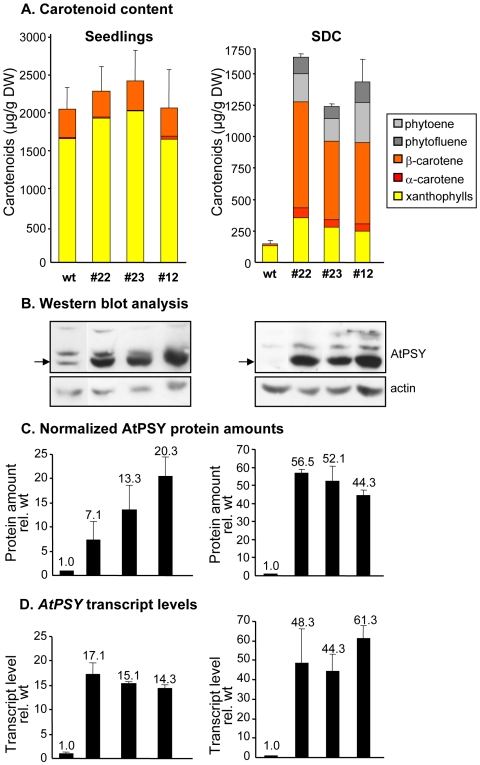
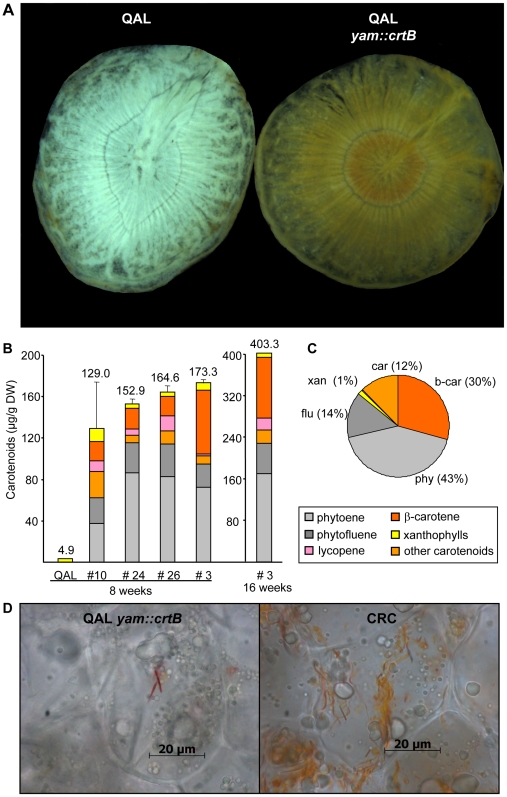
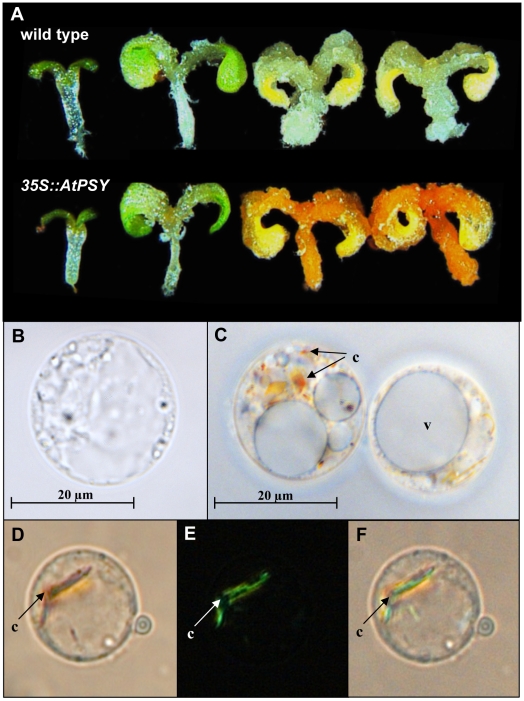
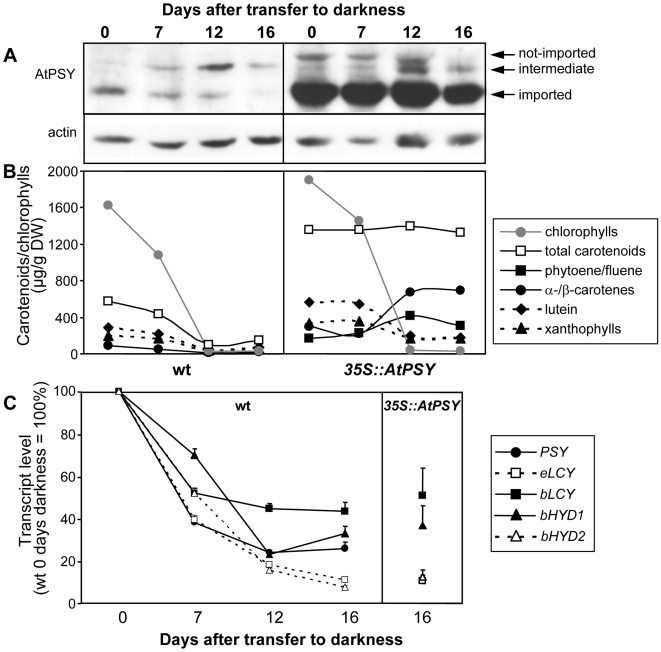
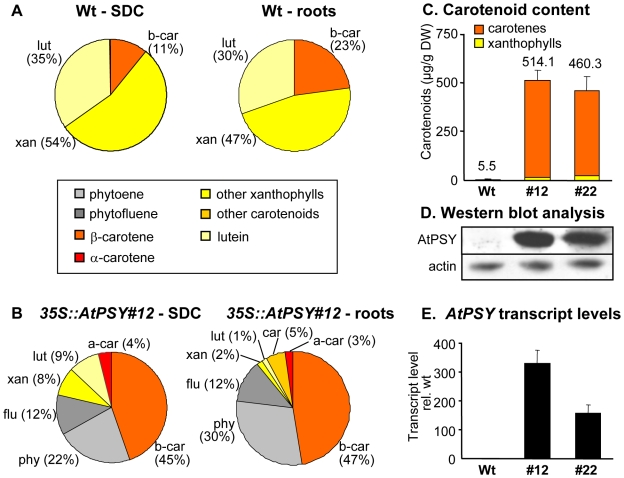
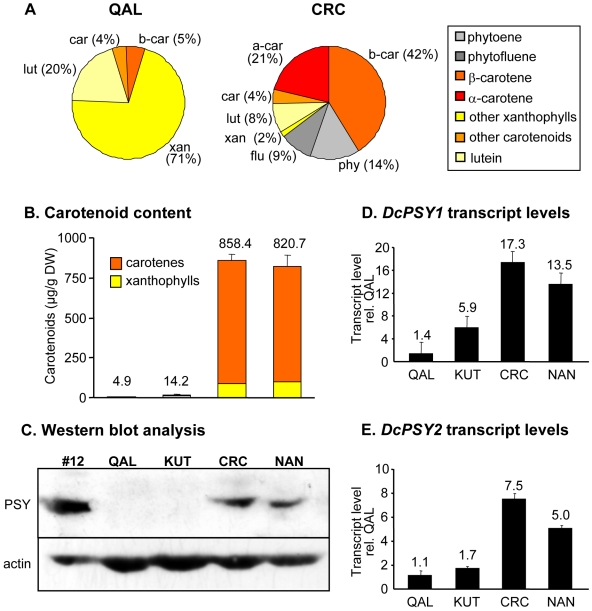
METHODOLOGY/PRINCIPAL FINDINGS: In Arabidopsis seedlings, carotenoid content remained unaffected by increased AtPSY levels although the protein was almost quantitatively imported into plastids, as shown by western blot analyses. In contrast, non-photosynthetic calli and roots overexpressing AtPSY accumulated carotenoids 10 and 100-fold above the corresponding wild-type tissues and contained 1800 and 500 microg carotenoids per g dry weight, respectively. This increase coincided with a change of the pattern of accumulated carotenoids, as xanthophylls decreased relative to beta-carotene and carotene intermediates accumulated. As shown by polarization microscopy, carotenoids were found deposited in crystals, similar to crystalline-type chromoplasts of non-green tissues present in several other taxa. In fact, orange-colored carrots showed a similar situation with increased PSY protein as well as carotenoid levels and accumulation patterns whereas wild white-rooted carrots were similar to Arabidopsis wild type roots in this respect. Initiation of carotenoid crystal formation by increased PSY protein amounts was further confirmed by overexpressing crtB, a bacterial PSY gene, in white carrots, resulting in increased carotenoid amounts deposited in crystals.
The sequestration of carotenoids into crystals can be driven by the functional overexpression of one biosynthetic enzyme in non-green plastids not requiring a chromoplast developmental program as this does not exist in Arabidopsis. Thus, PSY expression plays a major, rate-limiting role in the transition from white to orange-colored carrots.
作为类胡萝卜素生物合成中的首个途径特异性酶,八氢番茄红素合酶(PSY)是主要的调控靶点。这包括一些生物技术方法,这些方法已通过组织特异性过表达PSY成功提高了与农业相关的非绿色植物组织中的类胡萝卜素含量。我们研究了组成型AtPSY在转基因拟南芥品系的绿色和非绿色细胞中过表达的差异效应。这揭示了在类胡萝卜素含量和隔离机制方面与橙色胡萝卜根中情况的惊人相似之处。
方法/主要发现:在拟南芥幼苗中,尽管通过蛋白质印迹分析表明该蛋白质几乎定量地导入了质体,但类胡萝卜素含量并未因AtPSY水平的升高而受到影响。相反,过表达AtPSY的非光合愈伤组织和根积累的类胡萝卜素分别比相应的野生型组织高10倍和100倍,每克干重分别含有1800和500微克类胡萝卜素。这种增加与积累的类胡萝卜素模式的变化同时发生,因为相对于β-胡萝卜素,叶黄素减少,并且类胡萝卜素中间体积累。通过偏振显微镜观察发现,类胡萝卜素沉积在晶体中,类似于其他几个分类群中存在的非绿色组织的晶体型质体。事实上,橙色胡萝卜在PSY蛋白以及类胡萝卜素水平和积累模式增加方面表现出类似情况,而野生白根胡萝卜在这方面与拟南芥野生型根相似。通过在白萝卜中过表达细菌PSY基因crtB进一步证实了PSY蛋白量增加引发类胡萝卜素晶体形成,导致晶体中沉积的类胡萝卜素量增加。
类胡萝卜素向晶体中的隔离可以由非绿色质体中一种生物合成酶的功能性过表达驱动,而不需要质体发育程序,因为拟南芥中不存在这种程序。因此,PSY表达在从白色胡萝卜到橙色胡萝卜的转变中起主要的限速作用。