Phuc Tran Q, Mihrshahi Seema, Casey Gerard J, Phu Luong B, Tien Nong T, Caruana Sonia R, Thach Tran D, Montresor Antonio, Biggs Beverley-Ann
National Institute of Malariology, Parasitology and Entomology (NIMPE), Hanoi, Viet Nam.
BMC Public Health. 2009 Jul 28;9:266. doi: 10.1186/1471-2458-9-266.
Iron deficiency, anemia and hookworm disease are important public health problems for women of reproductive age living in developing countries and affect the health of newborns and infants. Iron supplementation and deworming treatment are effective in addressing these problems in both pregnant and non-pregnant women. Daily iron supplementation and deworming after the first trimester is recommended for pregnant women although these programs usually do not operate efficiently or effectively. Weekly iron-folic acid supplementation and regular deworming for non-pregnant women may be a viable approach for improving iron status and preventing anemia during the reproductive years. Addressing these diseases at a population level before women become pregnant could significantly improve women's health before and during pregnancy, as well as their infants' growth and development.
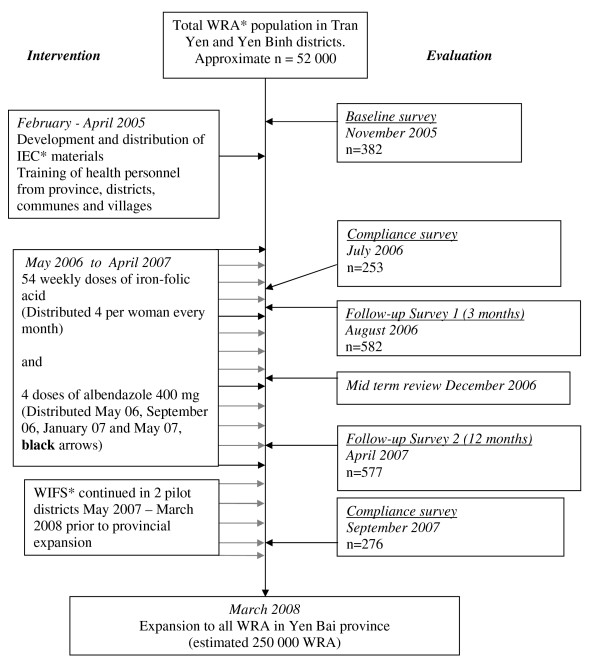
This paper describes the major processes undertaken in a demonstration intervention of preventive weekly iron-folic acid supplementation with regular deworming for all 52,000 women aged 15-45 years in two districts of Yen Bai province, in northern Viet Nam. The intervention strategy included extensive consultation with community leaders and village, commune, district and provincial health staff, and training for village health workers. Distribution of the drugs was integrated with the existing health service infrastructure and the village health workers were the direct point of contact with women. Iron-folic acid tablets and deworming treatment were provided free of charge from May 2006. An independent Vietnamese NGO was commissioned to evaluate compliance and identify potential problems. The program resulted in effective distribution of iron-folic acid tablets and deworming treatment to all villages in the target districts, with full or partial compliance of 85%.
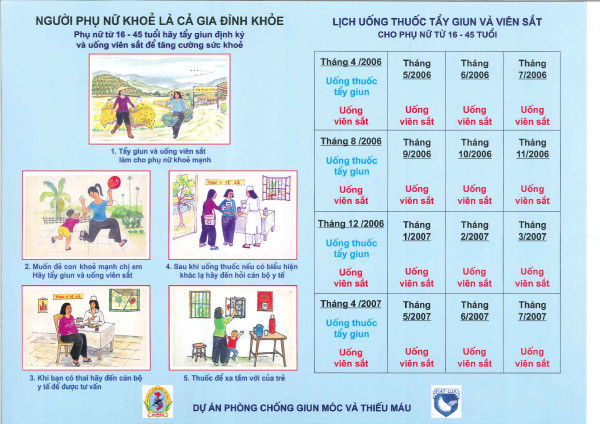
Training for health staff, the strong commitment of all partners and the use of appropriate educational materials led to broad support for weekly iron-folic acid supplementation and high participation in the regular deworming days. In March 2008 the program was expanded to all districts in the province, a target population of approximately 250,000 WRA, and management was handed over to provincial authorities.
缺铁、贫血和钩虫病是发展中国家育龄妇女面临的重要公共卫生问题,会影响新生儿和婴儿的健康。补充铁剂和驱虫治疗对解决孕妇和非孕妇的这些问题均有效。建议孕妇在孕中期之后每日补充铁剂并进行驱虫治疗,尽管这些项目通常运作效率不高或效果不佳。对非孕妇每周补充铁叶酸并定期驱虫可能是改善育龄期妇女铁营养状况和预防贫血的可行方法。在妇女怀孕前在人群层面解决这些疾病问题,可显著改善妇女孕前和孕期的健康状况以及其婴儿的生长发育情况。
本文描述了在越南北部宣光省两个地区针对52000名15至45岁妇女开展的预防性每周补充铁叶酸并定期驱虫示范干预所采取的主要过程。干预策略包括与社区领袖以及村、乡、区和省级卫生工作人员进行广泛协商,并对乡村卫生工作者进行培训。药品分发与现有的卫生服务基础设施相结合,乡村卫生工作者是与妇女的直接接触点。自2006年5月起免费提供铁叶酸片和驱虫治疗。委托一家独立的越南非政府组织评估依从性并识别潜在问题。该项目使铁叶酸片和驱虫治疗有效地分发到了目标地区的所有村庄,完全或部分依从率达85%。
对卫生工作人员的培训、所有合作伙伴的坚定承诺以及使用适当的教育材料,使得每周补充铁叶酸得到广泛支持,且在定期驱虫日参与度很高。2008年3月,该项目扩大到全省所有地区,目标人群约为25万育龄妇女,管理工作移交给了省级当局。