Parodi Luis, Pickering Eve, Cisar Laura A, Lee Doug, Soufi-Mahjoubi Raoudha
Arch Drug Inf. 2008 Dec;1(3):97-106. doi: 10.1111/j.1753-5174.2008.00014.x.
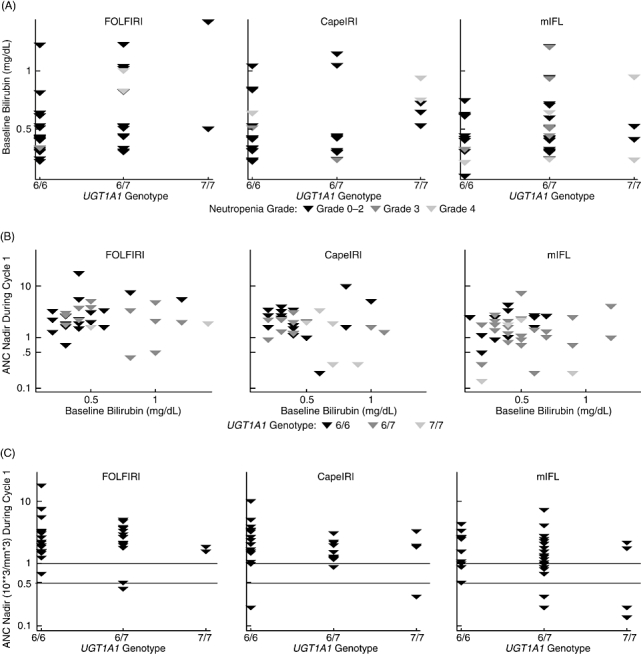
Statistical models for predicting hematologic toxicity were evaluated based on UGT1A1 polymorphisms and baseline serum bilirubin. METHODS: Blood DNA samples were collected from 113 patients with untreated metastatic colorectal cancer receiving irinotecan (FOLFIRI, n = 36; mIFL, n = 41; CapeIRI, n = 36). The primary endpoint was absolute neutrophil count nadir during first treatment cycle. Linear regression models, with increased R(2) implying important additional predictive power, sequentially added age, sex, baseline bilirubin level, and UGT1A1 genotype. RESULTS: All models demonstrated low R(2), suggesting unaccounted variables. UGT1A1 genotype added approximately 8-9% during cycle 1 and from approximately 7% [mIFL regimen] to 26% [CapeIRI regimen] after cycle 1. Correlation between genotype and overall ANC nadir without regard to treatment was low (R = -0.201, P = 0.035). Patients with genotype 7/7 may have increased risk for severe neutropenia, but data are insufficient to characterize this. Contribution of baseline bilirubin level was negligible. CONCLUSIONS: Ability of UGT1A1 or baseline bilirubin to predict neutropenia is low and depends on regimen.
基于尿苷二磷酸葡萄糖醛酸转移酶1A1(UGT1A1)基因多态性和基线血清胆红素水平,对预测血液学毒性的统计模型进行评估。方法:收集113例接受伊立替康治疗的未经治疗的转移性结直肠癌患者的血液DNA样本(FOLFIRI方案组36例;改良IFL方案组41例;CapeIRI方案组36例)。主要终点为首个治疗周期内的中性粒细胞绝对计数最低点。线性回归模型中,决定系数(R²)增加意味着具有重要的额外预测能力,依次纳入年龄、性别、基线胆红素水平和UGT1A1基因型。结果:所有模型的R²均较低,提示存在未考虑的变量。UGT1A1基因型在第1周期增加了约8 - 9%的预测能力,第1周期后在改良IFL方案组增加了约7%,在CapeIRI方案组增加了26%。不考虑治疗情况时,基因型与总体中性粒细胞计数最低点之间的相关性较低(R = -0.201,P = 0.035)。7/7基因型患者发生严重中性粒细胞减少的风险可能增加,但数据不足以对此进行特征描述。基线胆红素水平的贡献可忽略不计。结论:UGT1A1或基线胆红素预测中性粒细胞减少的能力较低,且取决于治疗方案。