Canzian Federico, Kaaks Rudolf, Cox David G, Henderson Katherine D, Henderson Brian E, Berg Christine, Bingham Sheila, Boeing Heiner, Buring Julie, Calle Eugenia E, Chanock Stephen, Clavel-Chapelon Francoise, Dossus Laure, Feigelson Heather Spencer, Haiman Christopher A, Hankinson Susan E, Hoover Robert, Hunter David J, Isaacs Claudine, Lenner Per, Lund Eiliv, Overvad Kim, Palli Domenico, Pearce Celeste Leigh, Quiros Jose R, Riboli Elio, Stram Daniel O, Thomas Gilles, Thun Michael J, Trichopoulos Dimitrios, van Gils Carla H, Ziegler Regina G
German Cancer Research Center (DKFZ), Heidelberg, Germany.
BMC Cancer. 2009 Jul 29;9:257. doi: 10.1186/1471-2407-9-257.
Gonadotropin releasing hormone (GNRH1) triggers the release of follicle stimulating hormone and luteinizing hormone from the pituitary. Genetic variants in the gene encoding GNRH1 or its receptor may influence breast cancer risk by modulating production of ovarian steroid hormones. We studied the association between breast cancer risk and polymorphisms in genes that code for GNRH1 and its receptor (GNRHR) in the large National Cancer Institute Breast and Prostate Cancer Cohort Consortium (NCI-BPC3).
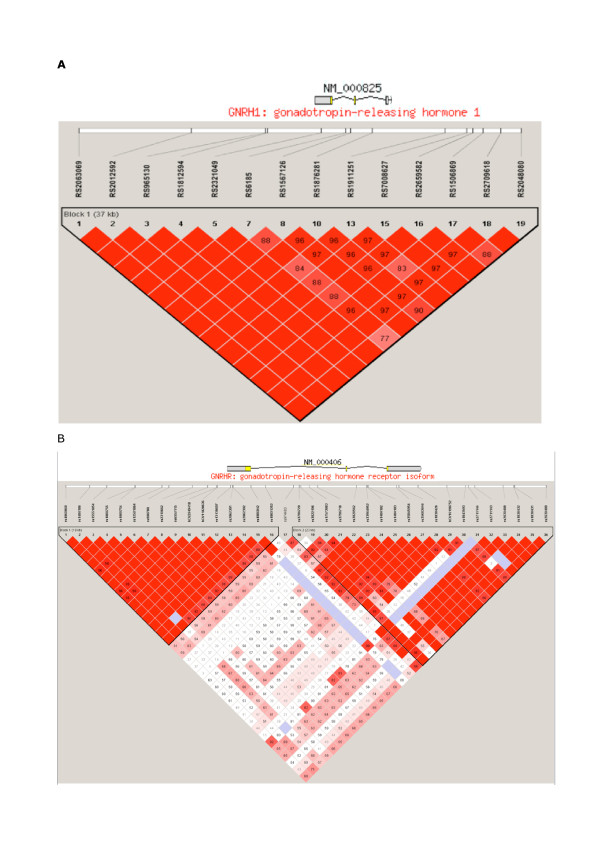
We sequenced exons of GNRH1 and GNRHR in 95 invasive breast cancer cases. Resulting single nucleotide polymorphisms (SNPs) were genotyped and used to identify haplotype-tagging SNPs (htSNPS) in a panel of 349 healthy women. The htSNPs were genotyped in 5,603 invasive breast cancer cases and 7,480 controls from the Cancer Prevention Study-II (CPS-II), European Prospective Investigation on Cancer and Nutrition (EPIC), Multiethnic Cohort (MEC), Nurses' Health Study (NHS), and Women's Health Study (WHS). Circulating levels of sex steroids (androstenedione, estradiol, estrone and testosterone) were also measured in 4713 study subjects.
Breast cancer risk was not associated with any polymorphism or haplotype in the GNRH1 and GNRHR genes, nor were there any statistically significant interactions with known breast cancer risk factors. Polymorphisms in these two genes were not strongly associated with circulating hormone levels.
Common variants of the GNRH1 and GNRHR genes are not associated with risk of invasive breast cancer in Caucasians.
促性腺激素释放激素(GNRH1)可触发垂体释放促卵泡激素和促黄体生成素。编码GNRH1或其受体的基因中的遗传变异可能通过调节卵巢甾体激素的产生来影响乳腺癌风险。我们在大型国立癌症研究所乳腺癌和前列腺癌队列联盟(NCI - BPC3)中研究了乳腺癌风险与编码GNRH1及其受体(GNRHR)的基因多态性之间的关联。
我们对95例浸润性乳腺癌病例的GNRH1和GNRHR外显子进行了测序。将所得的单核苷酸多态性(SNP)进行基因分型,并用于在一组349名健康女性中鉴定单倍型标签SNP(htSNP)。这些htSNP在来自癌症预防研究II(CPS - II)、欧洲癌症与营养前瞻性调查(EPIC)、多民族队列(MEC)、护士健康研究(NHS)和妇女健康研究(WHS)的5603例浸润性乳腺癌病例和7480例对照中进行了基因分型。还在4713名研究对象中测量了循环性激素(雄烯二酮、雌二醇、雌酮和睾酮)水平。
乳腺癌风险与GNRH1和GNRHR基因中的任何多态性或单倍型均无关联,与已知的乳腺癌风险因素也没有任何统计学上的显著相互作用。这两个基因中的多态性与循环激素水平没有强烈关联。
GNRH1和GNRHR基因的常见变异与白种人浸润性乳腺癌风险无关。