Zhang Min, Ono Takahiro, Chen Yongjin, Lv Xin, Wu Shun, Song Hong, Zhao Ruini, Wang Yibing
Department of General Dentistry & Emergency, School of Stomatology, Fourth Military Medical University, Xi'an 710032, China.
J Biomed Biotechnol. 2009;2009:509848. doi: 10.1155/2009/509848. Epub 2009 Jul 26.
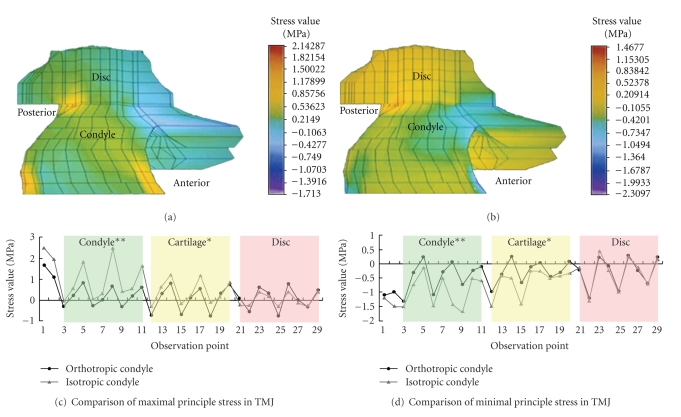
Mandibular condyle plays an important role in the growth and reconstruction of the temporomandibular joint (TMJ). We aimed to obtain orthotropic elastic parameters of the condyle using a continuous-wave ultrasonic technique and to observe the effects of condylar elastic parameters on stress distribution of the TMJ using finite element analysis (FEA). Using the ultrasonic technique, all nine elastic parameters were obtained, which showed that the mandibular condyle was orthotropic. With the condyle defined as orthotropic, the occlusal stress was transferred fluently and uniformly from the mandible to the TMJ. The stress distribution in the isotropic model showed stepped variation among different anatomical structures with higher stress values in the cartilage and condyle than in the orthotropic model. We conclude that anisotropy has subtle yet significant effects on stress distribution of the TMJ and could improve the reality of simulations.
下颌髁突在颞下颌关节(TMJ)的生长和重建中起着重要作用。我们旨在使用连续波超声技术获取髁突的正交各向异性弹性参数,并通过有限元分析(FEA)观察髁突弹性参数对TMJ应力分布的影响。使用超声技术获得了所有九个弹性参数,结果表明下颌髁突是正交各向异性的。将髁突定义为正交各向异性时,咬合应力从下颌骨顺畅且均匀地传递至TMJ。各向同性模型中的应力分布在不同解剖结构之间呈现阶梯状变化,软骨和髁突中的应力值高于正交各向异性模型。我们得出结论,各向异性对TMJ的应力分布具有细微但显著的影响,并且可以提高模拟的真实性。