Alto Laura Taylor, Havton Leif A, Conner James M, Hollis Edmund R, Blesch Armin, Tuszynski Mark H
Department of Neurosciences, University of California, San Diego, La Jolla, California, USA.
Nat Neurosci. 2009 Sep;12(9):1106-13. doi: 10.1038/nn.2365. Epub 2009 Aug 2.
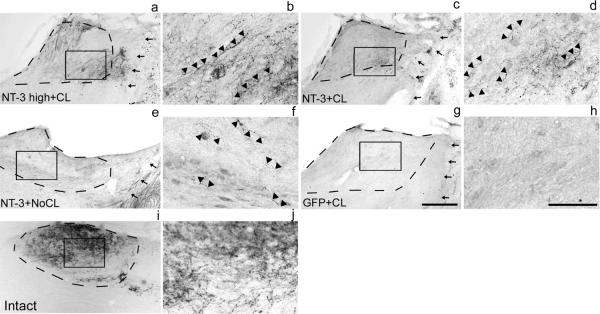
A principal objective of spinal cord injury (SCI) research is the restoration of axonal connectivity to denervated targets. We tested the hypothesis that chemotropic mechanisms would guide regenerating spinal cord axons to appropriate brainstem targets. We subjected rats to cervical level 1 (C1) lesions and combinatorial treatments to elicit axonal bridging into and beyond lesion sites. Lentiviral vectors expressing neurotrophin-3 (NT-3) were then injected into an appropriate brainstem target, the nucleus gracilis, and an inappropriate target, the reticular formation. NT-3 expression in the correct target led to reinnervation of the nucleus gracilis in a dose-related fashion, whereas NT-3 expression in the reticular formation led to mistargeting of regenerating axons. Axons regenerating into the nucleus gracilis formed axodendritic synapses containing rounded vesicles, reflective of pre-injury synaptic architecture. Thus, we report for the first time, to the best of our knowledge, the reinnervation of brainstem targets after SCI and an essential role for chemotropic axon guidance in target selection.
脊髓损伤(SCI)研究的一个主要目标是恢复轴突与失神经支配靶点的连接。我们测试了一种假说,即化学趋向机制会引导再生的脊髓轴突到达合适的脑干靶点。我们对大鼠进行颈1(C1)节段损伤及联合治疗,以促使轴突跨越损伤部位并延伸至更远端。然后将表达神经营养因子-3(NT-3)的慢病毒载体分别注射到合适的脑干靶点薄束核以及不合适的靶点网状结构中。在正确靶点中表达的NT-3以剂量相关的方式导致薄束核重新获得神经支配,而在网状结构中表达的NT-3则导致再生轴突误靶向。再生进入薄束核的轴突形成了含有圆形囊泡的轴-树突触,这反映了损伤前的突触结构。因此,据我们所知,我们首次报道了脊髓损伤后脑干靶点的重新神经支配以及化学趋向性轴突导向在靶点选择中的重要作用。