Genetics and Developmental Biology Program, West Virginia University, Morgantown, WV 26506, USA.
Part Fibre Toxicol. 2009 Aug 3;6:21. doi: 10.1186/1743-8977-6-21.
Many polycyclic aromatic hydrocarbons (PAHs) can cause DNA adducts and initiate carcinogenesis. Mixed exposures to coal dust (CD) and PAHs are common in occupational settings. In the CD and PAH-exposed lung, CD increases apoptosis and causes alveolar type II (AT-II) cell hyperplasia but reduces CYP1A1 induction. Inflammation, but not apoptosis, appears etiologically associated with reduced CYP1A1 induction in this mixed exposure model. Many AT-II cells in the CD-exposed lungs have no detectable CYP1A1 induction after PAH exposure. Although AT-II cells are a small subfraction of lung cells, they are believed to be a potential progenitor cell for some lung cancers. Because CYP1A1 is induced via ligand-mediated nuclear translocation of the aryl hydrocarbon receptor (AhR), we investigated the effect of CD on PAH-induced nuclear translocation of AhR in AT-II cells isolated from in vivo-exposed rats. Rats received CD or vehicle (saline) by intratracheal (IT) instillation. Three days before sacrifice, half of the rats in each group started daily intraperitoneal injections of the PAH, beta-naphthoflavone (BNF).
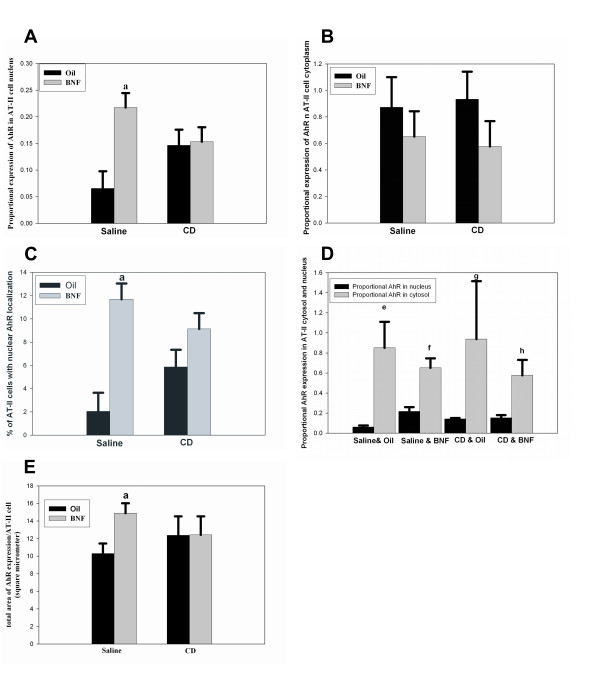
Fourteen days after IT CD exposure and 1 day after the last intraperitoneal BNF injection, AhR immunofluorescence indicated that proportional AhR nuclear expression and the percentage of cells with nuclear AhR were significantly increased in rats receiving IT saline and BNF injections compared to vehicle controls. However, in CD-exposed rats, BNF did not significantly alter the nuclear localization or cytosolic expression of AhR compared to rats receiving CD and oil.
Our findings suggest that during particle and PAH mixed exposures, CD alters the BNF-induced nuclear translocation of AhR in AT-II cells. This provides an explanation for the modification of CYP1A1 induction in these cells. Thus, this study suggests that mechanisms for reduced PAH-induced CYP1A1 activity in the CD exposed lung include not only the effects of inflammation on the lung as a whole, but also reduced PAH-associated nuclear translocation of AhR in an expanded population of AT-II cells.
许多多环芳烃(PAHs)可导致 DNA 加合物并引发致癌作用。在职业环境中,煤尘(CD)和 PAHs 的混合暴露很常见。在 CD 和 PAH 暴露的肺部,CD 会增加细胞凋亡并导致肺泡 II 型(AT-II)细胞增生,但会降低 CYP1A1 的诱导。在这种混合暴露模型中,炎症而不是细胞凋亡似乎与 CYP1A1 诱导降低有关。在 PAH 暴露后,暴露于 CD 的肺部中的许多 AT-II 细胞没有检测到 CYP1A1 的诱导。尽管 AT-II 细胞在肺细胞中所占比例很小,但它们被认为是某些肺癌的潜在祖细胞。由于 CYP1A1 是通过配体介导的芳烃受体(AhR)核易位诱导的,因此我们研究了 CD 对从体内暴露的大鼠中分离的 AT-II 细胞中 PAH 诱导的 AhR 核易位的影响。大鼠通过气管内(IT)滴注接受 CD 或载体(盐水)。在每组大鼠牺牲前 3 天,开始每日腹腔内注射 PAH,β-萘黄酮(BNF)。
在 IT CD 暴露后 14 天和最后一次腹腔内 BNF 注射后 1 天,AhR 免疫荧光表明,与接受 IT 盐水和油的对照相比,接受 IT 盐水和 BNF 注射的大鼠中 AhR 核表达的比例和具有核 AhR 的细胞的百分比均显着增加。但是,与接受 CD 和油的大鼠相比,在 CD 暴露的大鼠中,BNF 并未显着改变 AhR 的核定位或细胞溶质表达。
我们的研究结果表明,在颗粒和 PAH 混合暴露期间,CD 改变了 AT-II 细胞中 BNF 诱导的 AhR 核易位。这为这些细胞中 CYP1A1 诱导的改变提供了解释。因此,这项研究表明,CD 暴露的肺部中降低 PAH 诱导的 CYP1A1 活性的机制不仅包括炎症对整个肺部的影响,还包括在扩展的 AT-II 细胞群体中减少与 PAH 相关的 AhR 核易位。