Department of Oncology, University of Alberta, Cross Cancer Institute, 11560 University Avenue, Edmonton, Alberta, Canada T6G 1Z2.
Breast Cancer Res. 2009;11(4):R57. doi: 10.1186/bcr2347. Epub 2009 Aug 6.
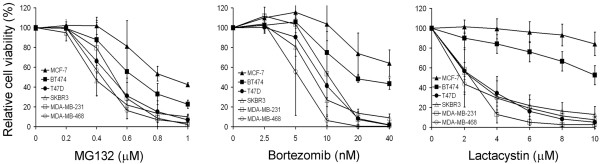
Notch is a family of transmembrane protein receptors whose activation requires proteolytic cleavage by gamma-secretase. Since aberrant Notch signaling can induce mammary carcinomas in transgenic mice and high expression levels of Notch receptors and ligands correlates with overall poor clinical outcomes, inhibiting gamma-secretase with small molecules may be a promising approach for breast cancer treatment. Consistent with this hypothesis, two recent papers reported that gamma-secretase inhibitor I (GSI I), Z-LLNle-CHO, is toxic to breast cancer cells both in vitro and in vivo. In this study, we compared the activity and cytotoxicity of Z-LLNle-CHO to that of two highly specific GSIs, DAPT and L-685,458 and three structurally unrelated proteasome inhibitors, MG132, lactacystin, and bortezomib in order to study the mechanism underlying the cytotoxicity of Z-LLNle-CHO in breast cancer cells.
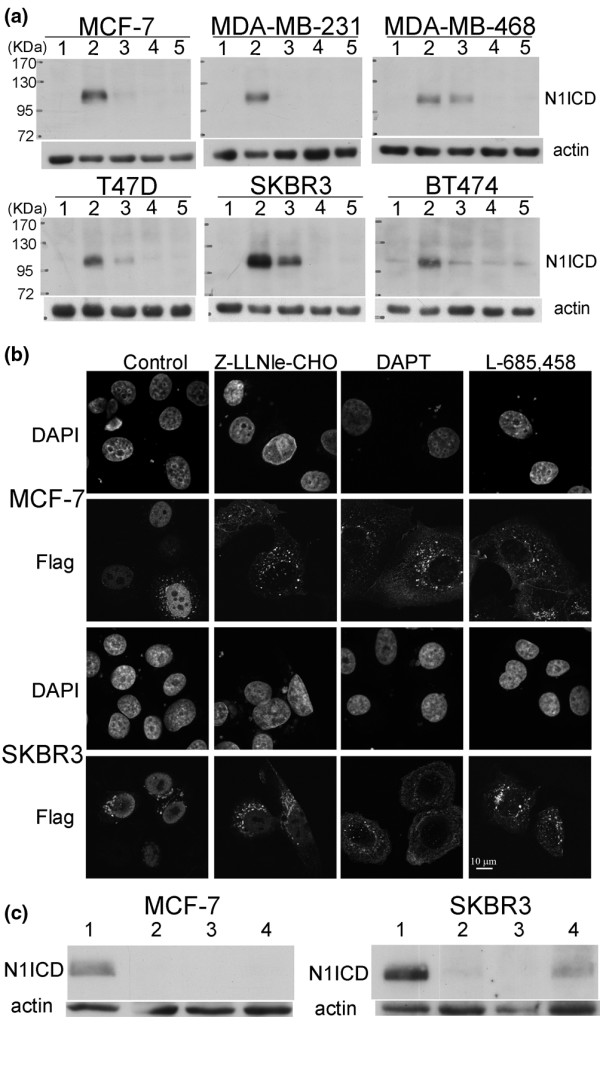
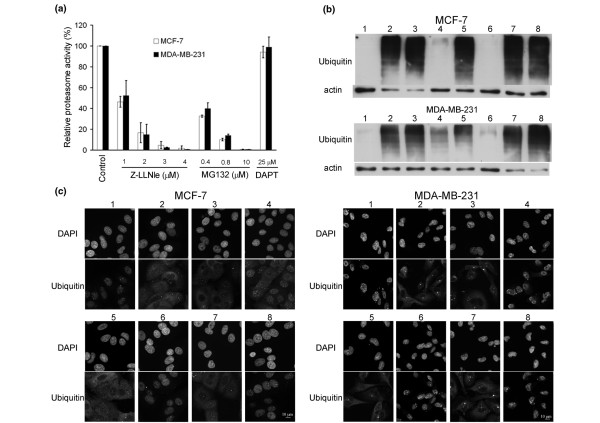
Three estrogen receptor (ER) positive cell lines, MCF-7, BT474, and T47D, and three ER negative cell lines, SKBR3, MDA-MB-231, and MDA-MB-468, were used in this study. Both SKBR3 and BT474 cells also overexpress HER2/neu. Cytotoxicity was measured by using an MTS cell viability/proliferation assay. Inhibition of gamma-secretase activity was measured by both immunoblotting and immunofluorescent microscopy in order to detect active Notch1 intracellular domain. Proteasome inhibition was determined by using a cell-based proteasome activity assay kit, by immunoblotting to detect accumulation of polyubiquitylated protein, and by immunofluorescent microscopy to detect redistribution of cellular ubiquitin.
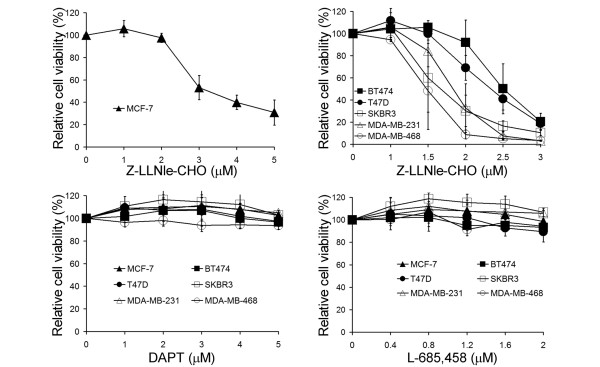
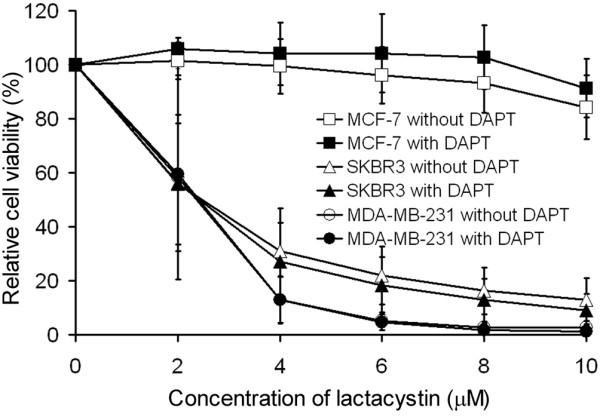
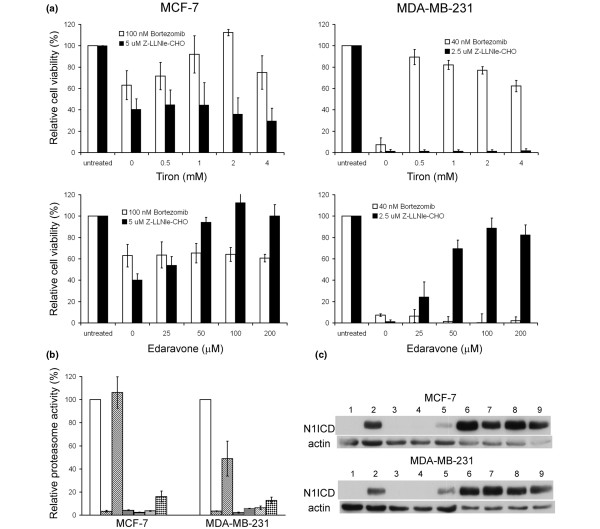
We found that blocking gamma-secretase activity by DAPT and L-685,458 had no effect on the survival and proliferation of a panel of six breast cancer cell lines while Z-LLNle-CHO could cause cell death even at concentrations that inhibited gamma-secretase activity less efficiently. Furthermore, we observed that Z-LLNle-CHO could inhibit proteasome activity and the relative cellular sensitivity of these six breast cancer cell lines to Z-LLNle-CHO was the same as observed for three proteasome inhibitors. Finally, we found that the cell killing effect of Z-LLNle-CHO could be reversed by a chemical that restored the proteasome activity.
We conclude that the cytotoxicity of Z-LLNle-CHO in breast cancer cells is mediated by proteasome inhibition, not by gamma-secretase inhibition.
Notch 是一种跨膜蛋白受体家族,其激活需要 γ-分泌酶的蛋白水解切割。由于异常 Notch 信号可以诱导转基因小鼠发生乳腺癌,并且 Notch 受体和配体的高表达水平与总体不良临床结局相关,因此用小分子抑制 γ-分泌酶可能是治疗乳腺癌的一种有前途的方法。这一假说得到了两项最新研究的支持,这两项研究报告称,γ-分泌酶抑制剂 I(GSI I)Z-LLNle-CHO 在体外和体内对乳腺癌细胞均具有毒性。在这项研究中,我们比较了 Z-LLNle-CHO 与两种高度特异性 GSI(DAPT 和 L-685,458)以及三种结构上无关的蛋白酶体抑制剂(MG132、乳胞素和硼替佐米)的活性和细胞毒性,以研究 Z-LLNle-CHO 在乳腺癌细胞中的细胞毒性的作用机制。
本研究使用了三种雌激素受体(ER)阳性细胞系 MCF-7、BT474 和 T47D,以及三种 ER 阴性细胞系 SKBR3、MDA-MB-231 和 MDA-MB-468。SKBR3 和 BT474 细胞还过表达 HER2/neu。通过 MTS 细胞活力/增殖测定法测量细胞毒性。通过免疫印迹和免疫荧光显微镜检测活性 Notch1 细胞内结构域来测量 γ-分泌酶活性的抑制。通过细胞蛋白酶体活性测定试剂盒、免疫印迹检测多泛素化蛋白积累以及免疫荧光显微镜检测细胞内泛素的重分布来检测蛋白酶体抑制作用。
我们发现,DAPT 和 L-685,458 阻断 γ-分泌酶活性对一组六种乳腺癌细胞系的存活和增殖没有影响,而 Z-LLNle-CHO 即使在抑制 γ-分泌酶活性效率较低的浓度下也能导致细胞死亡。此外,我们观察到 Z-LLNle-CHO 可以抑制蛋白酶体活性,并且这六种乳腺癌细胞系对 Z-LLNle-CHO 的相对细胞敏感性与三种蛋白酶体抑制剂相同。最后,我们发现 Z-LLNle-CHO 的细胞杀伤作用可以通过一种恢复蛋白酶体活性的化学物质逆转。
我们的结论是,Z-LLNle-CHO 在乳腺癌细胞中的细胞毒性是由蛋白酶体抑制介导的,而不是由 γ-分泌酶抑制介导的。