Servicio de Oncologia Medica, Consorcio Hospital General Universitario de Valencia, Avda Tres Cruces S/N, 46006, Valencia, Spain.
J Neurooncol. 2010 Feb;96(3):417-22. doi: 10.1007/s11060-009-9980-7. Epub 2009 Aug 8.
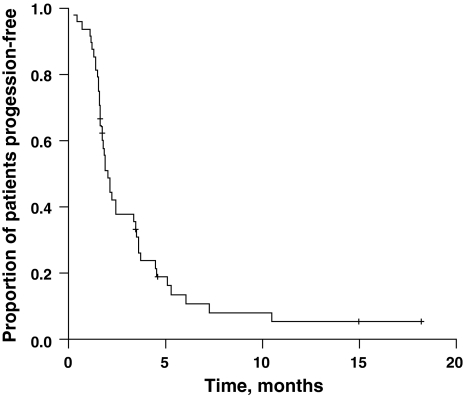
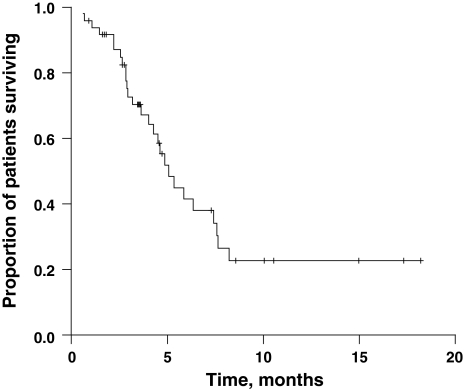
This multicenter phase II study conducted by the Spanish Neuro-Oncology Group evaluated the activity of an extended, dose-dense temozolomide regimen in patients with temozolomide-refractory malignant glioma. Adult patients (at least 18 years of age) with WHO grade III or IV glioma and a Karnofsky Performance Status of 60 or higher were treated with temozolomide (85 mg/m(2)/day) for 21 consecutive days every 28-day cycle until disease progression or unacceptable toxicity. All patients had developed progressive disease either during or less than 3 months after completing previous temozolomide treatment. Forty-seven patients were treated with a median of 2 (range, 1-13) cycles of temozolomide. Before study entry, patients had received a median of 6 cycles of temozolomide: 39 (83%) as part of initial therapy and 23 (49%) as second-line therapy. Three patients (6.4%) had a partial response with durations of 8.0, 3.5, and 3.2 months; 15 patients (31.9%) had stable disease with a median duration of 2.1 months, including 2 patients with stable disease (SD) for greater than 6 months (14 and 16 months). Median time to progression was 2 months, and median overall survival from study entry was 5.1 months. The 6-month progression-free survival rate was 16.7%. The most common hematologic toxicities were lymphopenia, thrombocytopenia, and leukopenia. Lymphopenia occurred in 83% of patients and was grade 3 in 28%, but no opportunistic infections occurred. In conclusion, this extended dose-dense schedule of temozolomide appears to have modest activity in patients refractory to previous treatment with temozolomide and is associated with manageable toxicity.
这项由西班牙神经肿瘤学组进行的多中心 II 期研究评估了延长、密集剂量替莫唑胺方案在替莫唑胺耐药性恶性胶质瘤患者中的活性。成人患者(至少 18 岁)患有世界卫生组织(WHO)分级 III 或 IV 级胶质瘤,卡氏功能状态评分为 60 或更高,每 28 天周期接受替莫唑胺(85mg/m2/天)治疗 21 天,直到疾病进展或无法耐受毒性。所有患者在接受替莫唑胺治疗期间或治疗结束后 3 个月内均出现进展性疾病。47 名患者接受中位数为 2(范围为 1-13)个周期的替莫唑胺治疗。在研究入组前,患者接受了中位数为 6 个周期的替莫唑胺治疗:39 例(83%)为初始治疗,23 例(49%)为二线治疗。3 名患者(6.4%)有部分缓解,持续时间分别为 8.0、3.5 和 3.2 个月;15 名患者(31.9%)疾病稳定,中位持续时间为 2.1 个月,包括 2 名疾病稳定时间大于 6 个月的患者(14 个月和 16 个月)。中位无进展生存期为 2 个月,中位总生存期为 5.1 个月。6 个月无进展生存率为 16.7%。最常见的血液学毒性是淋巴细胞减少、血小板减少和白细胞减少。淋巴细胞减少发生在 83%的患者中,其中 28%为 3 级,但没有发生机会性感染。总之,这种延长的密集剂量替莫唑胺方案在先前替莫唑胺治疗耐药的患者中似乎具有适度的活性,且毒性可管理。