Department of Ecology and Evolutionary Biology, University of California, Santa Cruz, CA 95064, USA.
Oecologia. 2010 Jan;162(1):71-80. doi: 10.1007/s00442-009-1424-8. Epub 2009 Aug 11.
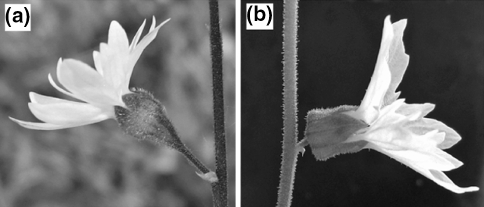
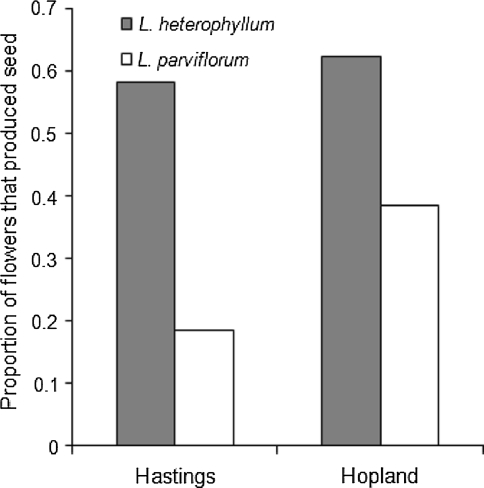
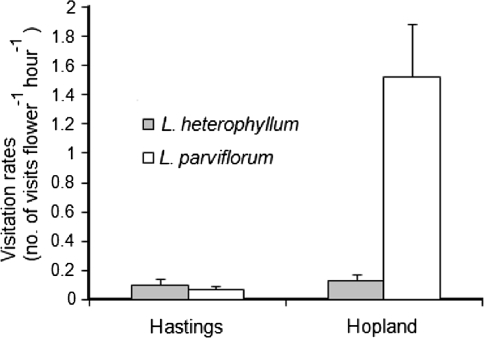
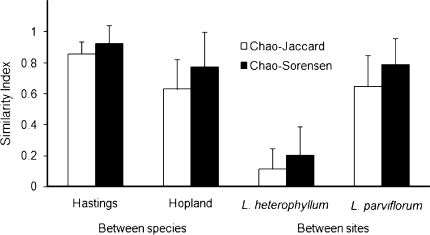
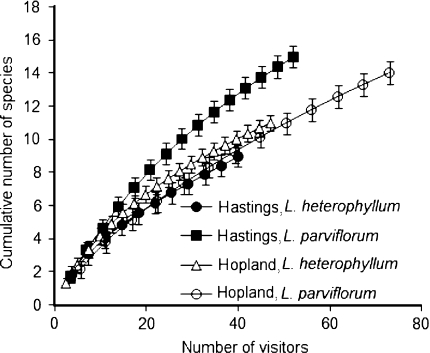
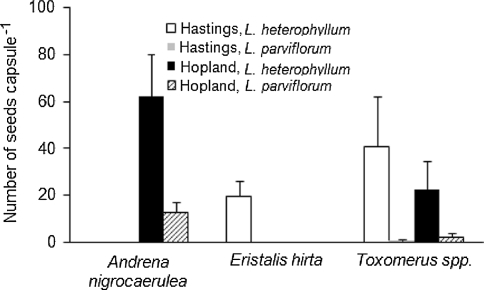
Most coevolving relationships between pairs of species are embedded in a broader multispecific interaction network. The mutualistic interaction between Lithophragma parviflorum (Saxifragaceae) and its pollinating floral parasite Greya politella (Lepidoptera, Prodoxidae) occurs in some communities as a pairwise set apart from most other interactions in those communities. In other communities, however, this pair of species occurs with congeners and with other floral visitors to Lithophragma. We analyzed local and geographic differences in the network formed by interactions between Lithophragma plants and Greya moths in communities containing two Lithophragma species, two Greya species, and floral visitors other than Greya that visit Lithophragma flowers. Our goal was to evaluate if non-Greya visitors were common, if visitor assembly differs between Lithophragma species and populations and if these visitors act as effective pollinators. Sympatric populations of L. heterophyllum and L. parviflorum differ in floral traits that may affect assemblies of floral visitors. Visitation rates by non-Greya floral visitors were low, and the asymptotic number of visitor species was less than 20 species in all populations. Lithophragma species shared some of the visitors, with visitor assemblages differing between sites more for L. heterophyllum than for L. parviflorum. Pollination efficacy experiments showed that most visitors were poor pollinators. Single visits to flowers by this assemblage of species resulted in significantly higher seed set in Lithophragma heterophyllum (30.6 +/- 3.9 SE) than in L. parviflorum (4.7 +/- 3.4 SE). This difference was consistent between sites, suggesting that these visitors provide a better fit to the floral morphology of L. heterophyllum. Overall, none of the non-Greya visitors appears to be either sufficiently common or efficient as a pollinator to impose strong selection on any of these four Lithophragma populations in comparison with Greya, which occurs within almost all populations of these species throughout their geographic ranges.
大多数物种对之间的协同进化关系都嵌入在更广泛的多物种相互作用网络中。在一些群落中,报春花科 Lithophragma parviflorum 和其传粉的花寄生蝇 Greya politella 之间的互利共生关系是作为一对相互作用而与群落中的大多数其他相互作用区分开来的。然而,在其他群落中,这一对物种与同属物种以及 Lithophragma 的其他花访客一起出现。我们分析了含有两种 Lithophragma 物种、两种 Greya 物种以及访问 Lithophragma 花朵的除 Greya 以外的其他花访客的群落中,Lithophragma 植物和 Greya 飞蛾之间相互作用形成的网络的局部和地理差异。我们的目标是评估非 Greya 访客是否常见,访客组装是否在 Lithophragma 物种和种群之间存在差异,以及这些访客是否作为有效的传粉者。L. heterophyllum 和 L. parviflorum 的同域种群在可能影响花访客组装的花特征上存在差异。非 Greya 花访客的访问率较低,在所有种群中,访客物种的渐近数量都少于 20 种。Lithophragma 物种共享一些访客,访客组装在 L. heterophyllum 之间的站点之间的差异大于 L. parviflorum。授粉效率实验表明,大多数访客都是较差的传粉者。由该物种组成的单一访问导致 Lithophragma heterophyllum(30.6 +/- 3.9 SE)的种子结实率明显高于 L. parviflorum(4.7 +/- 3.4 SE)。这种差异在站点之间是一致的,这表明这些访客更适合 L. heterophyllum 的花形态。总体而言,与在这些物种的整个地理范围内几乎所有种群中都存在的 Greya 相比,这些非 Greya 访客中的任何一种都没有足够的常见或高效作为传粉者,对这四个 Lithophragma 种群施加强烈的选择。