Zhang Sheng-Jia, Zou Ming, Lu Li, Lau David, Ditzel Désirée A W, Delucinge-Vivier Celine, Aso Yoshinori, Descombes Patrick, Bading Hilmar
Department of Neurobiology, Interdisciplinary Center for Neurosciences (IZN), University of Heidelberg, Heidelberg, Germany.
PLoS Genet. 2009 Aug;5(8):e1000604. doi: 10.1371/journal.pgen.1000604. Epub 2009 Aug 14.
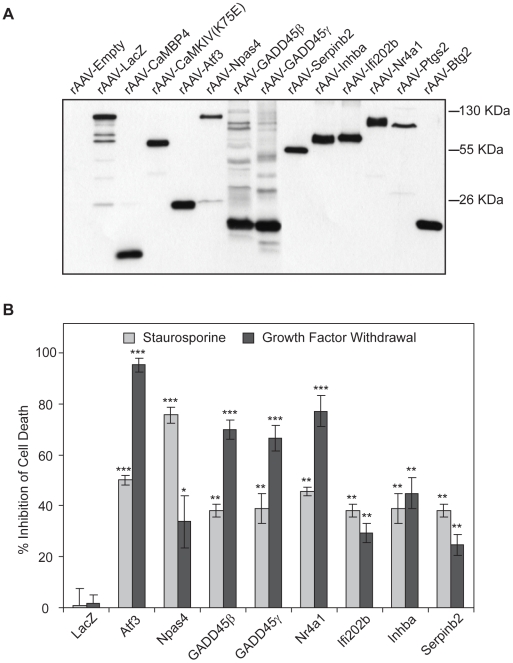
Synaptic activity can boost neuroprotection through a mechanism that requires synapse-to-nucleus communication and calcium signals in the cell nucleus. Here we show that in hippocampal neurons nuclear calcium is one of the most potent signals in neuronal gene expression. The induction or repression of 185 neuronal activity-regulated genes is dependent upon nuclear calcium signaling. The nuclear calcium-regulated gene pool contains a genomic program that mediates synaptic activity-induced, acquired neuroprotection. The core set of neuroprotective genes consists of 9 principal components, termed Activity-regulated Inhibitor of Death (AID) genes, and includes Atf3, Btg2, GADD45beta, GADD45gamma, Inhibin beta-A, Interferon activated gene 202B, Npas4, Nr4a1, and Serpinb2, which strongly promote survival of cultured hippocampal neurons. Several AID genes provide neuroprotection through a common process that renders mitochondria more resistant to cellular stress and toxic insults. Stereotaxic delivery of AID gene-expressing recombinant adeno-associated viruses to the hippocampus confers protection in vivo against seizure-induced brain damage. Thus, treatments that enhance nuclear calcium signaling or supplement AID genes represent novel therapies to combat neurodegenerative conditions and neuronal cell loss caused by synaptic dysfunction, which may be accompanied by a deregulation of calcium signal initiation and/or propagation to the cell nucleus.
突触活动可通过一种需要突触到细胞核通讯以及细胞核内钙信号的机制来增强神经保护作用。在此我们表明,在海马神经元中,核钙是神经元基因表达中最有效的信号之一。185个神经元活动调节基因的诱导或抑制取决于核钙信号传导。核钙调节的基因库包含一个基因组程序,该程序介导突触活动诱导的获得性神经保护作用。神经保护基因的核心集由9个主要成分组成,称为死亡活动调节抑制剂(AID)基因,包括Atf3、Btg2、GADD45β、GADD45γ、抑制素β-A、干扰素激活基因202B、Npas4、Nr4a1和Serpinb2,它们能强烈促进培养的海马神经元的存活。几个AID基因通过一个共同的过程提供神经保护作用,该过程使线粒体对细胞应激和毒性损伤更具抵抗力。将表达AID基因的重组腺相关病毒立体定向递送至海马体可在体内对癫痫诱导的脑损伤起到保护作用。因此,增强核钙信号传导或补充AID基因的治疗方法代表了对抗神经退行性疾病和由突触功能障碍引起的神经元细胞丢失的新疗法,突触功能障碍可能伴随着钙信号起始和/或向细胞核传播的失调。