Division of Respiratory Medicine, Department of Medicine, The University of Hong Kong, Queen Mary Hospital, Hong Kong, China.
Cancer Chemother Pharmacol. 2010 May;65(6):1023-8. doi: 10.1007/s00280-009-1107-5. Epub 2009 Aug 13.
Chemotherapy is the mainstay treatment for advanced non-small cell lung cancer (NSCLC). Gefitinib, an epidermal growth factor receptor-tyrosine kinase inhibitor (EGFR-TKI), has been recently shown to be effective as a first-line treatment in Asian patients with advanced NSCLC, especially for those with favourable clinical features such as female, non-smoker and adenocarcinoma. However, resistance to gefitinib ensues invariably and there is little evidence as for the effectiveness of subsequent salvage treatment. The purpose of this study is to evaluate the efficacy of erlotinib, another EGFR-TKI, after failed first-line use of gefitinib.
Retrospective review of NSCLC patients with favourable clinical features who received gefitinib as first-line treatment and subsequent salvage treatment with erlotinib.
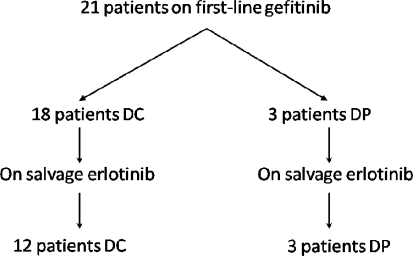
A total of 21 patients with NSCLC were included in the study. Among them, 18 (85.7%) patients had disease control with gefitinib and 12 (57.1%) patients with salvage erlotinib. There was an association between the disease control with gefitinib and erlotinib (p = 0.031). The disease control rate of erlotinib was independent of the chemotherapy use between the two EGFR-TKIs.
For NSCLC patients with favourable clinical features, erlotinib was effective in those who had prior disease control with first-line gefitinib.
化疗是晚期非小细胞肺癌(NSCLC)的主要治疗方法。表皮生长因子受体酪氨酸激酶抑制剂(EGFR-TKI)吉非替尼最近已被证明可作为晚期 NSCLC 亚洲患者的一线治疗方法有效,尤其是对于那些具有有利临床特征的患者,如女性、非吸烟者和腺癌。然而,吉非替尼的耐药性不可避免,并且几乎没有证据表明随后的挽救治疗有效。本研究旨在评估另一种 EGFR-TKI 厄洛替尼在一线使用吉非替尼失败后的疗效。
回顾性分析接受吉非替尼作为一线治疗且随后用厄洛替尼进行挽救治疗的具有有利临床特征的 NSCLC 患者。
共有 21 名 NSCLC 患者纳入本研究。其中,18 名(85.7%)患者使用吉非替尼控制疾病,12 名(57.1%)患者使用厄洛替尼控制疾病。吉非替尼和厄洛替尼的疾病控制存在相关性(p=0.031)。厄洛替尼的疾病控制率与两种 EGFR-TKI 之间的化疗使用无关。
对于具有有利临床特征的 NSCLC 患者,对于一线吉非替尼治疗后疾病得到控制的患者,厄洛替尼是有效的。