Ashton-Prolla Patricia, Giacomazzi Juliana, Schmidt Aishameriane V, Roth Fernanda L, Palmero Edenir I, Kalakun Luciane, Aguiar Ernestina S, Moreira Susana M, Batassini Erica, Belo-Reyes Vanessa, Schuler-Faccini Lavinia, Giugliani Roberto, Caleffi Maira, Camey Suzi Alves
Programa de Pós-Graduação em Genética e Biologia Molecular, Universidade Federal do Rio Grande do Sul , Porto Alegre, Brazil.
BMC Cancer. 2009 Aug 14;9:283. doi: 10.1186/1471-2407-9-283.
Breast cancer is a significant public health problem worldwide and the development of tools to identify individuals at-risk for hereditary breast cancer syndromes, where specific interventions can be proposed to reduce risk, has become increasingly relevant. A previous study in Southern Brazil has shown that a family history suggestive of these syndromes may be prevalent at the primary care level. Development of a simple and sensitive instrument, easily applicable in primary care units, would be particularly helpful in underserved communities in which identification and referral of high-risk individuals is difficult.
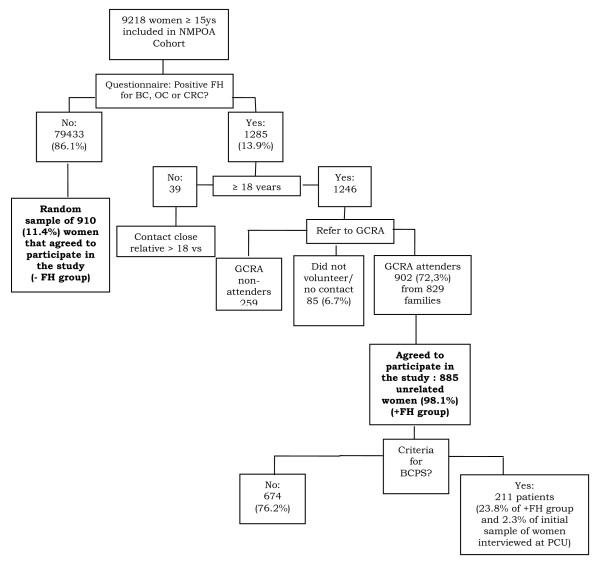
A simple 7-question instrument about family history of breast, ovarian and colorectal cancer, FHS-7, was developed to screen for individuals with an increased risk for hereditary breast cancer syndromes. FHS-7 was applied to 9218 women during routine visits to primary care units in Southern Brazil. Two consecutive samples of 885 women and 910 women who answered positively to at least one question and negatively to all questions were included, respectively. The sensitivity, specificity and positive and negative predictive values were determined.
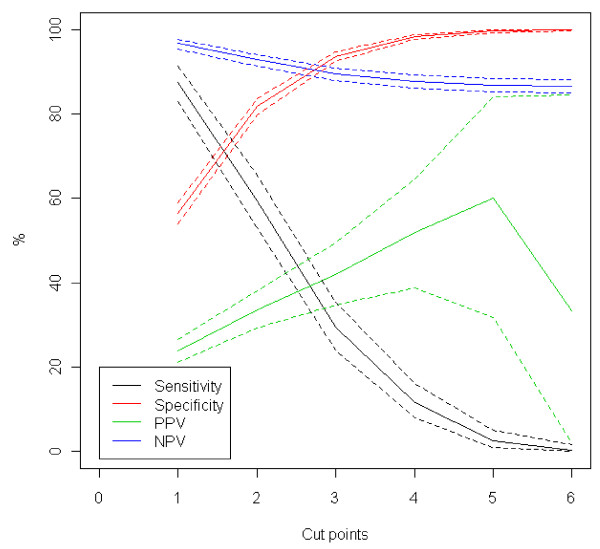
Of the 885 women reporting a positive family history, 211 (23.8%; CI95%: 21.5-26.2) had a pedigree suggestive of a hereditary breast and/or breast and colorectal cancer syndrome. Using as cut point one positive answer, the sensitivity and specificity of the instrument were 87.6% and 56.4%, respectively. Concordance between answers in two different applications was given by a intra-class correlation (ICC) of 0.84 for at least one positive answer. Temporal stability of the instrument was adequate (ICC = 0.65).
A simple instrument for the identification of the most common hereditary breast cancer syndrome phenotypes, showing good specificity and temporal stability was developed and could be used as a screening tool in primary care to refer at-risk individuals for genetic evaluations.
乳腺癌是全球一个重大的公共卫生问题,开发用于识别遗传性乳腺癌综合征高危个体的工具变得越来越重要,因为可以针对这些个体提出特定干预措施以降低风险。巴西南部先前的一项研究表明,提示这些综合征的家族史在初级保健层面可能很普遍。开发一种简单且灵敏的工具,使其易于在初级保健单位应用,对于难以识别和转诊高危个体的服务不足社区将特别有帮助。
开发了一种关于乳腺癌、卵巢癌和结直肠癌家族史的简单的7个问题的工具,即FHS-7,用于筛查遗传性乳腺癌综合征风险增加的个体。FHS-7应用于巴西南部初级保健单位常规就诊的9218名女性。分别纳入了连续的两个样本,即对至少一个问题回答为阳性且对所有问题回答为阴性的885名女性和910名女性。确定了敏感性、特异性以及阳性和阴性预测值。
在报告有阳性家族史的885名女性中,211名(23.8%;95%置信区间:21.5-26.2)的家系提示存在遗传性乳腺癌和/或乳腺癌与结直肠癌综合征。以一个阳性回答作为切点,该工具的敏感性和特异性分别为87.6%和56.4%。对于至少一个阳性回答,两次不同应用中回答的一致性通过组内相关系数(ICC)为0.84给出。该工具的时间稳定性足够(ICC = 0.65)。
开发了一种用于识别最常见遗传性乳腺癌综合征表型的简单工具,该工具显示出良好的特异性和时间稳定性,可作为初级保健中的筛查工具,用于将高危个体转诊进行基因评估。