Nganvongpanit Korakot, Pothacharoen Peraphan, Suwankong Niyada, Ong-Chai Siriwan, Kongtawelert Prachya
Bone and Joint Research Laboratory, Department of Veterinary Biosciences and Public Health, Faculty of Veterinary Medicine, Chiang Mai University, Chiang Mai 50100, Thailand.
J Vet Sci. 2009 Sep;10(3):239-47. doi: 10.4142/jvs.2009.10.3.239.
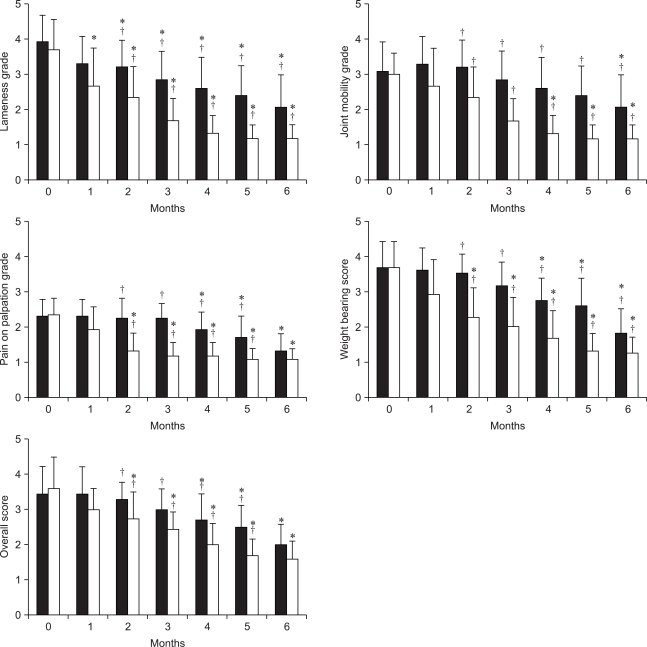
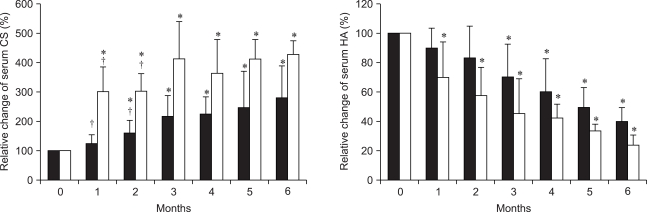
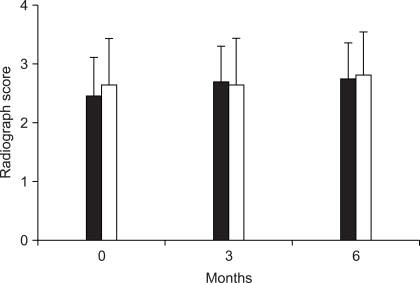
Twenty-five dogs were included in a randomized, double-blind trial to assess the efficacy of doxycycline (DOX) orally administered twice a day at 4 mg/kg/day (n = 12) for the treatment of osteoarthritis of the hip. Chondroitin sulfate (CS; 525 mg/day) was used as a positive control (n = 13). Dogs were re-examined monthly for 6 months after initiation of treatment. The assessment protocol included clinical score, radiographic findings and serum osteoarthritis biomarkers. Dogs treated with DOX showed statistically significant improvements (p < 0.05) in lameness, joint mobility, pain on palpation, weight-bearing and overall score at 2, 6, 4, 4 and 4 months, respectively, after treatment. Biomarker levels of CS-WF6 epitope and hyaluronan were significantly increased and decreased (p < 0.05) at 2 and 3 months after treatment compared to pretreatment. These results showed that DOX had a positive therapeutic effect in dogs with osteoarthritis.
25只犬被纳入一项随机双盲试验,以评估每天口服两次、剂量为4mg/kg/天的强力霉素(DOX)(n = 12)治疗髋关节骨关节炎的疗效。硫酸软骨素(CS;525mg/天)用作阳性对照(n = 13)。治疗开始后,每月对犬进行复查,持续6个月。评估方案包括临床评分、影像学检查结果和血清骨关节炎生物标志物。接受DOX治疗的犬在治疗后第2、6、4、4和4个月时,分别在跛行、关节活动度、触诊疼痛、负重和总体评分方面有统计学意义的改善(p < 0.05)。与治疗前相比,治疗后第2和3个月时,CS-WF6表位和透明质酸的生物标志物水平显著升高和降低(p < 0.05)。这些结果表明,DOX对患有骨关节炎的犬有积极的治疗效果。