Biological Monitoring and Modeling, Pacific Northwest National Laboratory, Richland, Washington, USA.
PLoS One. 2009 Aug 18;4(8):e6670. doi: 10.1371/journal.pone.0006670.
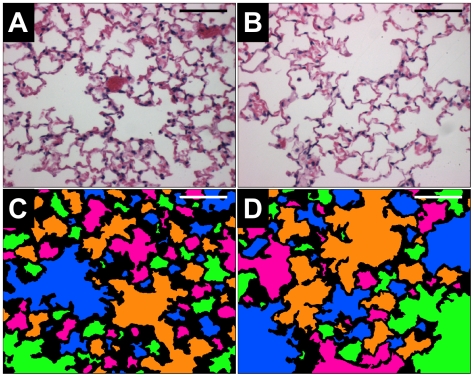
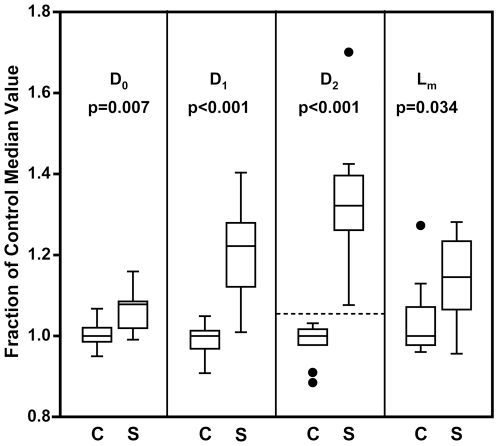
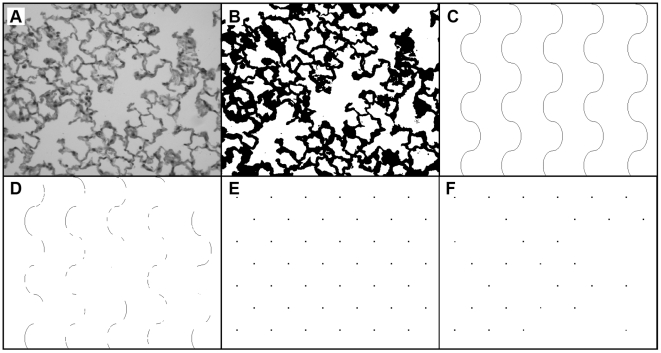
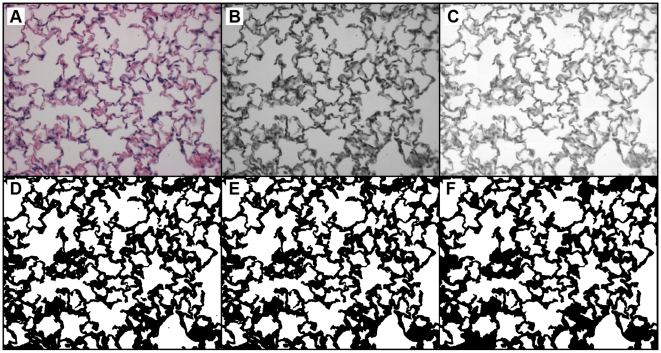
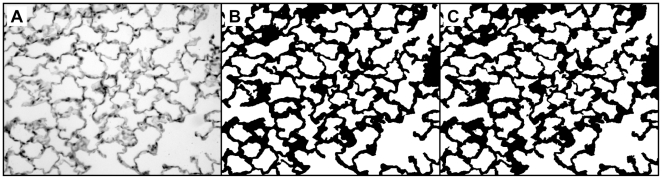
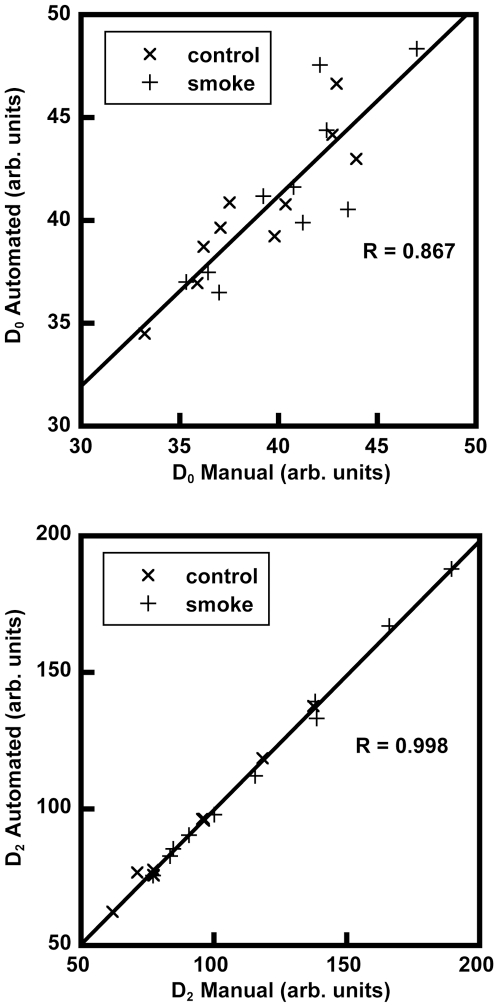
In this work, we compare two methods for evaluating and quantifying pulmonary airspace enlargement in a mouse model of chronic cigarette smoke exposure. Standard stereological sample preparation, sectioning, and imaging of mouse lung tissues were performed for semi-automated acquisition of mean linear intercept (L(m)) data. After completion of the L(m) measurements, D(2), a metric of airspace enlargement, was measured in a blinded manner on the same lung images using a fully automated technique developed in-house. An analysis of variance (ANOVA) shows that although L(m) was able to separate the smoke-exposed and control groups with statistical significance (p = 0.034), D(2) was better able to differentiate the groups (p<0.001) and did so without any overlap between the control and smoke-exposed individual animal data. In addition, the fully automated implementation of D(2) represented a time savings of at least 24x over semi-automated L(m) measurements. Although D(2) does not provide 3D stereological metrics of airspace dimensions as L(m) does, results show that it has higher sensitivity and specificity for detecting the subtle airspace enlargement one would expect to find in mild or early stage emphysema. Therefore, D(2) may serve as a more accurate screening measure for detecting early lung disease than L(m).
在这项工作中,我们比较了两种方法来评估和量化慢性吸烟暴露小鼠模型中的肺空气空间扩大。对小鼠肺组织进行了标准的体视学样本制备、切片和成像,以半自动方式获取平均线性截距 (L(m)) 数据。完成 L(m) 测量后,使用我们自主开发的完全自动化技术在相同的肺部图像上以盲法测量 D(2),这是一种空气空间扩大的度量。方差分析 (ANOVA) 表明,尽管 L(m) 能够以统计学意义将吸烟组和对照组分开 (p = 0.034),但 D(2) 能够更好地区分组 (p<0.001),并且在控制组和吸烟组个体动物数据之间没有重叠。此外,D(2) 的完全自动化实施至少节省了 24 倍的半自动 L(m) 测量时间。尽管 D(2) 不像 L(m) 那样提供空气空间尺寸的三维体视学度量,但结果表明,它对检测轻度或早期肺气肿中预期的微妙空气空间扩大具有更高的灵敏度和特异性。因此,D(2) 可能比 L(m) 更能作为检测早期肺部疾病的更准确的筛选指标。