Nelson Amy R, Davydova Julia, Curiel David T, Yamamoto Masato
The Division of Human Gene Therapy, University of Alabama at Birmingham, Birmingham, AL, USA.
Cancer Sci. 2009 Nov;100(11):2181-7. doi: 10.1111/j.1349-7006.2009.01289.x. Epub 2009 Jul 21.
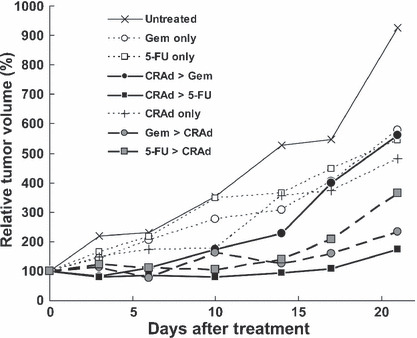
Due to devastating prognosis, novel therapies are needed for pancreatic cancer. We are in preparation for a human clinical trial of a conditionally replicative adenovirus (CRAd) we developed. While most patients in the target population are receiving either gemcitabine or 5-fluorouracil chemotherapy, the combination with CRAd has not yet been studied. This study was designed to evaluate combination therapies with CRAd and current standard chemotherapies in pancreatic cancer. When the combination therapy was tested in vitro, gemcitabine pretreatment showed a synergistic effect in two out of four cell lines whereas CRAd followed by gemcitabine exhibited a synergistic effect in one cell line. With 5-fluorouracil, pretreatment with 5-fluorouracil produced a synergistic effect in three cell lines whereas post-treatment was synergistic in only one cell line. These effects were not fully explained by either induction of cyclooxygenase (Cox) 2 activity or adenoviral receptors with chemotherapeutics. In in vivo analyses with Hs766T xenograft, 5-fluorouracil slightly improved the CRAd antitumor effect but it was not significant. Pretreatment with gemcitabine embodied a significant tumor reduction compared with single therapy with gemcitabine. The most significant antitumor effect occurred when tumors were treated with 5/3COX2CRAdF and subsequent gemcitabine (P = 0.001 vs gemcitabine alone, P = 0.012 vs 5/3COX2CRAdF alone) at day 12. In MIA Paca-2, pretreatments with either 5-fluorouracil or gemcitabine improved the CRAd therapeutic effect when administered before CRAd injection (P = 0.03 and P = 0.01, respectively). These experiments indicate the possible benefit of combination therapies, and thus it is not necessary to interrupt chemotherapeutics when receiving CRAd therapy.
由于胰腺癌预后不佳,需要新的治疗方法。我们正在筹备对我们研发的一种条件性复制腺病毒(CRAd)进行人体临床试验。虽然目标人群中的大多数患者正在接受吉西他滨或5-氟尿嘧啶化疗,但CRAd与这些化疗药物的联合应用尚未得到研究。本研究旨在评估CRAd与当前胰腺癌标准化疗药物的联合治疗效果。在体外试验联合疗法时,吉西他滨预处理在四个细胞系中的两个显示出协同作用,而CRAd后用吉西他滨处理在一个细胞系中表现出协同作用。对于5-氟尿嘧啶,5-氟尿嘧啶预处理在三个细胞系中产生协同作用,而后处理仅在一个细胞系中具有协同作用。环氧化酶(Cox)2活性的诱导或化疗药物对腺病毒受体的影响均不能完全解释这些作用。在Hs766T异种移植的体内分析中,5-氟尿嘧啶略微改善了CRAd的抗肿瘤作用,但不显著。与单用吉西他滨治疗相比,吉西他滨预处理使肿瘤明显缩小。当在第12天用5/3COX2CRAdF及随后的吉西他滨治疗肿瘤时,产生了最显著的抗肿瘤作用(与单用吉西他滨相比,P = 0.001;与单用5/3COX2CRAdF相比,P = 0.012)。在MIA Paca-2细胞中,5-氟尿嘧啶或吉西他滨在CRAd注射前进行预处理可提高CRAd的治疗效果(分别为P = 0.03和P = 0.01)。这些实验表明联合治疗可能有益,因此在接受CRAd治疗时无需中断化疗。