Eldesoky Ehab S, Kamel Sherif I, Farghaly Ahlam M, Bakheet Madiha Y, Hedaya Mohsen A, Siest Jean-Pascal
Pharmacology Dept, Faculty of Medicine, Assiut University, Assiut, Egypt.
Biomark Insights. 2007 Feb 7;1:157-64.
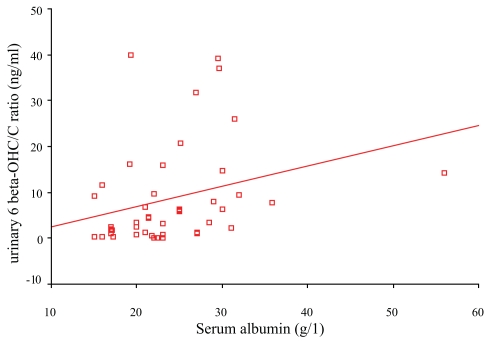
The urinary ratio of 6 beta-hydroxycortisol/cortisol (6 beta-OHC/C) as a biomarker of CYP3A4 metabolizing activity has been studied in Egyptian patients with chronic liver cirrhosis associated with previous hepatic Schistosomiasis infection to determine any possible alteration in enzyme activity. The ratio of 6-beta OHC/C was determined in morning urine samples collected from 8:00 a.m. to 12:00 p.m. in healthy adults (n = 36) and patients with liver cirrhosis (n = 57). The median age for control was 27 years (range: 18-50 years) and 50 years (range: 27-75 years) for patients. 6 beta-OHC was detected in urine by ELIZA kits (Stabiligen, France). Patients with liver cirrhosis were categorized according to Child Pugh Classification into Child B (n = 28) and Child C (n = 29) classes. Cholestasis was observed in 9/28 of Child B class and 8/29 of Child C class of patients. The control subjects showed gender-related difference in the urinary ratio of 6 beta-OHC/C. A significant reduction (P < 0.001) in 6 beta-OHC/C ratio was observed only in Child C patients in comparison with control subjects. Regression analysis showed a significant correlation (P < 0.05) between 6 beta-OHC/C ratio and serum albumin. The influence of cholestasis on the urinary ratio of 6-beta OHC/C was observed on cirrhotic patients of Child B class. In conclusion, patients with chronic liver cirrhosis might have a reduction of metabolizing activity of CYP3A4 enzymes which could be identified by measuring the urinary ratio of 6 beta-OHC/C. This reduction is more apparent in severe liver injury (Child C class). Therefore, it is important to understand the metabolic fate of drugs metabolized by 3A4 enzymes in patients with liver cirrhosis to avoid drug accumulation that might lead to development of drug toxicity.
6β-羟基皮质醇/皮质醇(6β-OHC/C)的尿比值作为CYP3A4代谢活性的生物标志物,已在先前感染过肝血吸虫病的埃及慢性肝硬化患者中进行了研究,以确定酶活性是否有任何可能的改变。在上午8:00至12:00收集的健康成年人(n = 36)和肝硬化患者(n = 57)的晨尿样本中测定6-βOHC/C的比值。对照组的中位年龄为27岁(范围:18 - 50岁),患者为50岁(范围:27 - 75岁)。通过ELISA试剂盒(法国Stabiligen)检测尿液中的6β-OHC。肝硬化患者根据Child Pugh分类分为Child B级(n = 28)和Child C级(n = 29)。Child B级患者中有9/28和Child C级患者中有8/29观察到胆汁淤积。对照组受试者的6β-OHC/C尿比值存在性别差异。与对照组相比,仅在Child C级患者中观察到6β-OHC/C比值显著降低(P < 0.001)。回归分析显示6β-OHC/C比值与血清白蛋白之间存在显著相关性(P < 0.05)。在Child B级肝硬化患者中观察到胆汁淤积对6-βOHC/C尿比值的影响。总之,慢性肝硬化患者可能存在CYP3A4酶代谢活性降低,这可以通过测量6β-OHC/C的尿比值来识别。这种降低在严重肝损伤(Child C级)中更为明显。因此,了解肝硬化患者中由3A4酶代谢的药物的代谢命运对于避免可能导致药物毒性发展的药物蓄积非常重要。