Schulze Katrin, Gaab Nadine, Schlaug Gottfried
Department of Neurology, Music and Neuroimaging Laboratory, Beth Israel Deaconess Medical Center and Harvard Medical School, Boston, MA, 02215, USA.
BMC Neurosci. 2009 Aug 27;10:106. doi: 10.1186/1471-2202-10-106.
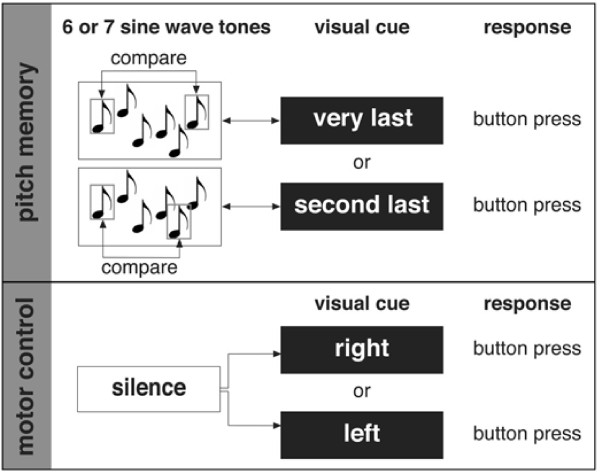
The perceptual-cognitive mechanisms and neural correlates of Absolute Pitch (AP) are not fully understood. The aim of this fMRI study was to examine the neural network underlying AP using a pitch memory experiment and contrasting two groups of musicians with each other, those that have AP and those that do not.
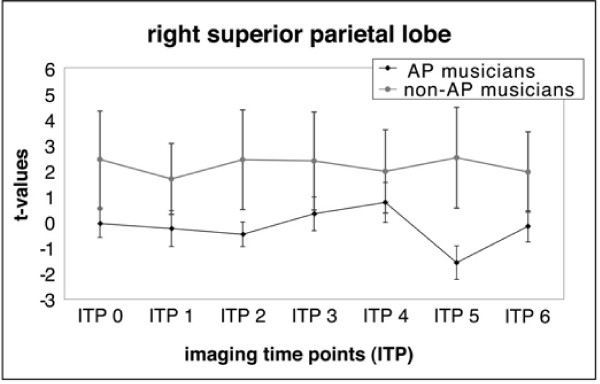
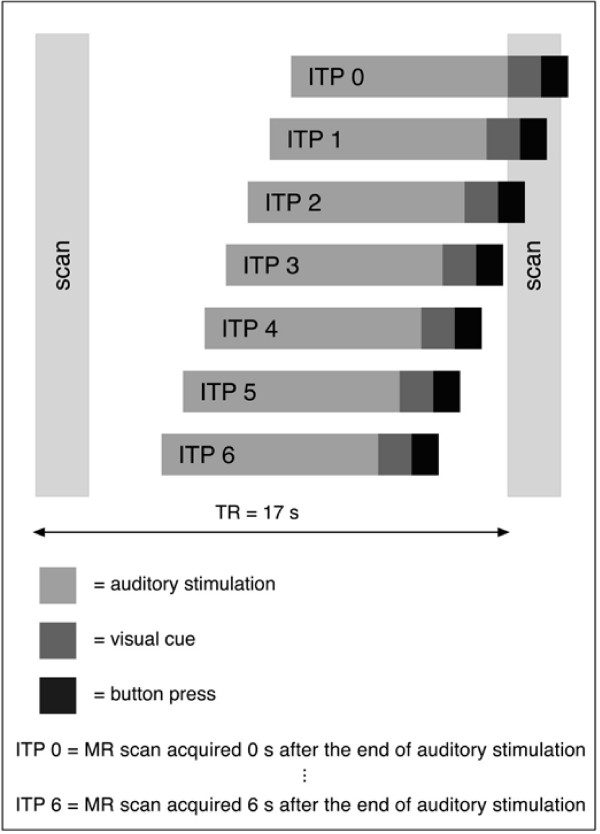
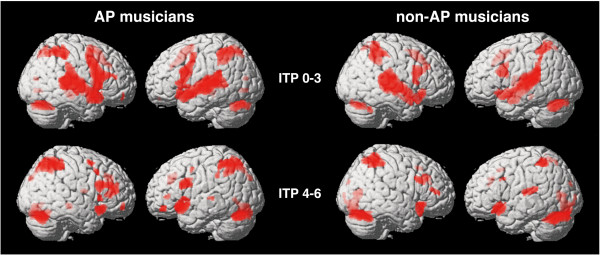
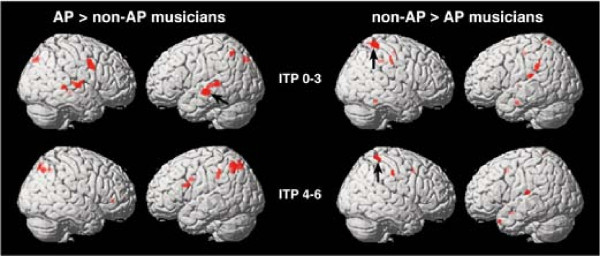
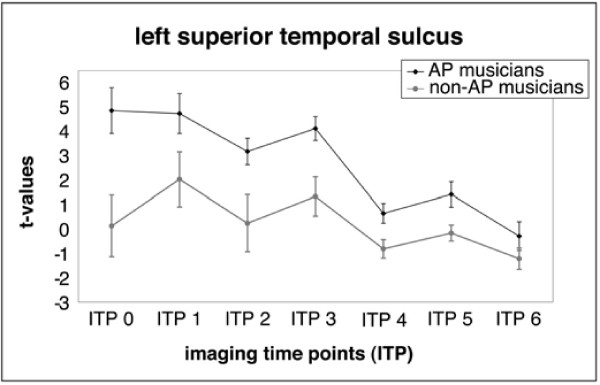
We found a common activation pattern for both groups that included the superior temporal gyrus (STG) extending into the adjacent superior temporal sulcus (STS), the inferior parietal lobule (IPL) extending into the adjacent intraparietal sulcus (IPS), the posterior part of the inferior frontal gyrus (IFG), the pre-supplementary motor area (pre-SMA), and superior lateral cerebellar regions. Significant between-group differences were seen in the left STS during the early encoding phase of the pitch memory task (more activation in AP musicians) and in the right superior parietal lobule (SPL)/intraparietal sulcus (IPS) during the early perceptual phase (ITP 0-3) and later working memory/multimodal encoding phase of the pitch memory task (more activation in non-AP musicians). Non-significant between-group trends were seen in the posterior IFG (more in AP musicians) and the IPL (more anterior activations in the non-AP group and more posterior activations in the AP group).
Since the increased activation of the left STS in AP musicians was observed during the early perceptual encoding phase and since the STS has been shown to be involved in categorization tasks, its activation might suggest that AP musicians involve categorization regions in tonal tasks. The increased activation of the right SPL/IPS in non-AP musicians indicates either an increased use of regions that are part of a tonal working memory (WM) network, or the use of a multimodal encoding strategy such as the utilization of a visual-spatial mapping scheme (i.e., imagining notes on a staff or using a spatial coding for their relative pitch height) for pitch information.
绝对音高(AP)的感知认知机制和神经关联尚未完全明确。本功能磁共振成像(fMRI)研究的目的是通过音高记忆实验,对比两组音乐家(有绝对音高者和无绝对音高者),来探究绝对音高背后的神经网络。
我们发现两组的共同激活模式包括延伸至相邻颞上沟(STS)的颞上回(STG)、延伸至相邻顶内沟(IPS)的顶下小叶(IPL)、额下回(IFG)后部、前辅助运动区(pre-SMA)以及小脑上外侧区域。在音高记忆任务的早期编码阶段,左侧STS出现显著的组间差异(绝对音高音乐家激活更强);在早期感知阶段(ITP 0 - 3)以及音高记忆任务的后期工作记忆/多模态编码阶段,右侧顶上小叶(SPL)/顶内沟(IPS)出现显著组间差异(非绝对音高音乐家激活更强)。在IFG后部(绝对音高音乐家激活更多)和IPL(非绝对音高组前部激活更多,绝对音高组后部激活更多)观察到非显著的组间趋势。
由于在早期感知编码阶段观察到绝对音高音乐家左侧STS激活增加,且STS已被证明参与分类任务,其激活可能表明绝对音高音乐家在音调任务中涉及分类区域。非绝对音高音乐家右侧SPL/IPS激活增加,表明要么是更多地使用了音调工作记忆(WM)网络的一部分区域,要么是采用了多模态编码策略,如利用视觉空间映射方案(即在五线谱上想象音符或使用空间编码表示其相对音高)来处理音高信息。