Lott Martin, Spillner Andreas, Huber Katharina T, Petri Anna, Oxelman Bengt, Moulton Vincent
School of Computing Sciences, University of East Anglia, Norwich, UK.
BMC Evol Biol. 2009 Aug 28;9:216. doi: 10.1186/1471-2148-9-216.
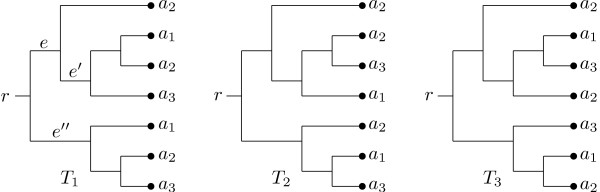
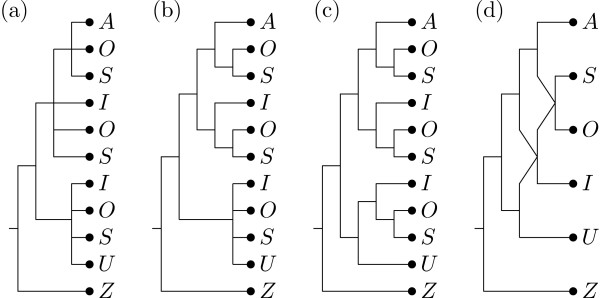
Gene trees that arise in the context of reconstructing the evolutionary history of polyploid species are often multiply-labeled, that is, the same leaf label can occur several times in a single tree. This property considerably complicates the task of forming a consensus of a collection of such trees compared to usual phylogenetic trees.
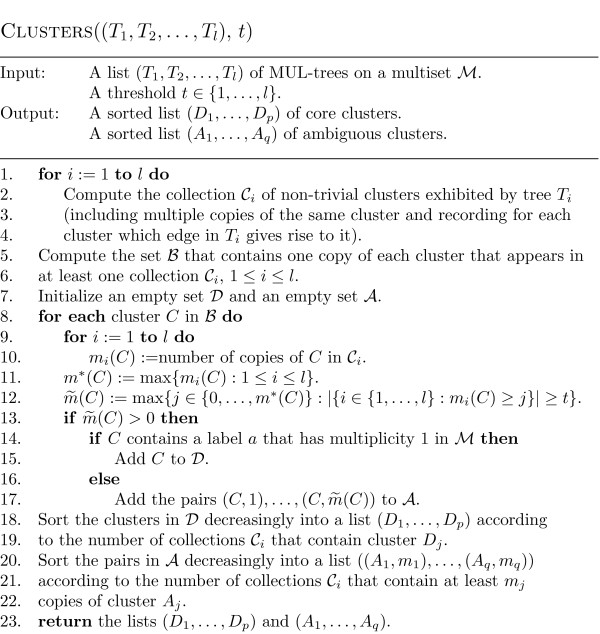
We present a method for computing a consensus tree of multiply-labeled trees. As with the well-known greedy consensus tree approach for phylogenetic trees, our method first breaks the given collection of gene trees into a set of clusters. It then aims to insert these clusters one at a time into a tree, starting with the clusters that are supported by most of the gene trees. As the problem to decide whether a cluster can be inserted into a multiply-labeled tree is computationally hard, we have developed a heuristic method for solving this problem.
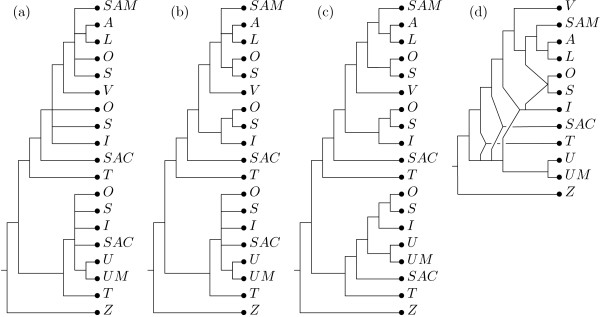
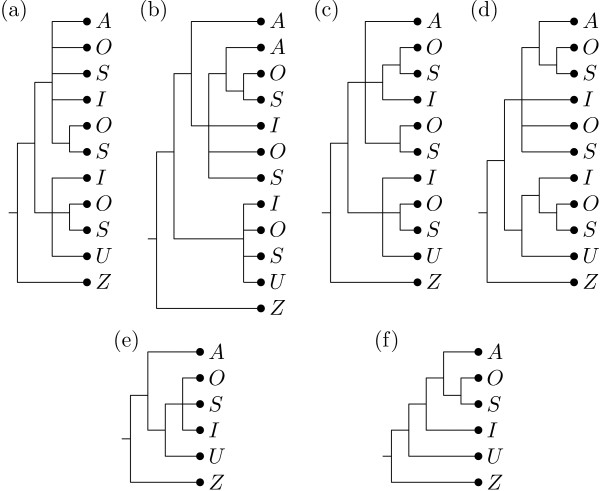
We illustrate the applicability of our method using two collections of trees for plants of the genus Silene, that involve several allopolyploids at different levels.
在重建多倍体物种进化历史的背景下出现的基因树通常有多重标记,也就是说,同一叶子标签在单个树中可能出现多次。与通常的系统发育树相比,这一特性极大地复杂化了形成此类树集合共识的任务。
我们提出了一种计算多重标记树共识树的方法。与用于系统发育树的著名贪婪共识树方法一样,我们的方法首先将给定的基因树集合分解为一组簇。然后,它旨在一次将这些簇插入到一棵树中,从得到大多数基因树支持的簇开始。由于决定一个簇是否可以插入到多重标记树中的问题在计算上是困难的,我们开发了一种启发式方法来解决这个问题。
我们使用两组关于蝇子草属植物的树说明了我们方法的适用性,这些树涉及不同层次的几个异源多倍体。