Carlin Sean, Pugachev Andrei, Sun Xiaorong, Burke Sean, Claus Filip, O'Donoghue Joseph, Ling C Clifton, Humm John L
Department of Medical Physics, Memorial Sloan-Kettering Cancer Center, New York, NY 10021, USA.
Nucl Med Biol. 2009 Oct;36(7):821-31. doi: 10.1016/j.nucmedbio.2009.06.006. Epub 2009 Jul 29.
To characterize a tumor model containing a hypoxia-inducible reporter gene and to demonstrate utility by comparison of reporter gene expression to the uptake and distribution of the hypoxia tracer (18)F-fluoromisonidazole ((18)F-FMISO).
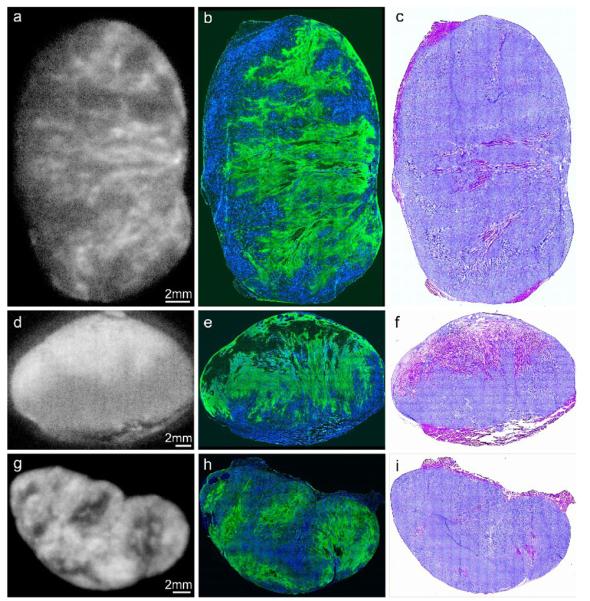
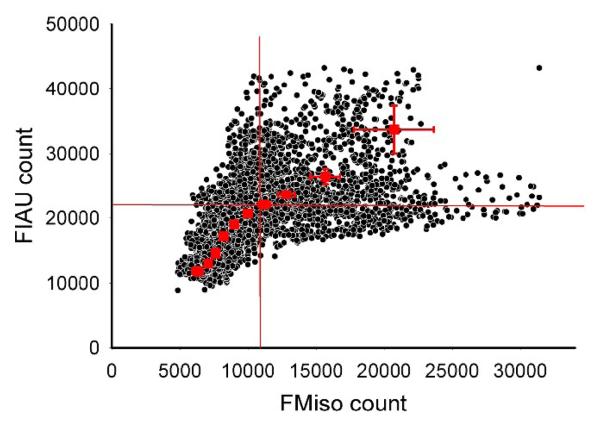
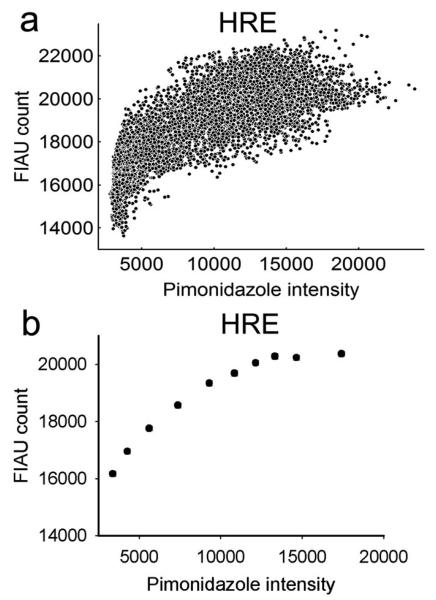
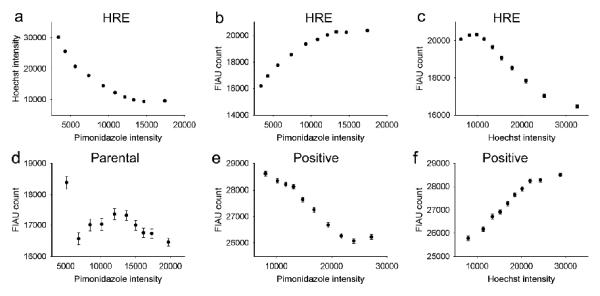
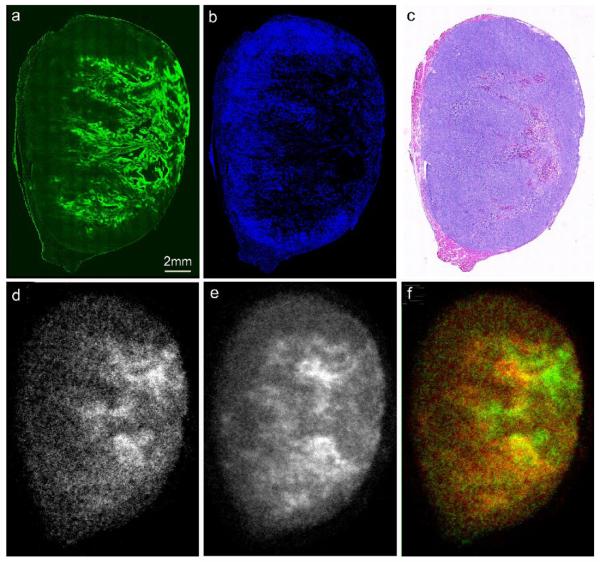
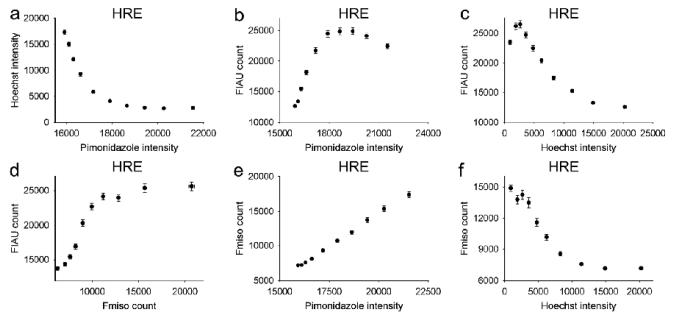
Three tumors derived from the rat prostate cancer cell line R3327-AT were grown in each of two rats as follows: (1) parental R3327-AT, (2) positive control R3327-AT/PC in which the HSV1-tkeGFP fusion reporter gene was expressed constitutively, (3) R3327-AT/HRE in which the reporter gene was placed under the control of a hypoxia-inducible factor-responsive promoter sequence (HRE). Animals were coadministered a hypoxia-specific marker (pimonidazole) and the reporter gene probe (124)I-2'-fluoro-2'-deoxy-1-beta-d-arabinofuranosyl-5-iodouracil ((124)I-FIAU) 3 h prior to sacrifice. Statistical analysis of the spatial association between (124)I-FIAU uptake and pimonidazole fluorescent staining intensity was then performed on a pixel-by-pixel basis. Utility of this system was demonstrated by assessment of reporter gene expression versus the exogenous hypoxia probe (18)F-FMISO. Two rats, each bearing a single R3327-AT/HRE tumor, were injected with (124)I-FIAU (3 h before sacrifice) and (18)F-FMISO (2 h before sacrifice). Statistical analysis of the spatial association between (18)F-FMISO and (124)I-FIAU on a pixel-by-pixel basis was performed.
Correlation coefficients between (124)I-FIAU uptake and pimonidazole staining intensity were: 0.11 in R3327-AT tumors, -0.66 in R3327-AT/PC and 0.76 in R3327-AT/HRE, confirming that only in the R3327-AT/HRE tumor was HSV1-tkeGFP gene expression associated with hypoxia. Correlation coefficients between (18)F-FMISO and (124)I-FIAU uptakes in R3327-AT/HRE tumors were r=0.56, demonstrating good spatial correspondence between the two tracers.
We have confirmed hypoxia-specific expression of the HSV1-tkeGFP fusion gene in the R3327-AT/HRE tumor model and demonstrated the utility of this model for the evaluation of radiolabeled hypoxia tracers.
表征一种包含缺氧诱导报告基因的肿瘤模型,并通过比较报告基因表达与缺氧示踪剂(18)F-氟米索硝唑((18)F-FMISO)的摄取和分布来证明其效用。
将源自大鼠前列腺癌细胞系R3327-AT的三种肿瘤分别在两只大鼠体内生长,如下所示:(1)亲本R3327-AT,(2)阳性对照R3327-AT/PC,其中HSV1-tkeGFP融合报告基因持续表达,(3)R3327-AT/HRE,其中报告基因置于缺氧诱导因子响应启动子序列(HRE)的控制之下。在处死动物前3小时,给动物同时施用缺氧特异性标记物(匹莫硝唑)和报告基因探针(124)I-2'-氟-2'-脱氧-1-β-D-阿拉伯呋喃糖基-5-碘尿嘧啶((124)I-FIAU)。然后逐像素地对(124)I-FIAU摄取与匹莫硝唑荧光染色强度之间的空间关联进行统计分析。通过评估报告基因表达与外源性缺氧探针(18)F-FMISO来证明该系统的效用。给两只各携带一个R3327-AT/HRE肿瘤的大鼠注射(124)I-FIAU(处死前3小时)和(18)F-FMISO(处死前2小时)。逐像素地对(18)F-FMISO与(124)I-FIAU之间的空间关联进行统计分析。
(124)I-FIAU摄取与匹莫硝唑染色强度之间的相关系数分别为:R3327-AT肿瘤中为0.11,R3327-AT/PC中为-0.66,R3327-AT/HRE中为0.76,证实仅在R3327-AT/HRE肿瘤中HSV1-tkeGFP基因表达与缺氧相关。R3327-AT/HRE肿瘤中(18)F-FMISO与(124)I-FIAU摄取之间的相关系数r = 0.56,表明两种示踪剂之间具有良好的空间对应性。
我们已证实在R3327-AT/HRE肿瘤模型中HSV1-tkeGFP融合基因的缺氧特异性表达,并证明了该模型在评估放射性标记的缺氧示踪剂方面的效用。