Department of Medicine, The University of Hong Kong, Pokfulam, Hong Kong.
Osteoporos Int. 2010 Jun;21(6):1009-20. doi: 10.1007/s00198-009-1043-6. Epub 2009 Sep 1.
We performed an association study of five candidate genes within chromosome 3p14-25 in 1,080 Chinese female subjects. Polymorphisms in FLNB/CRTAP are associated with bone mineral density (BMD) in Chinese.
Chromosomal region 3p14-25 has shown strong evidence of linkage to BMD in genome-wide linkage scans. The variants responsible for this linkage signal, nonetheless, remain obscure.
Thirty SNPs in five positional and functional candidate genes within 3p14-25 (PPARG, CRTAP, TDGF1, PTHR1, and FLNB) and rs7646054 in the ARHGEF3 gene were genotyped in a case-control cohort of 1,080 Chinese females. Allelic and haplotypic association were tested using logistic regression analysis implemented in PLINK software. Potential transcription factor binding sites were predicted with MatInspector.
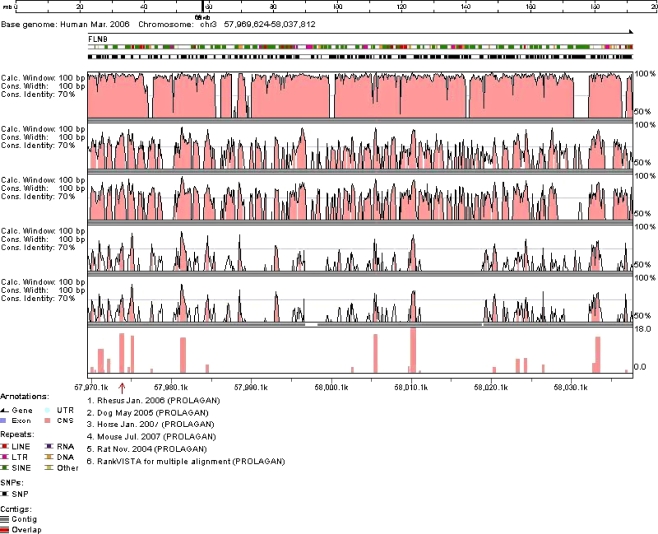
Multiple SNPs and haplotypes in FLNB were significantly associated with BMDs, with the strongest association between lumbar spine BMD and rs9828717 (p = 0.005). SNP rs7623768 and the haplotype G-C of rs4076086-rs7623768 in CRTAP were associated with femoral neck BMD (p = 0.009 and p = 0.003, respectively). PTHR1 showed haplotypic associations with lumbar spine and femoral neck BMD (p = 0.02 and p = 0.044, respectively). Nevertheless, the association between rs7646054 in ARHGEF3 and BMD observed in Caucasians was not replicated in our samples. Comparative genomics analysis indicated that rs9828717 is located within a highly conserved region. The minor T allele at rs9828717 may lead to loss of binding site for nuclear factor of activated T cells which binds and triggers the transcriptional program of osteoblasts.
Our data suggest that variants in FLNB and CRTAP at 3p are involved in BMD regulation in southern Chinese.
我们在中国 1080 名女性研究对象中,对染色体 3p14-25 内的 5 个候选基因进行了关联研究。FLNB/CRTAP 多态性与中国人的骨密度(BMD)有关。
染色体 3p14-25 区域在全基因组连锁扫描中显示出与 BMD 强烈的连锁信号。然而,导致这种连锁信号的变异体仍然不清楚。
在一个由 1080 名中国女性组成的病例对照队列中,对 3p14-25 内的 5 个位置和功能候选基因(PPARG、CRTAP、TDGF1、PTHR1 和 FLNB)中的 30 个 SNP 以及 ARHGEF3 基因中的 rs7646054 进行了基因分型。使用 PLINK 软件中的逻辑回归分析测试了等位基因和单倍型的关联。使用 MatInspector 预测潜在的转录因子结合位点。
FLNB 中的多个 SNP 和单倍型与 BMD 显著相关,其中与腰椎 BMD 最强的关联是 rs9828717(p = 0.005)。CRTAP 中的 SNP rs7623768 和 rs4076086-rs7623768 的 G-C 单倍型与股骨颈 BMD 相关(p = 0.009 和 p = 0.003)。PTHR1 与腰椎和股骨颈 BMD 呈单倍型关联(p = 0.02 和 p = 0.044)。然而,在我们的样本中,高加索人群中观察到的 ARHGEF3 中的 rs7646054 与 BMD 之间的关联并没有得到复制。比较基因组学分析表明,rs9828717 位于一个高度保守的区域内。rs9828717 的较小 T 等位基因可能导致核因子激活 T 细胞的结合位点丢失,核因子激活 T 细胞结合并触发成骨细胞的转录程序。
我们的数据表明,中国南方人群中 3p 上的 FLNB 和 CRTAP 变体参与了 BMD 的调节。