Department of Biochemistry and Molecular Biology, School of Pharmacy, University of Barcelona, Diagonal Avenue, E-08028 Barcelona, Spain.
Genome Med. 2009 Sep 4;1(9):83. doi: 10.1186/gm83.
The need for an integrated view of data obtained from high-throughput technologies gave rise to network analyses. These are especially useful to rationalize how external perturbations propagate through the expression of genes. To address this issue in the case of drug resistance, we constructed biological association networks of genes differentially expressed in cell lines resistant to methotrexate (MTX).
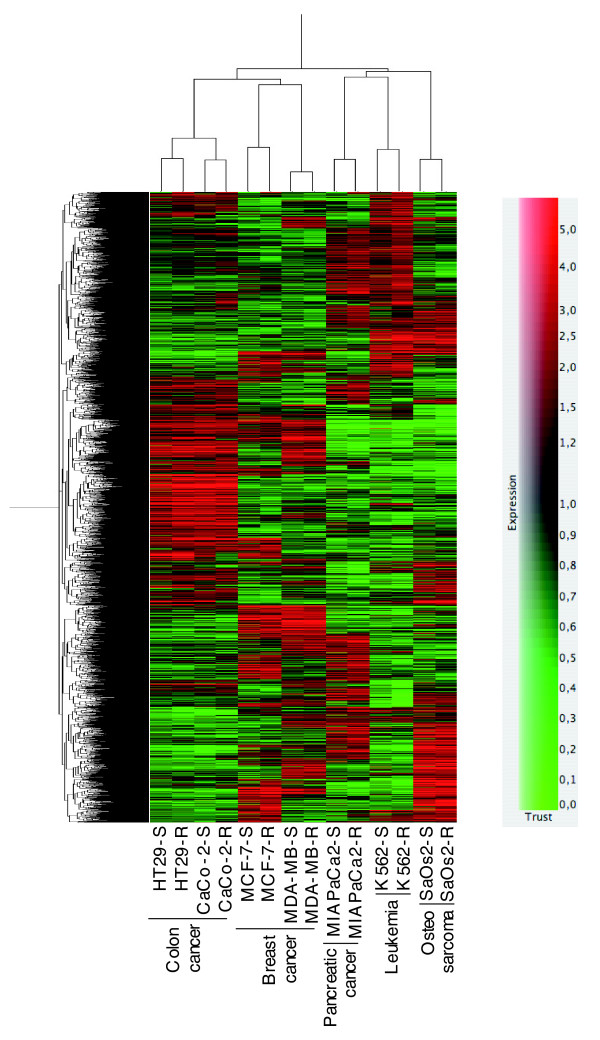
Seven cell lines representative of different types of cancer, including colon cancer (HT29 and Caco2), breast cancer (MCF-7 and MDA-MB-468), pancreatic cancer (MIA PaCa-2), erythroblastic leukemia (K562) and osteosarcoma (Saos-2), were used. The differential expression pattern between sensitive and MTX-resistant cells was determined by whole human genome microarrays and analyzed with the GeneSpring GX software package. Genes deregulated in common between the different cancer cell lines served to generate biological association networks using the Pathway Architect software.
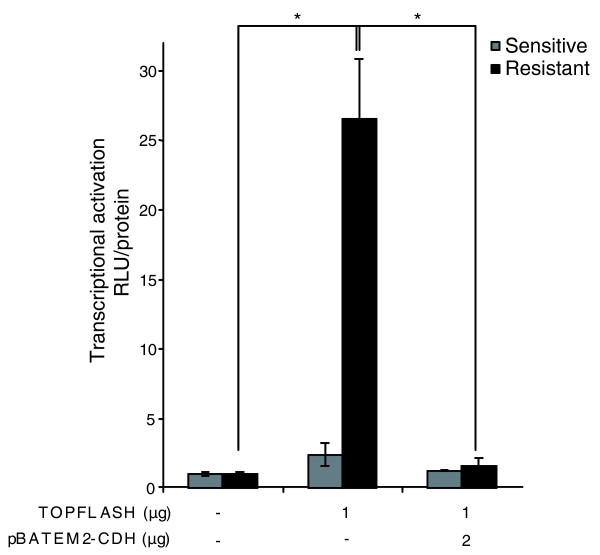
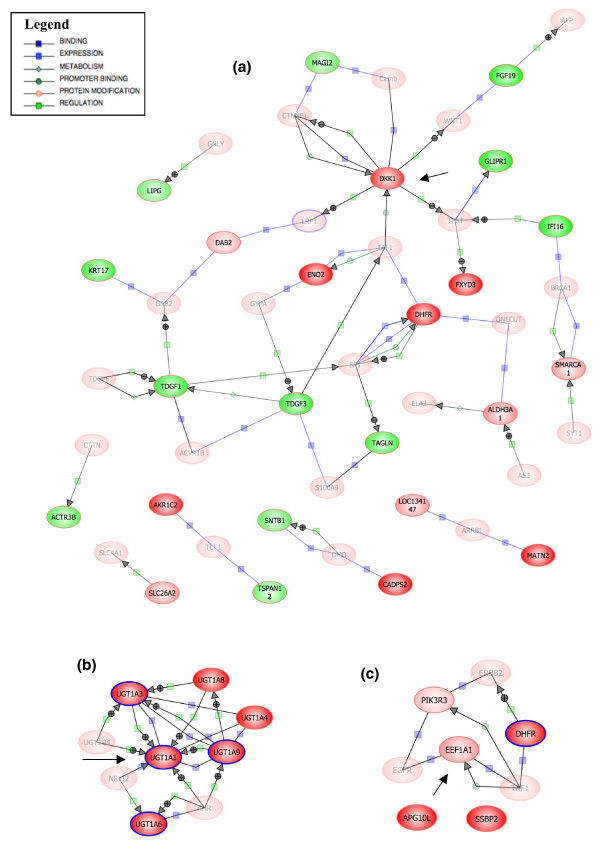
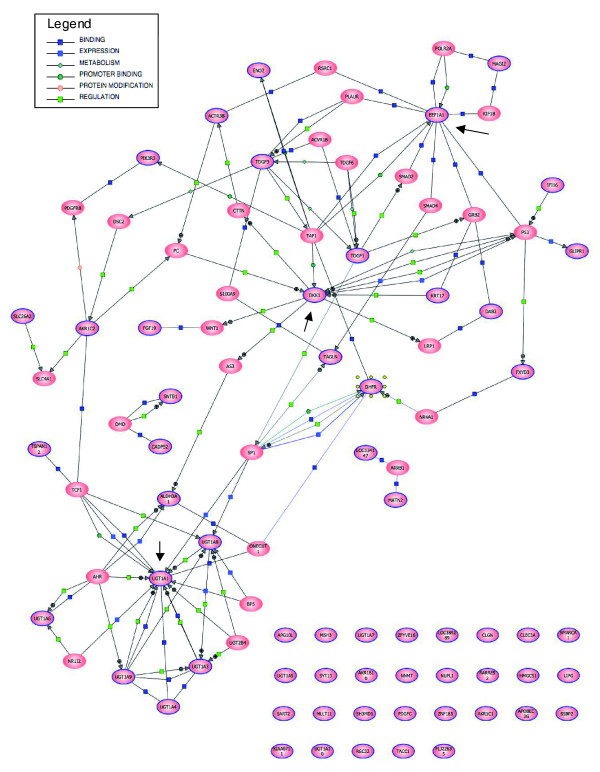
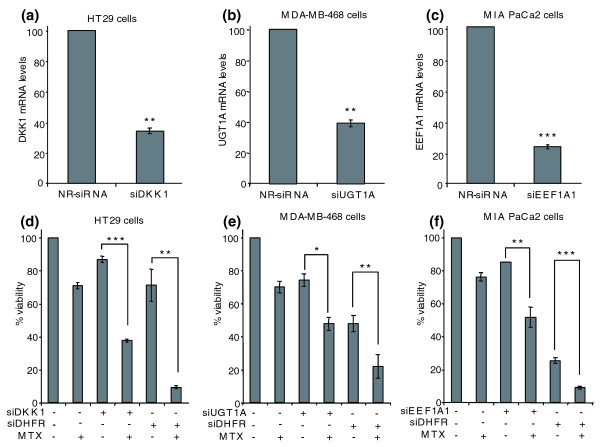
Dikkopf homolog-1 (DKK1) is a highly interconnected node in the network generated with genes in common between the two colon cancer cell lines, and functional validations of this target using small interfering RNAs (siRNAs) showed a chemosensitization toward MTX. Members of the UDP-glucuronosyltransferase 1A (UGT1A) family formed a network of genes differentially expressed in the two breast cancer cell lines. siRNA treatment against UGT1A also showed an increase in MTX sensitivity. Eukaryotic translation elongation factor 1 alpha 1 (EEF1A1) was overexpressed among the pancreatic cancer, leukemia and osteosarcoma cell lines, and siRNA treatment against EEF1A1 produced a chemosensitization toward MTX.
Biological association networks identified DKK1, UGT1As and EEF1A1 as important gene nodes in MTX-resistance. Treatments using siRNA technology against these three genes showed chemosensitization toward MTX.
高通量技术获得的数据需要综合分析,由此产生了网络分析。这些分析特别有助于阐明外部干扰如何通过基因表达传播。为了解决耐药性问题,我们构建了对甲氨蝶呤(MTX)耐药的细胞系中差异表达的基因的生物关联网络。
使用七种不同类型癌症的代表性细胞系,包括结肠癌(HT29 和 Caco2)、乳腺癌(MCF-7 和 MDA-MB-468)、胰腺癌(MIA PaCa-2)、红白血病(K562)和骨肉瘤(Saos-2)。通过全人类基因组微阵列确定敏感细胞和 MTX 耐药细胞之间的差异表达模式,并使用 GeneSpring GX 软件包进行分析。在不同的癌细胞系中共同下调的基因用于使用 Pathway Architect 软件生成生物关联网络。
Dickkopf 同源物-1(DKK1)是在共同的两个结肠癌细胞系之间生成的网络中的一个高度连接的节点,使用小干扰 RNA(siRNA)对该靶标进行功能验证表明其对 MTX 具有化学增敏作用。UDP-葡萄糖醛酸转移酶 1A(UGT1A)家族的成员在两个乳腺癌细胞系中差异表达的基因形成了一个网络。针对 UGT1A 的 siRNA 处理也显示出对 MTX 敏感性的增加。真核翻译延伸因子 1 阿尔法 1(EEF1A1)在胰腺癌、白血病和骨肉瘤细胞系中过表达,针对 EEF1A1 的 siRNA 处理产生了对 MTX 的化学增敏作用。
生物关联网络确定了 DKK1、UGT1As 和 EEF1A1 为 MTX 耐药性中的重要基因节点。针对这三个基因的 siRNA 技术治疗显示出对 MTX 的化学增敏作用。