
用于脑功能网络的自适应复杂网络模型。
An adaptive complex network model for brain functional networks.
机构信息
Statistical and Interdisciplinary Physics Group, Centro Atómico Bariloche, Bariloche, Río Negro, Argentina.
出版信息
PLoS One. 2009 Sep 7;4(9):e6863. doi: 10.1371/journal.pone.0006863.
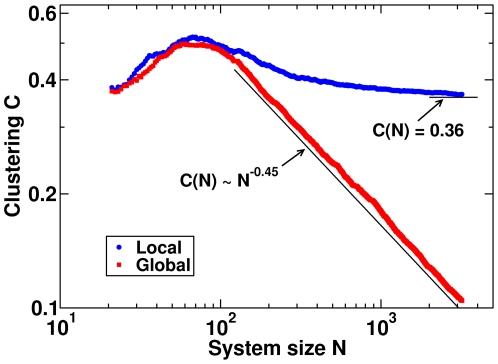
Brain functional networks are graph representations of activity in the brain, where the vertices represent anatomical regions and the edges their functional connectivity. These networks present a robust small world topological structure, characterized by highly integrated modules connected sparsely by long range links. Recent studies showed that other topological properties such as the degree distribution and the presence (or absence) of a hierarchical structure are not robust, and show different intriguing behaviors. In order to understand the basic ingredients necessary for the emergence of these complex network structures we present an adaptive complex network model for human brain functional networks. The microscopic units of the model are dynamical nodes that represent active regions of the brain, whose interaction gives rise to complex network structures. The links between the nodes are chosen following an adaptive algorithm that establishes connections between dynamical elements with similar internal states. We show that the model is able to describe topological characteristics of human brain networks obtained from functional magnetic resonance imaging studies. In particular, when the dynamical rules of the model allow for integrated processing over the entire network scale-free non-hierarchical networks with well defined communities emerge. On the other hand, when the dynamical rules restrict the information to a local neighborhood, communities cluster together into larger ones, giving rise to a hierarchical structure, with a truncated power law degree distribution.
脑功能网络是大脑活动的图表示,其中顶点代表解剖区域,边代表它们的功能连接。这些网络呈现出稳健的小世界拓扑结构,其特征是高度集成的模块通过长程连接稀疏连接。最近的研究表明,其他拓扑性质,如度分布和分层结构的存在(或不存在),并不稳健,表现出不同的有趣行为。为了理解这些复杂网络结构出现所必需的基本成分,我们提出了一种用于人脑功能网络的自适应复杂网络模型。该模型的微观单元是动态节点,代表大脑的活跃区域,其相互作用产生复杂的网络结构。节点之间的连接是根据自适应算法选择的,该算法在具有相似内部状态的动态元素之间建立连接。我们表明,该模型能够描述从功能磁共振成像研究中获得的人脑网络的拓扑特征。具体来说,当模型的动力学规则允许在整个网络范围内进行集成处理时,就会出现具有明确社区的无标度非分层网络。另一方面,当动力学规则将信息限制在局部邻域时,社区会聚集在一起形成更大的社区,从而产生具有截断幂律度分布的层次结构。




 Zotero 插件