Drago Antonio, Liappas Ioannis, Petio Carmine, Albani Diego, Forloni Gianluigi, Malitas Petros, Piperi Christina, Politis Antonis, Tzavellas Elias O, Zisaki Katerina K, Prato Francesca, Batelli Sara, Polito Letizia, De Ronchi Diana, Paparrigopoulos Thomas, Kalofoutis Anastasios, Serretti Alessandro
Institute of Psychiatry, University of Bologna, Italy.
Int J Environ Res Public Health. 2009 Jul;6(7):1980-90. doi: 10.3390/ijerph6071980. Epub 2009 Jul 16.
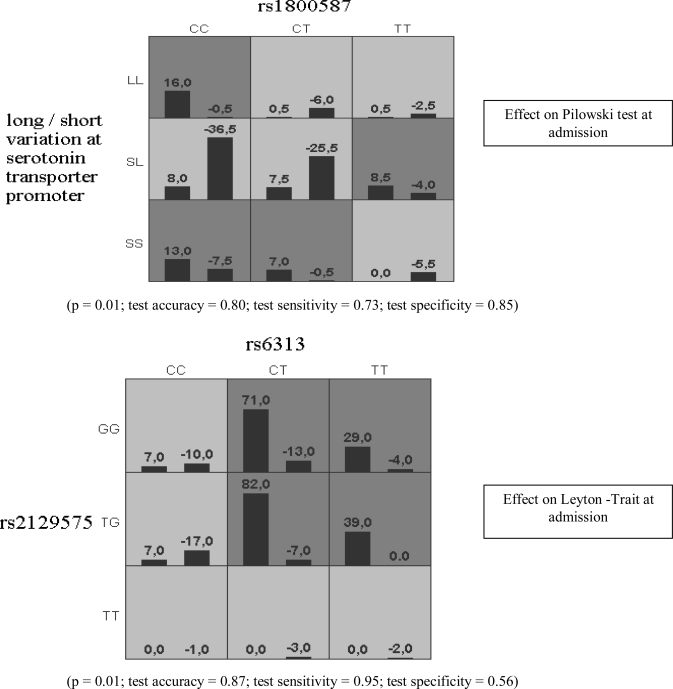
We assessed a set of biological (HDL, LDL, SGOT, SGPT, GGT, HTc, Hb and T levels) and psychometric variables (investigated through HAM-D, HAM-A, GAS, Liebowitz Social Anxiety Scale, Mark & Mathews Scale, Leyton scale, and Pilowski scale) in a sample of 64 alcohol dependent patients, at baseline and after a detoxification treatment. Moreover, we recruited 47 non-consanguineous relatives who did not suffer alcohol related disorders and underwent the same tests. In both groups we genotyped 11 genetic variations (rs1800587; rs3087258; rs1799724; 5-HTTLPR; rs1386493; rs1386494; rs1487275; rs1843809; rs4570625; rs2129575; rs6313) located in genes whose impact on alcohol related behaviors and disorders has been hypothesized (IL1A, IL1B, TNF, 5-HTTLPR, TPH2 and HTR2A). We analyzed the epistasis of these genetic variations upon the biological and psychological dimensions in the cases and their relatives. Further on, we analyzed the effects of the combined genetic variations on the short - term detoxification treatment efficacy. Finally, being the only not yet investigated variation within this sample, we analyzed the impact of the rs6313 alone on baseline assessment and treatment efficacy. We detected the following results: the couple rs6313 + rs2129575 affected the Leyton -Trait at admission (p = 0.01) (obsessive-compulsive trait), whilst rs1800587 + 5-HTTLPR impacted the Pilowski test at admission (p = 0.01) (hypochondriac symptoms). These results did not survive Bonferroni correction (p < or = 0.004). This lack of association may depend on the incomplete gene coverage or on the small sample size which limited the power of the study. On the other hand, it may reflect a substantial absence of relevance of the genotype variants toward the alcohol related investigated dimensions. Nonetheless, the marginal significance we detected could witness an informative correlation worth investigating in larger samples.
我们在64名酒精依赖患者样本的基线期及解毒治疗后,评估了一组生物学变量(高密度脂蛋白、低密度脂蛋白、谷草转氨酶、谷丙转氨酶、γ-谷氨酰转肽酶、总胆固醇、血红蛋白和甲状腺激素水平)和心理测量变量(通过汉密尔顿抑郁量表、汉密尔顿焦虑量表、总体幸福感量表、莱博维茨社交焦虑量表、马克&马修斯量表、莱顿量表和皮洛夫斯基量表进行调查)。此外,我们招募了47名无血缘关系且未患酒精相关疾病的亲属,并让他们接受相同测试。在两组中,我们对位于已假定其对酒精相关行为和疾病有影响的基因(白细胞介素1A、白细胞介素1B、肿瘤坏死因子、5-羟色胺转运体相关多态性区域、色氨酸羟化酶2和5-羟色胺受体2A)中的11个基因变异(rs1800587;rs3087258;rs1799724;5-羟色胺转运体相关多态性区域;rs1386493;rs1386494;rs1487275;rs1843809;rs4570625;rs2129575;rs6313)进行了基因分型。我们分析了这些基因变异在病例及其亲属的生物学和心理维度上的上位性。此外,我们分析了组合基因变异对短期解毒治疗疗效的影响。最后,作为该样本中唯一尚未研究的变异,我们分析了rs6313单独对基线评估和治疗疗效的影响。我们检测到以下结果:rs6313 + rs2129575这一组合在入院时影响莱顿特质(p = 0.01)(强迫性特质),而rs1800587 + 5-羟色胺转运体相关多态性区域在入院时影响皮洛夫斯基测试(p = 0.01)(疑病症状)。这些结果在经邦费罗尼校正后不显著(p≤0.004)。这种缺乏关联性可能取决于基因覆盖不完整或样本量小,从而限制了研究的效力。另一方面,这可能反映出基因变异与所研究的酒精相关维度基本无关。尽管如此,我们检测到的边缘显著性可能表明存在一种值得在更大样本中研究的信息性关联。