Todd Derrick J, McHeyzer-Williams Louise J, Kowal Czeslawa, Lee Ann-Hwee, Volpe Bruce T, Diamond Betty, McHeyzer-Williams Michael G, Glimcher Laurie H
Department of Immunology and Infectious Diseases, Harvard School of Public Health, Boston, MA 02115, USA.
J Exp Med. 2009 Sep 28;206(10):2151-9. doi: 10.1084/jem.20090738. Epub 2009 Sep 14.
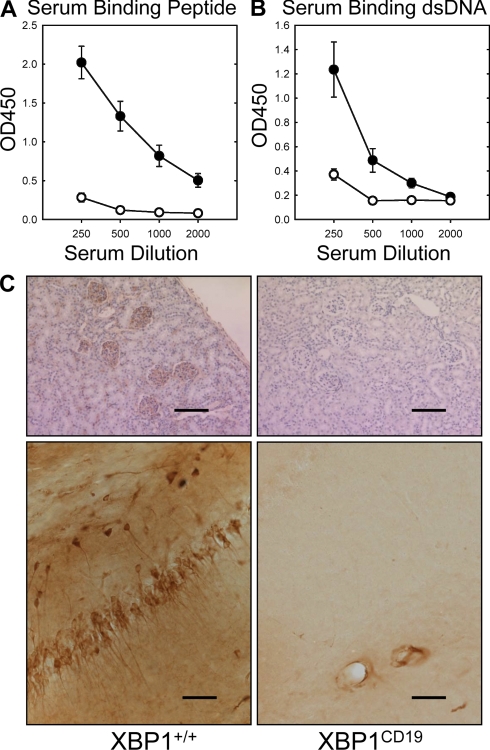
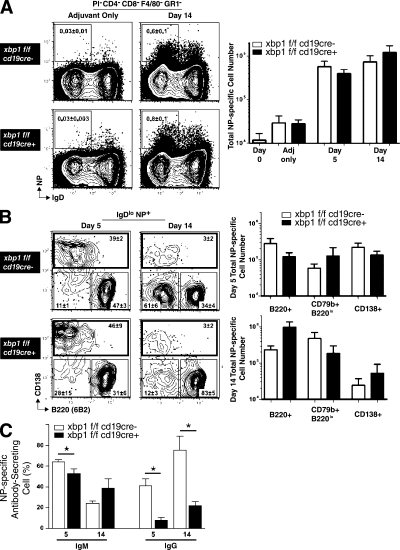
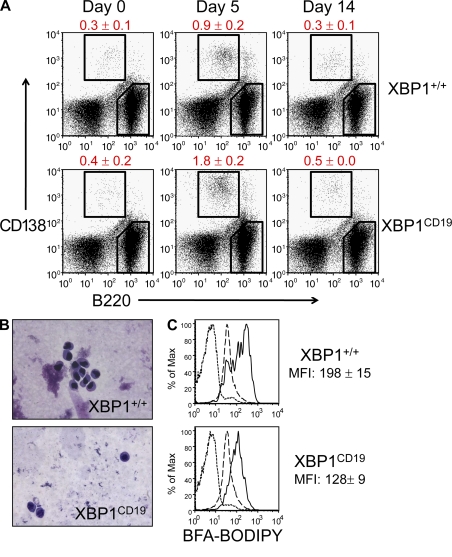
The unfolded protein response (UPR) is a stress response pathway that is driven by the increased load of unfolded proteins in the endoplasmic reticulum of highly secretory cells such as plasma cells (PCs). X box binding protein 1 (XBP1) is a transcription factor that mediates one branch of the UPR and is crucial for the development of antibody-secreting PCs. PCs represent only one class of terminally differentiated B cells, however, and little is known about the role for XBP1 in the other class: memory B cells. We have developed an XBP1(fl/fl) CD19(+/cre) conditional knockout (XBP1(CD19)) mouse to build upon our current understanding of the function of XBP1 in PC differentiation as well as to explore the role of XBP1 in memory cell development. Using this model, we show that XBP1(CD19) mice are protected from disease in an autoantibody-mediated mouse lupus model. We also identify a novel developmental stage at which B cells express the traditional PC marker CD138 (syndecan-1) but have yet to undergo XBP1-dependent functional and morphological differentiation into antibody-secreting cells. Finally, we show that memory B cells develop normally in XBP1(CD19) mice, demonstrating that XBP1-mediated functions occur independently of any memory cell lineage commitment.
未折叠蛋白反应(UPR)是一种应激反应途径,由浆细胞(PC)等高分泌细胞内质网中未折叠蛋白负荷增加所驱动。X盒结合蛋白1(XBP1)是一种转录因子,介导UPR的一个分支,对分泌抗体的PC的发育至关重要。然而,PC仅代表终末分化B细胞的一类,关于XBP1在另一类细胞即记忆B细胞中的作用知之甚少。我们构建了XBP1(fl/fl) CD19(+/cre)条件性敲除(XBP1(CD19))小鼠,以加深我们目前对XBP1在PC分化中功能的理解,并探索XBP1在记忆细胞发育中的作用。利用该模型,我们发现XBP1(CD19)小鼠在自身抗体介导的小鼠狼疮模型中对疾病具有抵抗力。我们还确定了一个新的发育阶段,此时B细胞表达传统的PC标志物CD138(多配体蛋白聚糖-1),但尚未经历XBP1依赖的功能和形态分化成为分泌抗体的细胞。最后,我们表明记忆B细胞在XBP1(CD19)小鼠中正常发育,这表明XBP1介导的功能独立于任何记忆细胞谱系定向而发生。