Center for Learning and Memory, The University of Texas at Austin, 78712, USA.
J Gen Physiol. 2009 Oct;134(4):281-93. doi: 10.1085/jgp.200910295. Epub 2009 Sep 14.
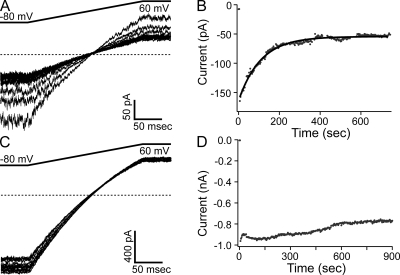
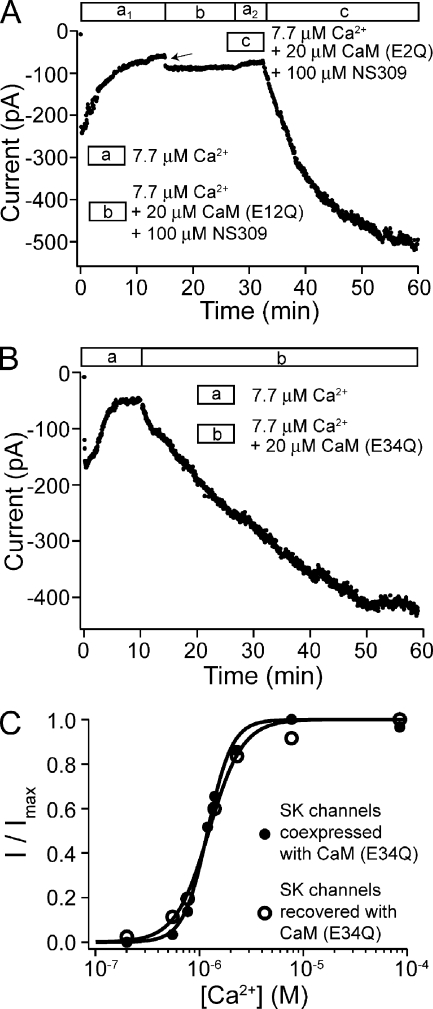
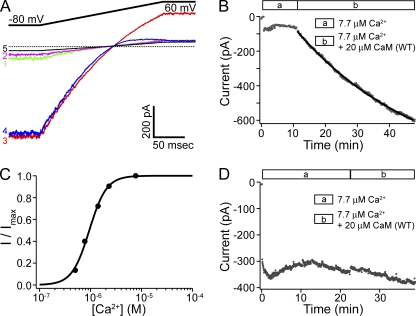
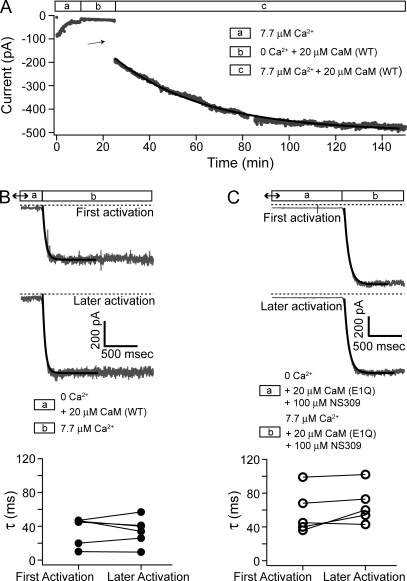
Small conductance calcium-activated potassium (SK) channels respond to intracellular Ca(2+) via constitutively associated calmodulin (CaM). Previous studies have proposed a modular design for the interaction between CaM and SK channels. The C-lobe and the linker of CaM are thought to regulate the constitutive binding, whereas the N-lobe binds Ca(2+) and gates SK channels. However, we found that coexpression of mutant CaM (E/Q) where the N-lobe has only one functional EF hand leads to rapid rundown of SK channel activity, which can be recovered with exogenously applied wild-type (WT), but not mutant, CaM. Our results suggest that the mutation at the N-lobe EF hand disrupts the stable interaction between CaM and SK channel subunits, such that mutant CaM dissociates from the channel complex when the inside of the membrane is exposed to CaM-free solution. The disruption of the stable interaction does not directly result from the loss of Ca(2+)-binding capacity because SK channels and WT CaM can stably interact in the absence of Ca(2+). These findings question a previous conclusion that CaM where the N-lobe has only one functional EF hand can stably support the gating of SK channels. They cannot be explained by the current model of modular interaction between CaM and SK channels, and they imply a role for N-lobe EF hand residues in binding to the channel subunits. Additionally, we found that a potent enhancer for SK channels, 3-oxime-6,7-dichloro-1H-indole-2,3-dione (NS309), enables the recovery of channel activity with CaM (E/Q), suggesting that NS309 stabilizes the interaction between CaM and SK channels. CaM (E/Q) can regulate Ca(2+)-dependent gating of SK channels in the presence of NS309, but with a lower apparent Ca(2+) affinity than WT CaM.
小电导钙激活钾 (SK) 通道通过组成型相关的钙调蛋白 (CaM) 对细胞内 Ca(2+) 作出反应。先前的研究提出了 CaM 与 SK 通道相互作用的模块设计。CaM 的 C 结构域和连接子被认为调节组成型结合,而 N 结构域结合 Ca(2+) 并门控 SK 通道。然而,我们发现,当 N 结构域中只有一个功能 EF 手的突变型 CaM (E/Q) 共表达时,SK 通道活性会迅速失活,而外源性施用野生型 (WT) CaM 而不是突变型 CaM 可以恢复这种失活。我们的结果表明,N 结构域 EF 手突变破坏了 CaM 与 SK 通道亚基之间的稳定相互作用,使得当膜内侧暴露于无 CaM 溶液时,突变型 CaM 从通道复合物中解离。这种稳定相互作用的破坏并不是直接由于 Ca(2+) 结合能力的丧失,因为 SK 通道和 WT CaM 可以在没有 Ca(2+) 的情况下稳定地相互作用。这些发现对先前的结论提出了质疑,即只有一个功能 EF 手的 CaM 可以稳定地支持 SK 通道的门控。它们不能用 CaM 与 SK 通道之间的当前模块相互作用模型来解释,并且它们暗示了 N 结构域 EF 手残基在与通道亚基结合中的作用。此外,我们发现 SK 通道的一种强效增强剂,3-肟-6,7-二氯-1H-吲哚-2,3-二酮 (NS309),可以使 CaM (E/Q) 恢复通道活性,这表明 NS309 稳定了 CaM 和 SK 通道之间的相互作用。在 NS309 的存在下,CaM (E/Q) 可以调节 Ca(2+) 依赖性的 SK 通道门控,但与 WT CaM 相比,其表观 Ca(2+) 亲和力较低。