
钙黏蛋白23亚型的表达并不保守:对1D型Usher综合征小鼠模型的启示。
Expression of cadherin 23 isoforms is not conserved: implications for a mouse model of Usher syndrome type 1D.
作者信息
Lagziel Ayala, Overlack Nora, Bernstein Steven L, Morell Robert J, Wolfrum Uwe, Friedman Thomas B
机构信息
Section on Human Genetics, Laboratory of Molecular Genetics, National Institute on Deafness and Other Communication Disorders, National Institutes of Health, Rockville, MD 20850, USA.
出版信息
Mol Vis. 2009 Sep 12;15:1843-57.
PURPOSE
We compared cadherin 23 (Cdh23) mRNA and protein variants in the inner ear and retina of wild-type and mutant mice and primates to better understand the pleiotropic effects of Cdh23 mutations, and specifically to understand the absence of retinal degeneration in Cdh23 mutant mice.
METHODS
Semiquantitative real-time PCR was used to compare the level of expression of Cdh23 alternative transcripts in the inner ear and retina of wild-type and homozygous Cdh23(v-6J) (waltzer) mice. Antibodies generated against CDH23 isoforms were used in immunohistochemistry, immunohistology, electron microscopy, and western blot analyses of mouse and primate inner ear and retina to study the distribution of these isoforms in various cellular compartments.
RESULTS
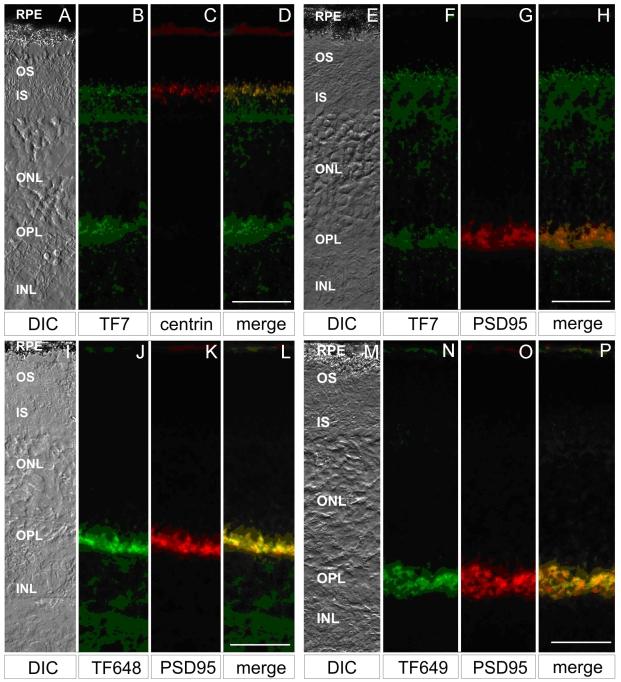
Cdh23 mRNA alternative splice variants were temporally and spatially regulated in the inner ear and retina. In the mature mouse retina, CDH23 isoforms were broadly expressed in various cellular compartments of the photoreceptor layer. The wild-type CDH23_V3 protein isoform, which has PDZ binding motifs but neither extracellular domains nor a transmembrane domain, localized exclusively to the outer plexiform layer of the retina containing photoreceptor cell synapses and to the synaptic region of auditory and vestibular hair cells. The longest CDH23 protein isoform, CDH23_V1, appeared by western blotting to be the only one affected by the Cdh23(v-6J) mutation; it was expressed in the wild-type mouse inner ear, but not in the mouse retina. However, CDH23_V1 was detected in western blot analyses of monkey and human retinas.
CONCLUSIONS
The time- and tissue-dependent expression patterns that we have shown for Cdh23 alternative transcripts suggest developmental roles and tissue-specific functions for the various transcripts. Many of these isoforms continue to be expressed in waltzer mice. The longest CDH23 isoform (CDH23_V1), however, is not expressed in mutant mice and is necessary for normal inner ear function. The longest isoform is expressed in the retinas of primates, but not detected in the mouse retina. This species difference suggests that the mouse may not be a suitable model for studying the retinitis pigmentosa phenotype of human Usher syndrome type 1D.
目的
我们比较了野生型和突变型小鼠及灵长类动物内耳和视网膜中钙黏蛋白23(Cdh23)的mRNA和蛋白质变体,以更好地理解Cdh23突变的多效性影响,特别是理解Cdh23突变型小鼠视网膜变性缺失的原因。
方法
采用半定量实时PCR比较野生型和纯合Cdh23(v - 6J)(waltzer)小鼠内耳和视网膜中Cdh23可变转录本的表达水平。针对CDH23异构体产生的抗体用于小鼠和灵长类动物内耳和视网膜的免疫组织化学、免疫组织学、电子显微镜和蛋白质印迹分析,以研究这些异构体在不同细胞区室中的分布。
结果
Cdh23 mRNA可变剪接变体在内耳和视网膜中受到时间和空间调控。在成熟小鼠视网膜中,CDH23异构体在光感受器层的不同细胞区室中广泛表达。野生型CDH23_V3蛋白质异构体具有PDZ结合基序,但既没有细胞外结构域也没有跨膜结构域,仅定位于含有光感受器细胞突触的视网膜外网状层以及听觉和前庭毛细胞的突触区域。通过蛋白质印迹法显示,最长的CDH23蛋白质异构体CDH23_V1是唯一受Cdh23(v - 6J)突变影响的异构体;它在野生型小鼠内耳中表达,但不在小鼠视网膜中表达。然而,在猴和人类视网膜的蛋白质印迹分析中检测到了CDH23_V1。
结论
我们所展示的Cdh23可变转录本的时间和组织依赖性表达模式表明各种转录本具有发育作用和组织特异性功能。许多这些异构体在waltzer小鼠中继续表达。然而,最长的CDH23异构体(CDH23_V1)在突变型小鼠中不表达,并且是正常内耳功能所必需的。最长的异构体在灵长类动物的视网膜中表达,但在小鼠视网膜中未检测到。这种物种差异表明小鼠可能不是研究人类1D型Usher综合征视网膜色素变性表型的合适模型。




 Zotero 插件