Shin Dong-In, Deneke Thomas, Gorr Eduard, Anders Helge, Buenz Kathrin, Paesler Marcus, Horlitz Marc
Department of Cardiology and Electrophysiology, Krankenhaus Porz am Rhein, Cologne, Germany.
Indian Pacing Electrophysiol J. 2009 Sep 1;9(5):241-6.
Catheter ablation for atrial fibrillation is a clinically established treatment by now while success rate varies between 60% and 85%. Interventional treatment of atrial fibrillation is still a challenging technique associated with a long procedure time and risk of major complications in up to 6 % of treated patients. The aim of this study was to investigate the predictive value of plasma brain natriuretic peptide (BNP) in patients undergoing pulmonary vein isolation concerning stable sinus rhythm after ablation.
In 68 consecutive patients with atrial fibrillation (AF) and normal left ventricular ejection fraction, BNP was measured at baseline before pulmonary vein isolation (PVI). All patients received a 7-days-holter monitoring 3 months after radiofrequency (RF) ablation in order to detect recurrent AF episodes.
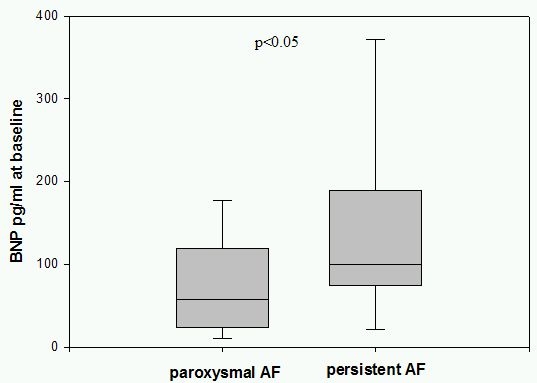
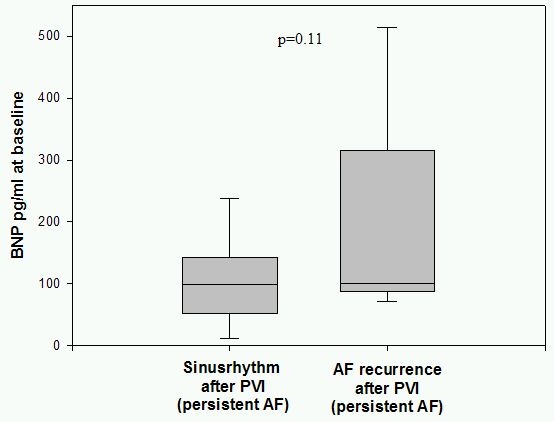
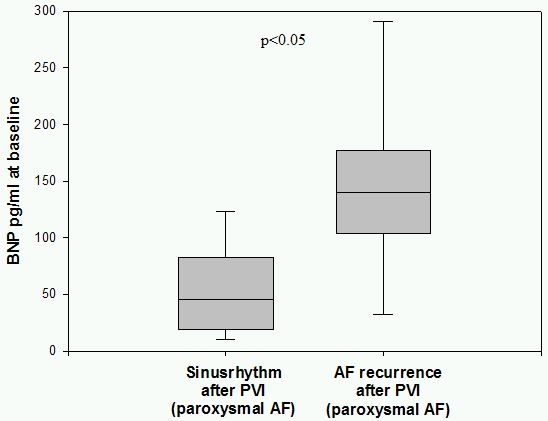
48 patients with paroxysmal and 20 patients with persistent AF were enrolled. Baseline BNP was significantly higher in patients with persistent AF compared to patients with paroxysmal AF (145,5 pg/ml vs. 84,4 pg/ml; p<0,05). 3 months after PVI 38 patients (79,1%) with paroxysmal AF had a stable sinus rhythm documented on 7-days-holter monitoring, where as in 10 patients (20,9%) AF episodes were detected. Patients with a successful PVI showed significantly lower BNP plasma levels at baseline compared to patients with AF recurrrence (68,7 pg/ml vs. 144,1 pg/ml; p<0,05). In patients with persistent AF 55% (11 cases) had no recurrence of AF at 3 months 7-days holter and in 9 patients (45%) AF recurred. BNP plasma levels at baseline were lower in patients with stable sinusrhythm after 3 months compared to the group of recurrent AF (105,8 pg/ml vs. 193,3 pg/ml; p=0,11).
Patients with AF and low preprocedural BNP plasma levels showed a better outcome after PVI. Thus BNP may be helpful in patient selection for a successful treatment of AF by PVI.
目前,导管消融治疗心房颤动已成为一种临床认可的治疗方法,但其成功率在60%至85%之间。心房颤动的介入治疗仍然是一项具有挑战性的技术,手术时间长,且高达6%的接受治疗患者有发生重大并发症的风险。本研究的目的是探讨血浆脑钠肽(BNP)对接受肺静脉隔离术的患者消融术后窦性心律稳定性的预测价值。
连续纳入68例心房颤动(AF)且左心室射血分数正常的患者,在肺静脉隔离(PVI)术前测量其基线BNP水平。所有患者在射频(RF)消融术后3个月接受为期7天的动态心电图监测,以检测房颤复发情况。
纳入48例阵发性房颤患者和20例持续性房颤患者。持续性房颤患者的基线BNP水平显著高于阵发性房颤患者(145.5 pg/ml对84.4 pg/ml;p<0.05)。PVI术后3个月,48例(79.1%)阵发性房颤患者在7天动态心电图监测中记录到窦性心律稳定,而10例(20.9%)患者检测到房颤发作。PVI成功的患者基线时的血浆BNP水平显著低于房颤复发患者(68.7 pg/ml对144.1 pg/ml;p<0.05)。持续性房颤患者中,55%(11例)在术后3个月的7天动态心电图监测中无房颤复发,9例(45%)房颤复发。术后3个月窦性心律稳定患者的基线血浆BNP水平低于房颤复发组(105.8 pg/ml对193.3 pg/ml;p=0.11)。
房颤患者术前血浆BNP水平较低者PVI术后预后较好。因此,BNP可能有助于筛选适合PVI成功治疗房颤的患者。