University of Washington School of Medicine, Seattle, USA.
Am J Obstet Gynecol. 2010 Jan;202(1):61.e1-7. doi: 10.1016/j.ajog.2009.07.041. Epub 2009 Sep 20.
We sought to identify factors associated with high antenatal psychosocial stress and describe the course of psychosocial stress during pregnancy.
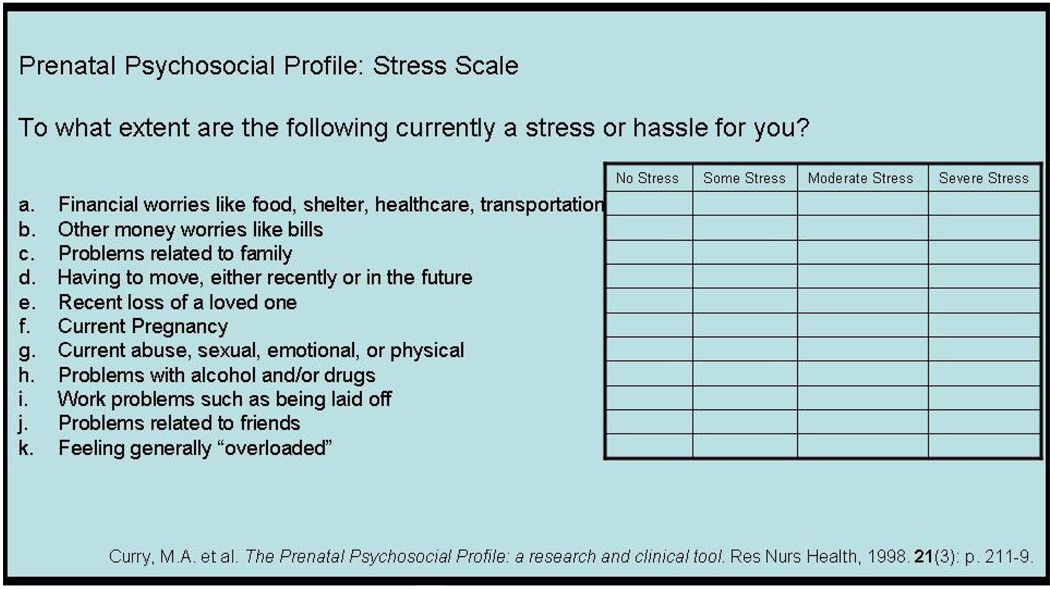
We performed a cross-sectional analysis of data from an ongoing registry. Study participants were 1522 women receiving prenatal care at a university obstetric clinic from January 2004 through March 2008. Multiple logistic regression identified factors associated with high stress as measured by the Prenatal Psychosocial Profile stress scale.
The majority of participants reported antenatal psychosocial stress (78% low-moderate, 6% high). Depression (odds ratios [OR], 9.6; 95% confidence interval [CI], 5.5-17.0), panic disorder (OR, 6.8; 95% CI, 2.9-16.2), drug use (OR, 3.8; 95% CI, 1.2-12.5), domestic violence (OR, 3.3; 95% CI, 1.4-8.3), and having > or =2 medical comorbidities (OR, 3.1; 95% CI, 1.8-5.5) were significantly associated with high psychosocial stress. For women who screened twice during pregnancy, mean stress scores declined during pregnancy (14.8 +/- 3.9 vs 14.2 +/- 3.8; P < .001).
Antenatal psychosocial stress is common, and high levels are associated with maternal factors known to contribute to poor pregnancy outcomes.
我们旨在找出与产前心理社会压力高相关的因素,并描述孕期心理社会压力的变化过程。
我们对一项正在进行的注册研究的数据进行了横断面分析。研究对象为 2004 年 1 月至 2008 年 3 月在一所大学妇产科诊所接受产前保健的 1522 名妇女。多因素逻辑回归分析确定了产前心理社会压力量表(Prenatal Psychosocial Profile stress scale)评估的高压力相关因素。
大多数参与者报告存在产前心理社会压力(78%为中低水平,6%为高水平)。抑郁(比值比 [OR],9.6;95%置信区间 [CI],5.5-17.0)、惊恐障碍(OR,6.8;95% CI,2.9-16.2)、药物使用(OR,3.8;95% CI,1.2-12.5)、家庭暴力(OR,3.3;95% CI,1.4-8.3)和存在≥2 种合并医学疾病(OR,3.1;95% CI,1.8-5.5)与高心理社会压力显著相关。对于在孕期接受两次筛查的女性,孕期平均压力评分下降(14.8 ± 3.9 与 14.2 ± 3.8;P<.001)。
产前心理社会压力很常见,高水平与已知会导致不良妊娠结局的产妇因素有关。