Barreiro Luis B, Henriques Ricardo, Mhlanga Musa M
Department of Human Genetics, The University of Chicago, Chicago, IL, USA.
Methods Mol Biol. 2009;578:255-76. doi: 10.1007/978-1-60327-411-1_17.
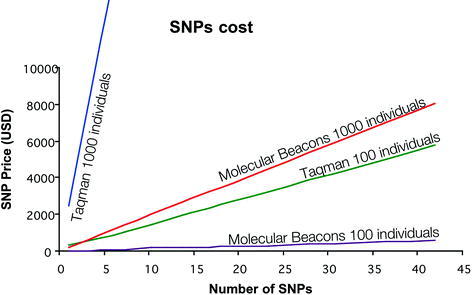
In the last decade, molecular beacons have emerged to become a widely used tool in the multiplex typing of single nucleotide polymorphisms (SNPs). Improvements in detection technologies in instrumentation and chemistries to label these probes have made it possible to use up to six spectrally distinguishable probes per reaction well. With the remarkable advances made in the characterization of human genome diversity, it has been possible to describe empirical patterns of SNPs and haplotype variation in the genome of diverse human populations. These patterns have revealed that the human genome is structured in blocks of strong linkage disequilibrium (LD). Because SNPs tend to be in LD with each other, common haplotypes share common SNPs and thus the majority of the diversity in a region can be characterized by typing a very small number of SNPs; so-called tag SNPs. Herein lies the advantage of the multiplexing ability of molecular beacons, since it becomes possible to use as few as 30 probes to interrogate several haplotypes in a high-throughput approach. Thus, through the combined use of tag SNPs and molecular beacons it becomes possible to type individuals for clinically relevant haplotypes in a high-throughput manner at a cost that is orders of magnitude less than that for high throughput sequencing methods.
在过去十年中,分子信标已成为单核苷酸多态性(SNP)多重分型中广泛使用的工具。仪器设备和标记这些探针的化学方法的检测技术改进,使得每个反应孔最多可使用六种光谱可区分的探针。随着人类基因组多样性表征方面取得的显著进展,已经能够描述不同人类群体基因组中SNP和单倍型变异的经验模式。这些模式表明,人类基因组是由强连锁不平衡(LD)区域构成的。由于SNP往往彼此处于LD状态,常见单倍型共享常见SNP,因此一个区域内的大部分多样性可以通过对极少数SNP(即所谓的标签SNP)进行分型来表征。这就是分子信标的多重分析能力的优势所在,因为可以采用高通量方法,仅使用30个探针就能检测几种单倍型。因此,通过结合使用标签SNP和分子信标,就有可能以高通量方式对个体的临床相关单倍型进行分型,其成本比高通量测序方法低几个数量级。