Paganin-Gioanni Aurelie, Bellard Elisabeth, Couderc Bettina, Teissié Justin, Golzio Muriel
IPBS CNRS (UMR 5089 Université de Toulouse III, CNRS), 205 Route de Narbonne, 31077 Toulouse France.
J RNAi Gene Silencing. 2008 May 27;4(1):281-8.
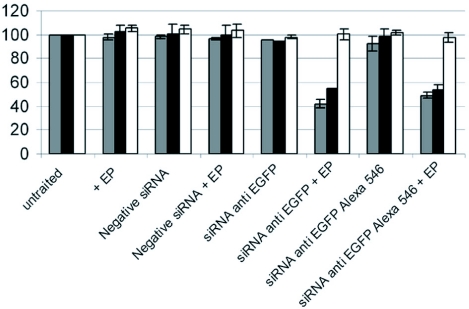
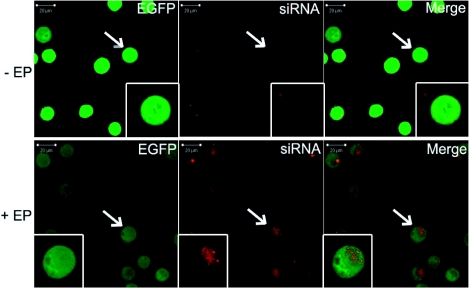
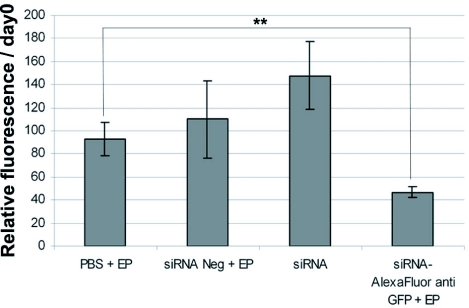
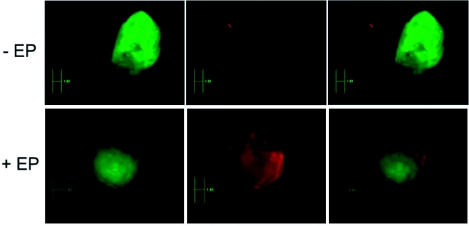
RNA interference-mediated gene silencing offers the potential of targeted inhibition of disease-relevant genes. In vivo delivery of RNAi reagents can be obtained by a variety of approaches. Physical delivery methods appear safer and lack side effects. Electro-permeabilization is one of the non-viral methods successfully used to transfer small interfering RNAs (siRNAs) in vitro and in vivo. A promising approach may be, very little is known about the fundamental processes mediating siRNA transfer. In this study, we have investigated cellular delivery pathways involved in electro-delivery of siRNAs by a direct fluorescence imaging method. An Alexa-labeled siRNA was electro-transferred into murine melanoma cells stably-expressing the enhanced green fluorescent protein (eGFP) target reporter gene. The silencing of eGFP gene expression was quantified by time-lapsed fluorescence microscopy. Fluorescently-labeled siRNAs were found distributed homogeneously in cytoplasm 48 hours after electro-transfer, apparently by diffusion. Furthermore, siRNAs showed homogeneous distribution in vivo 48 hrs after intra-tumoral injection followed by electro- permeabilization. Histological fluorescence microscopy showed that siRNAs were mostly localized in the cytoplasm. Overall, this study shows that electro-permeabilization facilitates cytoplasmic distribution of siRNA, both in cultured cells and in vivo. This method offers a potential therapeutic tool to facilitate direct siRNA penetration into solid tumors.
RNA干扰介导的基因沉默为靶向抑制疾病相关基因提供了可能。RNA干扰试剂的体内递送可通过多种方法实现。物理递送方法似乎更安全且无副作用。电穿孔是一种成功用于在体外和体内转染小干扰RNA(siRNA)的非病毒方法。尽管这是一种很有前景的方法,但对于介导siRNA转染的基本过程我们却知之甚少。在本研究中,我们通过直接荧光成像方法研究了电递送siRNA所涉及的细胞递送途径。将一种Alexa标记的siRNA电转染到稳定表达增强型绿色荧光蛋白(eGFP)靶报告基因的小鼠黑色素瘤细胞中。通过延时荧光显微镜对eGFP基因表达的沉默情况进行定量分析。电转染48小时后,发现荧光标记的siRNA明显通过扩散均匀分布于细胞质中。此外,在瘤内注射后进行电穿孔处理48小时后,siRNA在体内也呈现均匀分布。组织学荧光显微镜检查显示,siRNA大多定位于细胞质中。总体而言,本研究表明电穿孔处理可促进siRNA在培养细胞和体内的细胞质分布。该方法为促进siRNA直接渗透进入实体瘤提供了一种潜在的治疗工具。