Department of Health Sciences, Division of Physical Therapy, Lund University, Lund, Sweden.
BMC Musculoskelet Disord. 2009 Sep 25;10:118. doi: 10.1186/1471-2474-10-118.
Despite conflicting results after surgically treated ankle fractures few studies have evaluated the effects of different types of training programs performed after plaster removal. The aim of this study was to evaluate the effects of a 12-week standardised but individually suited training program (training group) versus usual care (control group) after plaster removal in adults with surgically treated ankle fractures.
In total, 110 men and women, 18-64 years of age, with surgically treated ankle fracture were included and randomised to either a 12-week training program or to a control group. Six and twelve months after the injury the subjects were examined by the same physiotherapist who was blinded to the treatment group. The main outcome measure was the Olerud-Molander Ankle Score (OMAS) which rates symptoms and subjectively scored function. Secondary outcome measures were: quality of life (SF-36), timed walking tests, ankle mobility tests, muscle strength tests and radiological status.
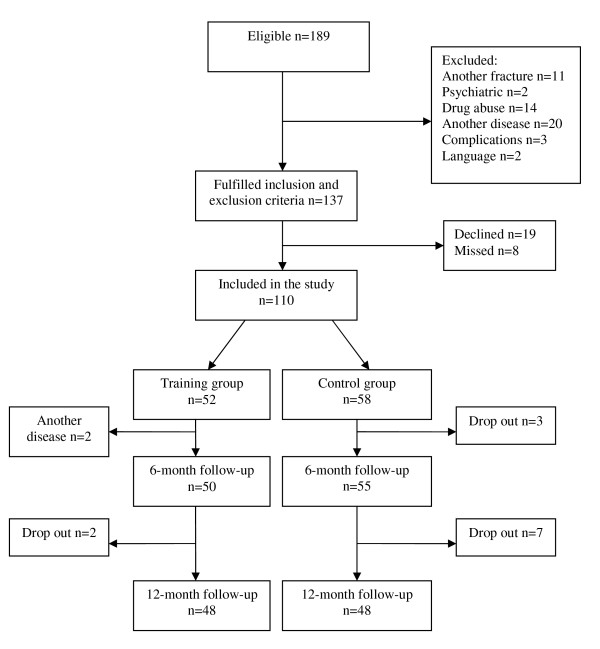
52 patients were randomised to the training group and 58 to the control group. Five patients dropped out before the six-month follow-up resulting in 50 patients in the training group and 55 in the control group. Nine patients dropped out between the six- and twelve-month follow-up resulting in 48 patients in both groups. When analysing the results in a mixed model analysis on repeated measures including interaction between age-group and treatment effect the training group demonstrated significantly improved results compared to the control group in subjects younger than 40 years of age regarding OMAS (p = 0.028), muscle strength in the plantar flexors (p = 0.029) and dorsiflexors (p = 0.030).
The results of this study suggest that when adjusting for interaction between age-group and treatment effect the training model employed in this study was superior to usual care in patients under the age of 40. However, as only three out of nine outcome measures showed a difference, the beneficial effect from an additional standardised individually suited training program can be expected to be limited. There is need for further studies to elucidate how a training program should be designed to increase and optimise function in patients middle-aged or older.
Current Controlled Trials ACTRN12609000327280.
尽管手术后踝关节骨折的治疗结果存在争议,但很少有研究评估去除石膏后不同类型的训练方案的效果。本研究旨在评估标准化但个体化的 12 周训练方案(训练组)与去除石膏后常规护理(对照组)对接受手术治疗的踝关节骨折成年人的影响。
共纳入 110 名年龄在 18-64 岁之间的男性和女性,他们接受了手术治疗的踝关节骨折,并被随机分配到 12 周的训练方案或对照组。受伤后 6 个月和 12 个月,由同一位对治疗组不知情的物理治疗师对受试者进行检查。主要结局指标是 Olerud-Molander 踝关节评分(OMAS),它评估症状和主观评分功能。次要结局指标包括:生活质量(SF-36)、计时步行测试、踝关节活动度测试、肌肉力量测试和影像学状态。
52 名患者被随机分配到训练组,58 名患者被分配到对照组。在 6 个月的随访前,有 5 名患者退出,导致训练组有 50 名患者,对照组有 55 名患者。9 名患者在 6 个月至 12 个月的随访期间退出,两组各有 48 名患者。在混合模型分析中,对重复测量进行分析,包括年龄组和治疗效果之间的交互作用,结果显示,在年龄小于 40 岁的患者中,与对照组相比,训练组在 OMAS(p=0.028)、足底屈肌(p=0.029)和背屈肌(p=0.030)的肌肉力量方面的结果显著改善。
本研究结果表明,当调整年龄组和治疗效果之间的相互作用时,本研究中采用的训练模式在 40 岁以下患者中优于常规护理。然而,由于只有 9 项结果测量中的 3 项显示出差异,因此可以预期,从额外的标准化个体化训练方案中获得的有益效果是有限的。需要进一步的研究来阐明如何设计训练方案,以增加和优化中年或老年患者的功能。
当前对照试验 ACTRN12609000327280。