McCreedy Rebecca A, Fleet James C
Department of Foods and Nutrition, and Center for Gene Environment Interactions, Purdue University, West Lafayette, Indiana 47906-2059, USA.
Nutr Rev. 2009 Oct;67(10):607-10. doi: 10.1111/j.1753-4887.2009.00233.x.
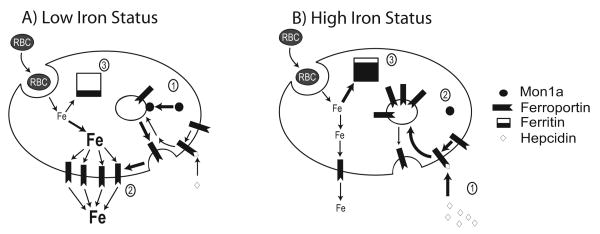
A recent study used a forward genetics approach to identify a new gene whose protein product controls erythrocyte iron recycling mediated through macrophages in the spleen. Initially the investigators found a genetic region on chromosome 9 accounting for one third of the variation in spleen iron level in mice. Additional approaches to narrow the genomic region identified the gene Mon1a, which codes for a protein that acts as a novel regulator of spleen iron release. Cell-based studies showed that Mon1a is necessary for vesicular trafficking of proteins, including the iron-export protein ferroportin, to the macrophage cell membrane. The forward genetics approach, which has currently only been used sparingly by the nutrition research community, offers a powerful and unbiased approach to identifying genes important in nutritional metabolism.
最近的一项研究采用正向遗传学方法鉴定出一个新基因,其蛋白质产物可控制通过脾脏巨噬细胞介导的红细胞铁循环。最初,研究人员在9号染色体上发现了一个遗传区域,该区域占小鼠脾脏铁水平变异的三分之一。进一步缩小基因组区域的方法确定了基因Mon1a,它编码一种蛋白质,作为脾脏铁释放的新型调节因子。基于细胞的研究表明,Mon1a对于包括铁输出蛋白铁转运蛋白在内的蛋白质向巨噬细胞膜的囊泡运输是必需的。正向遗传学方法目前在营养研究领域使用较少,它为鉴定营养代谢中重要的基因提供了一种强大且无偏差的方法。