Department of Physiology, University of Massachusetts Medical School, Worcester, 01655, USA.
J Gen Physiol. 2009 Oct;134(4):267-80. doi: 10.1085/jgp.200910285.
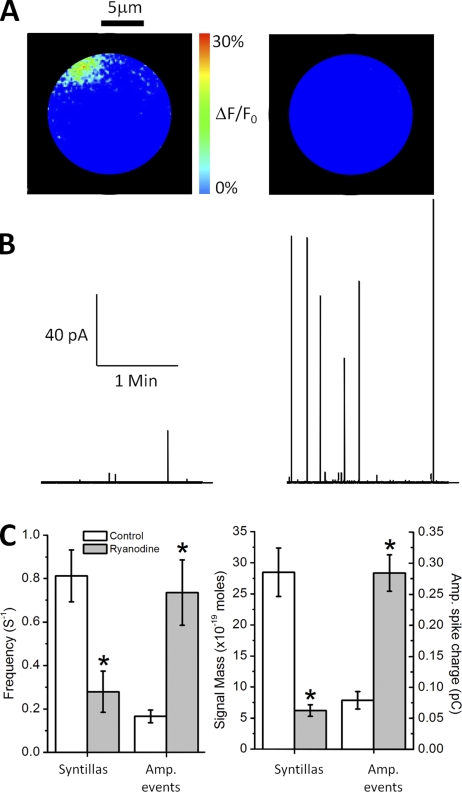
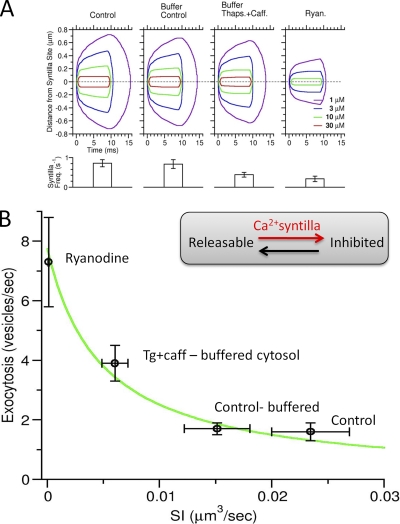
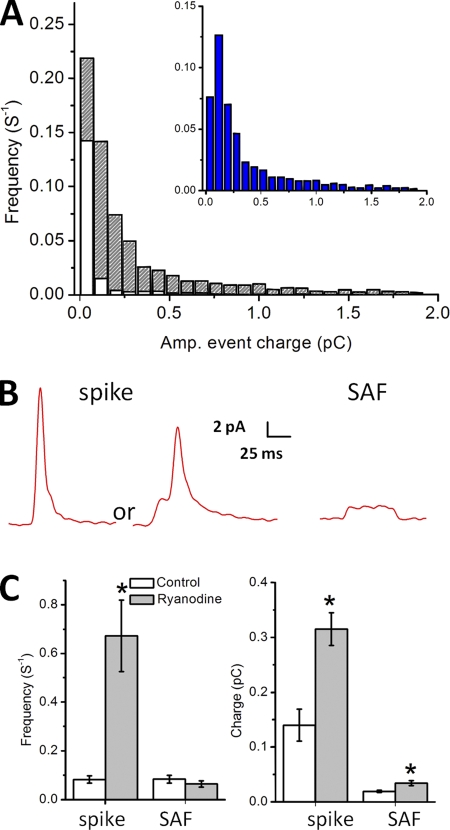
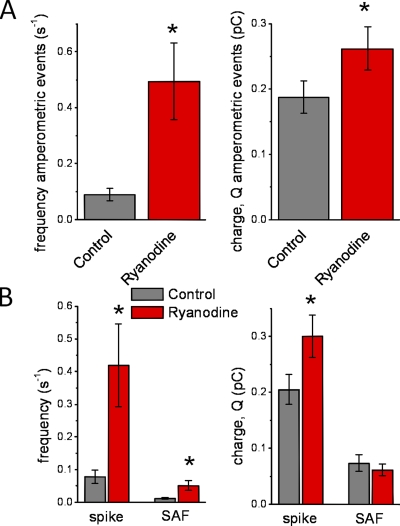
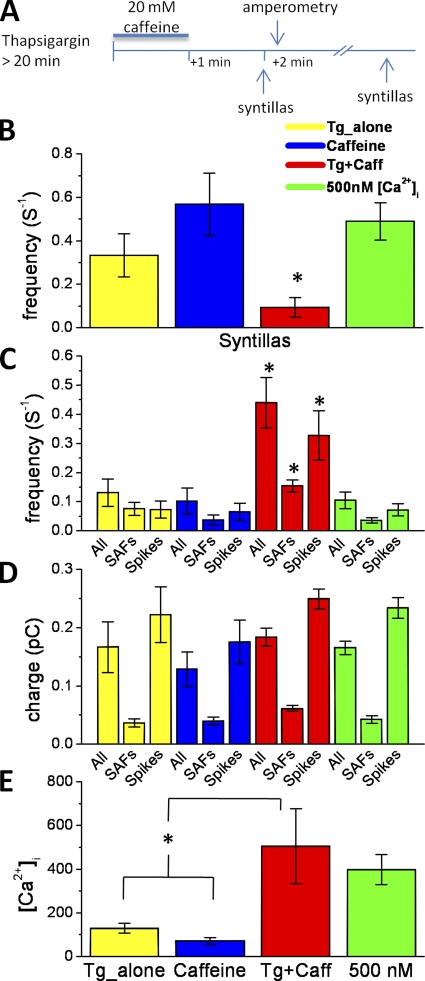
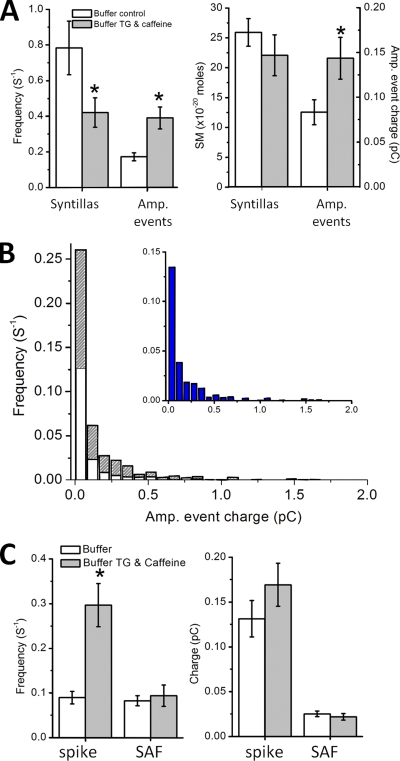
A central concept in the physiology of neurosecretion is that a rise in cytosolic [Ca(2+)] in the vicinity of plasmalemmal Ca(2+) channels due to Ca(2+) influx elicits exocytosis. Here, we examine the effect on spontaneous exocytosis of a rise in focal cytosolic [Ca(2+)] in the vicinity of ryanodine receptors (RYRs) due to release from internal stores in the form of Ca(2+) syntillas. Ca(2+) syntillas are focal cytosolic transients mediated by RYRs, which we first found in hypothalamic magnocellular neuronal terminals. (scintilla, Latin for spark; found in nerve terminals, normally synaptic structures.) We have also observed Ca(2+) syntillas in mouse adrenal chromaffin cells. Here, we examine the effect of Ca(2+) syntillas on exocytosis in chromaffin cells. In such a study on elicited exocytosis, there are two sources of Ca(2+): one due to influx from the cell exterior through voltage-gated Ca(2+) channels, and that due to release from intracellular stores. To eliminate complications arising from Ca(2+) influx, we have examined spontaneous exocytosis where influx is not activated. We report here that decreasing syntillas leads to an increase in spontaneous exocytosis measured amperometrically. Two independent lines of experimentation each lead to this conclusion. In one case, release from stores was blocked by ryanodine; in another, stores were partially emptied using thapsigargin plus caffeine, after which syntillas were decreased. We conclude that Ca(2+) syntillas act to inhibit spontaneous exocytosis, and we propose a simple model to account quantitatively for this action of syntillas.
神经分泌生理学的一个核心概念是,由于 Ca(2+) 内流导致质膜 Ca(2+) 通道附近的细胞溶质 [Ca(2+)] 升高,从而引发胞吐作用。在这里,我们研究了由于内部储存以 Ca(2+) 火花的形式释放而导致附近兰尼碱受体 (RYR) 处局部细胞质 [Ca(2+)] 升高对自发胞吐作用的影响。Ca(2+) 火花是由 RYR 介导的局部细胞质瞬变,我们首先在下丘脑大细胞神经元末梢中发现了这种瞬变。(火花,拉丁语为火花;在神经末梢发现,通常是突触结构。)我们还观察到在小鼠肾上腺嗜铬细胞中的 Ca(2+) 火花。在这里,我们研究了 Ca(2+) 火花对嗜铬细胞胞吐作用的影响。在这种关于诱发胞吐作用的研究中,有两种 Ca(2+) 来源:一种是由于通过电压门控 Ca(2+) 通道从细胞外流入,另一种是由于从细胞内储存中释放。为了消除由于 Ca(2+) 内流引起的复杂性,我们研究了自发胞吐作用,其中内流未被激活。我们在此报告,减少火花会导致通过安培测量法测量的自发胞吐作用增加。两个独立的实验路线都得出了这个结论。在一种情况下,通过兰尼碱阻断了储存的释放;在另一种情况下,使用 thapsigargin 加咖啡因部分排空储存后,火花减少。我们得出结论,Ca(2+) 火花会抑制自发胞吐作用,我们提出了一个简单的模型来定量解释火花的这种作用。