Laboratory of Experimental Hemato-Oncology (LHCE), Department of Oncology, Luxembourg.
J Cell Mol Med. 2010 Jun;14(6A):1264-75. doi: 10.1111/j.1582-4934.2009.00918.x. Epub 2009 Oct 3.
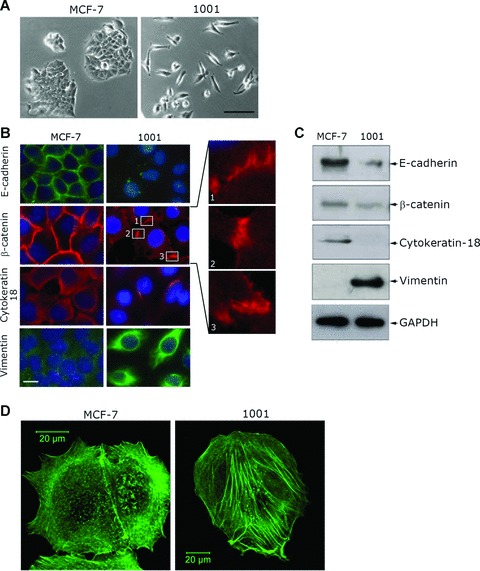
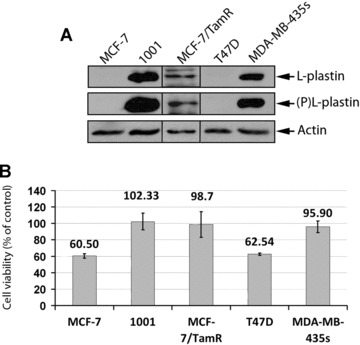
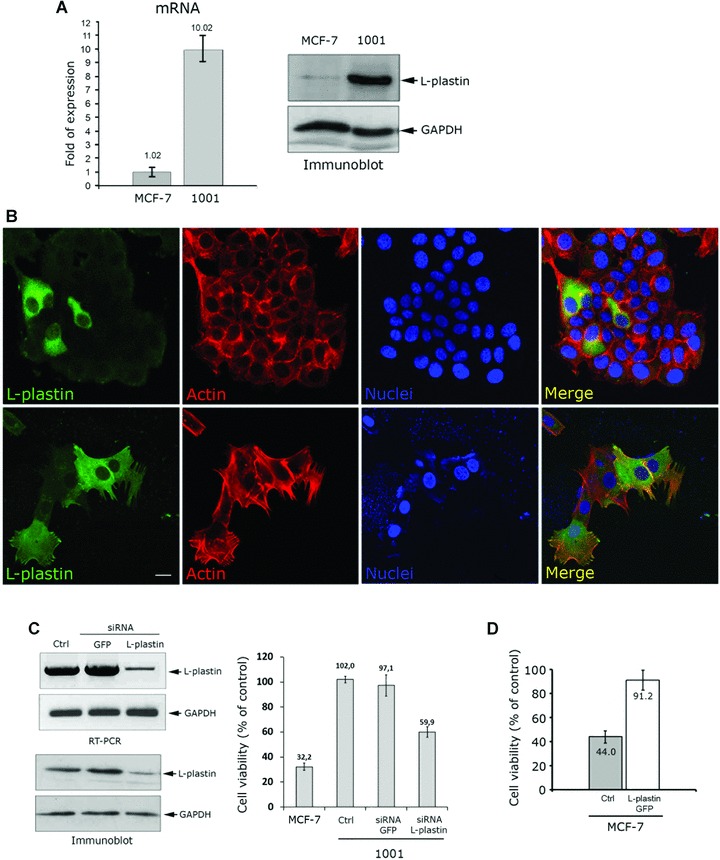
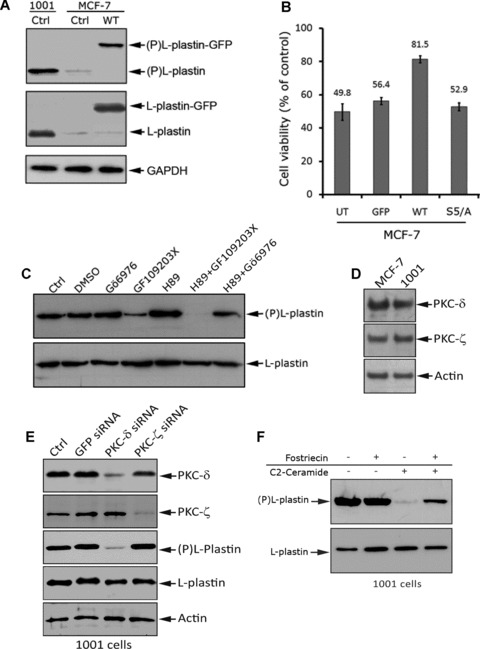
We used a tumour necrosis factor (TNF)-alpha resistant breast adenocarcinoma MCF-7 cell line to investigate the involvement of the actin cytoskeleton in the mechanism of cell resistance to this cytokine. We found that TNF resistance correlates with the loss of cell epithelial properties and the gain of a mesenchymal phenotype, reminiscent of an epithelial-to-mesenchymal transition (EMT). Morphological changes were associated with a profound reorganization of the actin cytoskeleton and with a change in the repertoire of expressed actin cytoskeleton genes and EMT markers, as revealed by DNA microarray-based expression profiling. L-plastin, an F-actin cross-linking and stabilizing protein, was identified as one of the most significantly up-regulated genes in TNF-resistant cells. Knockdown of L-plastin in these cells revealed its crucial role in conferring TNF resistance. Importantly, overexpression of wild-type L-plastin in TNF-sensitive MCF-7 cells was sufficient to protect them against TNF-mediated cell death. Furthermore, we found that this effect is dependent on serine-5 phosphorylation of L-plastin and that non-conventional protein kinase C isoforms and the ceramide pathway may regulate its phosphorylation state. The protective role of L-plastin was not restricted to TNF-alpha resistant MCF-7 cells because a correlation between the expression of L-plastin and the resistance to TNF-alpha was observed in other breast cancer cell lines. Together, our study discloses a novel unexpected role of the actin bundling protein L-plastin as a cell protective protein against TNF-cytotoxicity.
我们使用肿瘤坏死因子 (TNF)-alpha 抗性乳腺腺癌 MCF-7 细胞系来研究细胞对这种细胞因子产生抗性的机制中肌动蛋白细胞骨架的作用。我们发现 TNF 抗性与细胞上皮特性的丧失和间质表型的获得相关,类似于上皮-间质转化 (EMT)。形态变化与肌动蛋白细胞骨架的深刻重排以及通过 DNA 微阵列表达谱分析揭示的表达肌动蛋白细胞骨架基因和 EMT 标志物的变化相关。L-肌动蛋白结合蛋白 (L-plastin) 是一种 F-肌动蛋白交联和稳定蛋白,被鉴定为 TNF 抗性细胞中上调最显著的基因之一。在这些细胞中敲低 L-plastin 揭示了它在赋予 TNF 抗性中的关键作用。重要的是,野生型 L-plastin 在 TNF 敏感的 MCF-7 细胞中的过表达足以保护它们免受 TNF 介导的细胞死亡。此外,我们发现这种效应依赖于 L-plastin 的丝氨酸-5 磷酸化,并且非典型蛋白激酶 C 同工型和神经酰胺途径可能调节其磷酸化状态。L-plastin 的保护作用不仅限于 TNF-alpha 抗性 MCF-7 细胞,因为在其他乳腺癌细胞系中观察到 L-plastin 的表达与对 TNF-alpha 的抗性之间存在相关性。总之,我们的研究揭示了肌动蛋白束蛋白 L-plastin 作为一种针对 TNF 细胞毒性的细胞保护蛋白的新的意想不到的作用。