Fernández-Ramires R, Solé X, De Cecco L, Llort G, Cazorla A, Bonifaci N, Garcia M J, Caldés T, Blanco I, Gariboldi M, Pierotti M A, Pujana M A, Benítez J, Osorio A
Spanish National Cancer Center (CNIO) and CIBERER, Madrid, Spain.
Br J Cancer. 2009 Oct 20;101(8):1469-80. doi: 10.1038/sj.bjc.6605275.
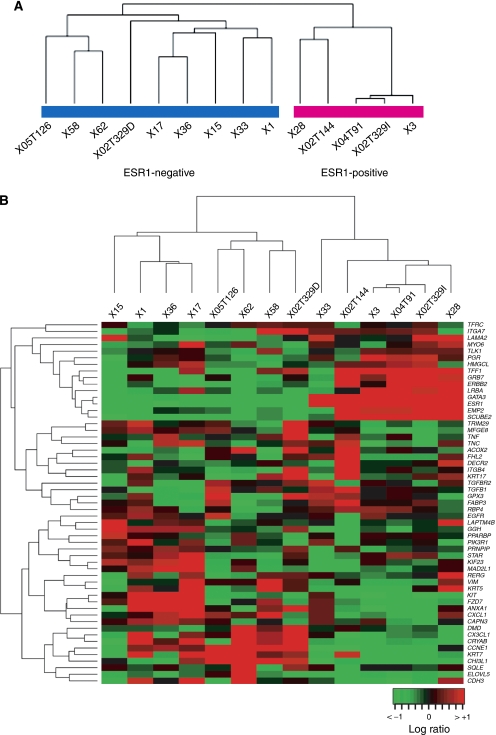
Gene expression profiling has distinguished sporadic breast tumour classes with genetic and clinical differences. Less is known about the molecular classification of familial breast tumours, which are generally considered to be less heterogeneous. Here, we describe molecular signatures that define BRCA1 subclasses depending on the expression of the gene encoding for oestrogen receptor, ESR1.
For this purpose, we have used the Oncochip v2, a cancer-related cDNA microarray to analyze 14 BRCA1-associated breast tumours.
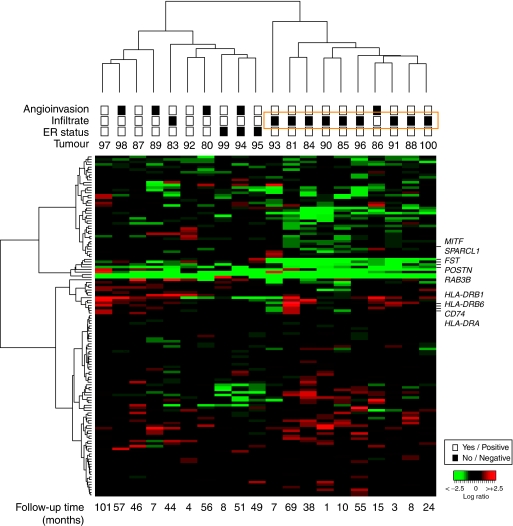
Signatures were found to be molecularly associated with different biological processes and transcriptional regulatory programs. The signature of ESR1-positive tumours was mainly linked to cell proliferation and regulated by ER, whereas the signature of ESR1-negative tumours was mainly linked to the immune response and possibly regulated by transcription factors of the REL/NFkappaB family. These signatures were then verified in an independent series of familial and sporadic breast tumours, which revealed a possible prognostic value for each subclass. Over-expression of immune response genes seems to be a common feature of ER-negative sporadic and familial breast cancer and may be associated with good prognosis. Interestingly, the ESR1-negative tumours were substratified into two groups presenting slight differences in the magnitude of the expression of immune response transcripts and REL/NFkappaB transcription factors, which could be dependent on the type of BRCA1 germline mutation.
This study reveals the molecular complexity of BRCA1 breast tumours, which are found to display similarities to sporadic tumours, and suggests possible prognostic implications.
基因表达谱分析已区分出具有遗传和临床差异的散发性乳腺肿瘤类别。对于家族性乳腺肿瘤的分子分类了解较少,这类肿瘤通常被认为异质性较低。在此,我们描述了根据雌激素受体编码基因ESR1的表达来定义BRCA1亚类的分子特征。
为此,我们使用了Oncochip v2,一种与癌症相关的cDNA微阵列,来分析14例与BRCA1相关的乳腺肿瘤。
发现这些特征在分子水平上与不同的生物学过程和转录调控程序相关。ESR1阳性肿瘤的特征主要与细胞增殖相关且受雌激素受体调控,而ESR1阴性肿瘤的特征主要与免疫反应相关且可能受REL/NFκB家族转录因子调控。然后在一系列独立的家族性和散发性乳腺肿瘤中验证了这些特征,结果显示每个亚类都具有潜在的预后价值。免疫反应基因的过表达似乎是雌激素受体阴性散发性和家族性乳腺癌的共同特征,且可能与良好预后相关。有趣的是,ESR1阴性肿瘤可分为两组,它们在免疫反应转录本和REL/NFκB转录因子表达水平上存在细微差异,这可能取决于BRCA1种系突变的类型。
本研究揭示了BRCA1乳腺肿瘤的分子复杂性,发现其与散发性肿瘤存在相似性,并提示了可能的预后意义。