Villafuerte Sandra M, Vallabhaneni Kamala, Sliwerska Elzbieta, McMahon Francis J, Young Elizabeth A, Burmeister Margit
Molecular & Behavioral Neuroscience Institute, Department of Psychiatry, University of Michigan, Ann Arbor, Michigan 48109-2200, USA.
Psychiatr Genet. 2009 Dec;19(6):281-91. doi: 10.1097/YPG.0b013e32832a506e.
Desensitization of serotonin 1A (HTR1A) and 1B (HTR1B) autoreceptors has been proposed to be involved in the delayed onset of response to selective serotonin reuptake inhibitors (SSRIs). Variations in gene expression in these genes may thus affect SSRI response.
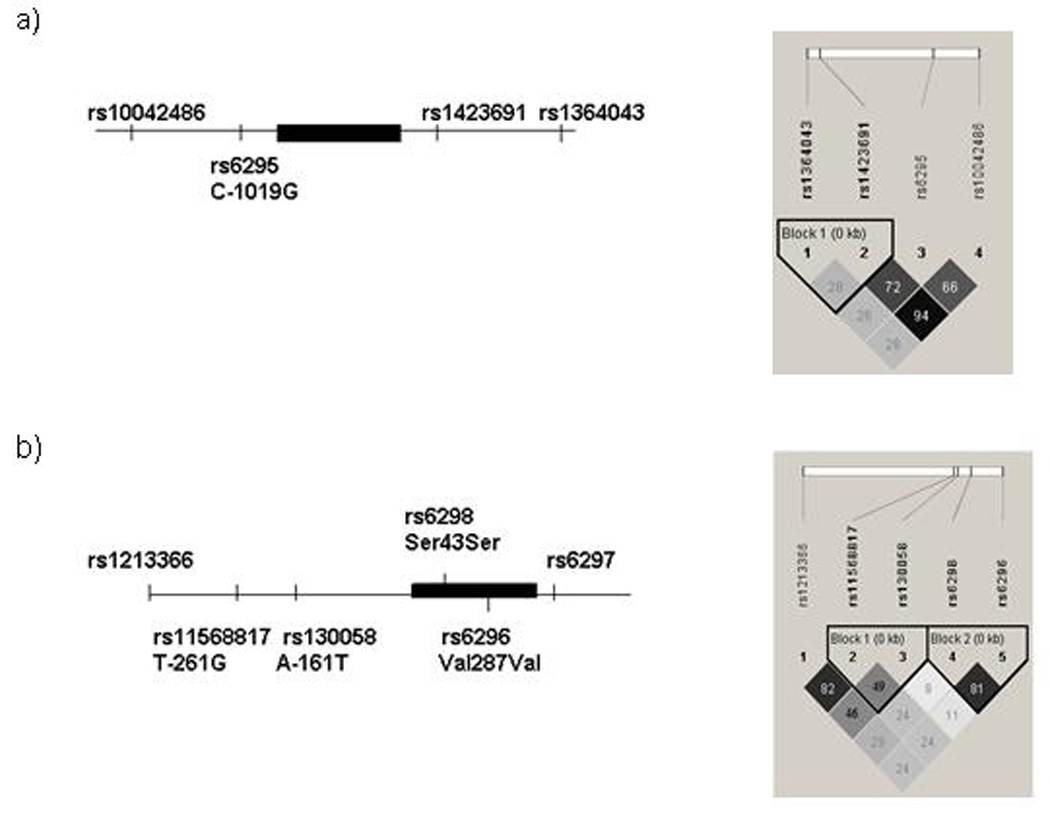
Here, we test this hypothesis in two samples from the Sequenced Treatment Alternatives to Relieve Depression (STAR*D), and show evidence for involvement of several genetic variants alone and in interaction. Initially, three functional single nucleotide polymorphisms (SNPs) in the HTR1B gene and in the HTR1A gene were analyzed in 153 depressed patients treated with citalopram. The 16-item Quick Inventory of Depressive Symptomatology Clinician scores were evaluated over time with respect to genetic variation.
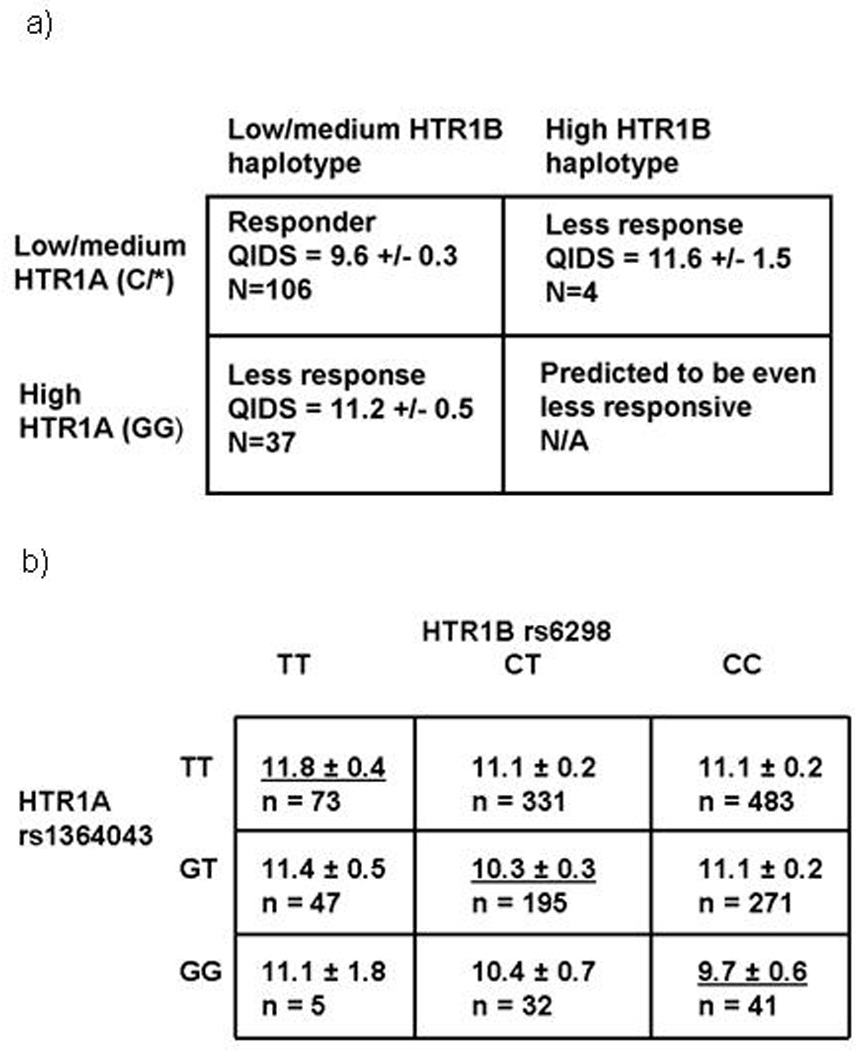
Individuals homozygous for the -1019 G allele (rs6295) in HTR1A showed the higher baseline 16-item Quick Inventory of Depressive Symptomatology Clinician scores (P=0.033), and by 12 weeks had a significantly lower response rate (P=0.005). HTR1B haplotypes were estimated according to the previously reported in-vitro expression levels. Individuals who were homozygous for the high-expression haplotype showed significantly slower response to citalopram (P=0.034). We then analyzed more SNPs in the extended overall STAR*D sample. Although we could not directly test the same functional SNPs, we found that homozygotes for the G allele at rs1364043 in HTR1A (P=0.045) and the C allele of rs6298 in HTR1B showed better response to citalopram over time (P=0.022). Test for interaction between rs6298 in HTR1B and rs1364043 in HTR1A was significant (overall P=0.032).
Our data suggest that an enhanced capacity of HTR1B or HTR1A transcriptional activity may impair desensitization of the autoreceptors during SSRI treatment.
血清素1A(HTR1A)和1B(HTR1B)自身受体的脱敏作用被认为与选择性血清素再摄取抑制剂(SSRI)反应的延迟起效有关。因此,这些基因的基因表达变化可能会影响SSRI反应。
在此,我们在缓解抑郁症的序贯治疗替代方案(STAR*D)的两个样本中检验了这一假设,并展示了几个单独的基因变异及其相互作用的参与证据。最初,在153名接受西酞普兰治疗的抑郁症患者中分析了HTR1B基因和HTR1A基因中的三个功能性单核苷酸多态性(SNP)。随着时间的推移,根据基因变异情况评估了16项抑郁症状快速检查表临床医生评分。
HTR1A基因中-1019 G等位基因(rs6295)的纯合个体在基线时16项抑郁症状快速检查表临床医生评分较高(P=0.033),到12周时反应率显著较低(P=0.005)。根据先前报道的体外表达水平估计HTR1B单倍型。高表达单倍型的纯合个体对西酞普兰的反应明显较慢(P=0.034)。然后,我们在扩展的整个STAR*D样本中分析了更多的SNP。尽管我们无法直接测试相同的功能性SNP,但我们发现HTR1A基因中rs1364043的G等位基因(P=0.045)和HTR1B基因中rs6298的C等位基因的纯合个体随着时间的推移对西酞普兰的反应更好(P=0.022)。HTR1B基因中的rs6298与HTR1A基因中的rs1364043之间的相互作用检验具有显著性(总体P=0.032)。
我们的数据表明,HTR1B或HTR1A转录活性增强可能会损害SSRI治疗期间自身受体的脱敏作用。