Montreal Neurological Institute, McGill University, Montreal, Quebec, Canada.
PLoS One. 2009 Oct 16;4(10):e7487. doi: 10.1371/journal.pone.0007487.
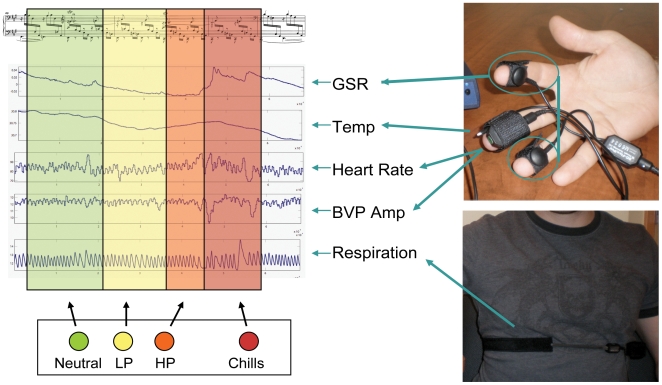
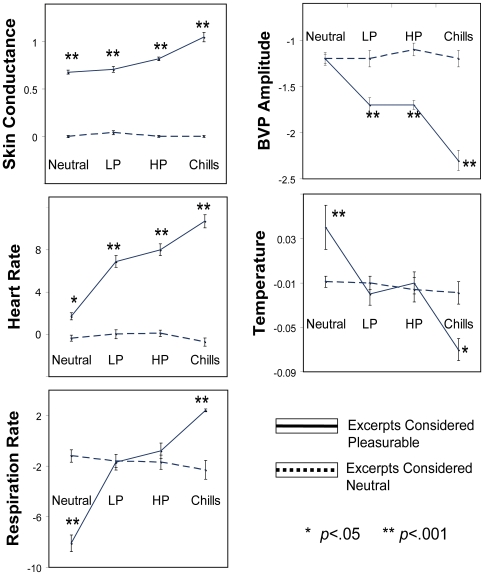
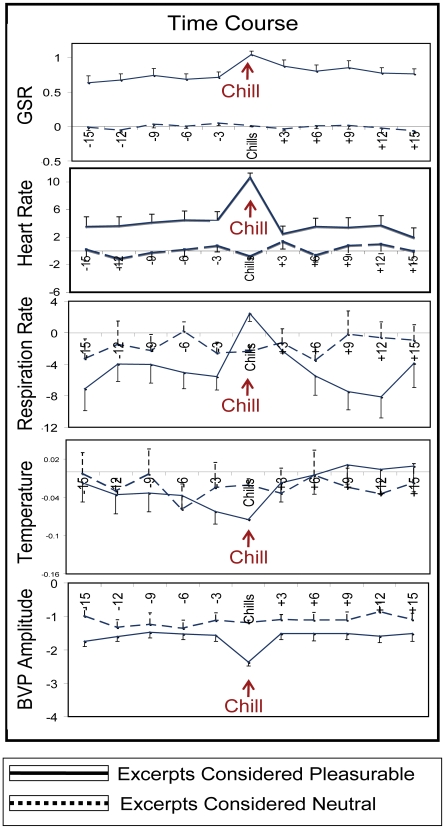
Listening to music is amongst the most rewarding experiences for humans. Music has no functional resemblance to other rewarding stimuli, and has no demonstrated biological value, yet individuals continue listening to music for pleasure. It has been suggested that the pleasurable aspects of music listening are related to a change in emotional arousal, although this link has not been directly investigated. In this study, using methods of high temporal sensitivity we investigated whether there is a systematic relationship between dynamic increases in pleasure states and physiological indicators of emotional arousal, including changes in heart rate, respiration, electrodermal activity, body temperature, and blood volume pulse.
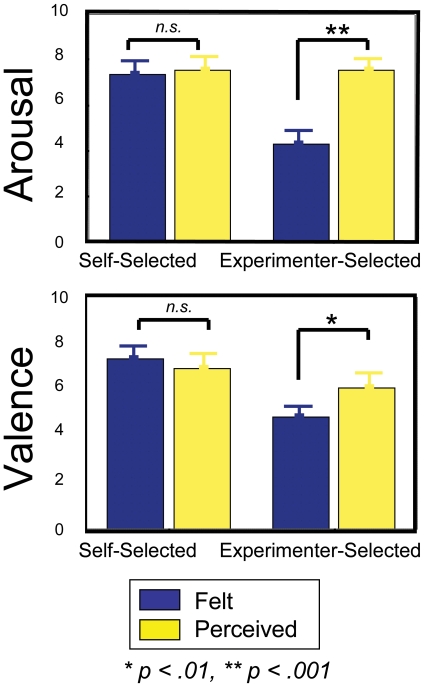
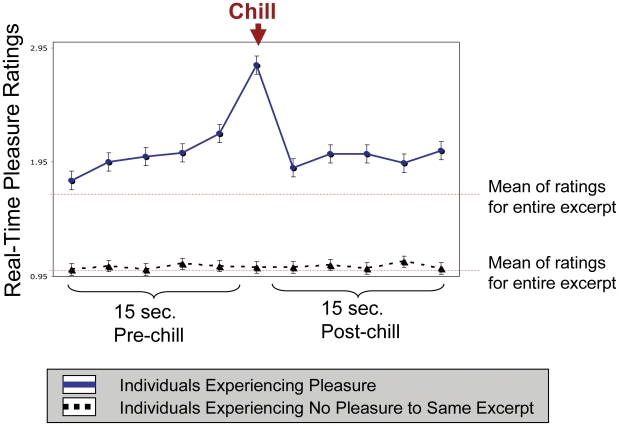
Twenty-six participants listened to self-selected intensely pleasurable music and "neutral" music that was individually selected for them based on low pleasure ratings they provided on other participants' music. The "chills" phenomenon was used to index intensely pleasurable responses to music. During music listening, continuous real-time recordings of subjective pleasure states and simultaneous recordings of sympathetic nervous system activity, an objective measure of emotional arousal, were obtained.
Results revealed a strong positive correlation between ratings of pleasure and emotional arousal. Importantly, a dissociation was revealed as individuals who did not experience pleasure also showed no significant increases in emotional arousal.
CONCLUSIONS/SIGNIFICANCE: These results have broader implications by demonstrating that strongly felt emotions could be rewarding in themselves in the absence of a physically tangible reward or a specific functional goal.
听音乐是人类最有价值的体验之一。音乐与其他奖励刺激没有功能上的相似之处,也没有表现出生物价值,但个体仍然为了愉悦而听音乐。有人认为,听音乐的愉悦方面与情绪唤醒的变化有关,尽管这一联系尚未得到直接研究。在这项研究中,我们使用高时间敏感度的方法,研究了愉悦状态的动态增加与情绪唤醒的生理指标之间是否存在系统关系,包括心率、呼吸、皮肤电活动、体温和血流脉冲的变化。
26 名参与者听他们自己选择的极度愉悦的音乐和“中性”音乐,这些音乐是根据他们在其他参与者的音乐中提供的低愉悦评分为他们单独选择的。“兴奋”现象被用来表示对音乐的极度愉悦反应。在听音乐的过程中,连续实时记录主观愉悦状态,并同时记录交感神经系统活动的客观测量,这是情绪唤醒的一个客观指标。
结果显示愉悦评分与情绪唤醒之间存在强烈的正相关。重要的是,研究发现了一种分离现象,即那些没有体验到愉悦的人也没有表现出明显的情绪唤醒增加。
结论/意义:这些结果具有更广泛的意义,表明强烈的情感本身可能是有益的,即使没有有形的奖励或特定的功能目标。