
醛脱氢酶活性促进人类肌肉前体细胞的存活。
Aldehyde dehydrogenase activity promotes survival of human muscle precursor cells.
机构信息
INSERM, ERI 25, Muscle et Pathologies, Montpellier, France.
出版信息
J Cell Mol Med. 2011 Jan;15(1):119-33. doi: 10.1111/j.1582-4934.2009.00942.x.
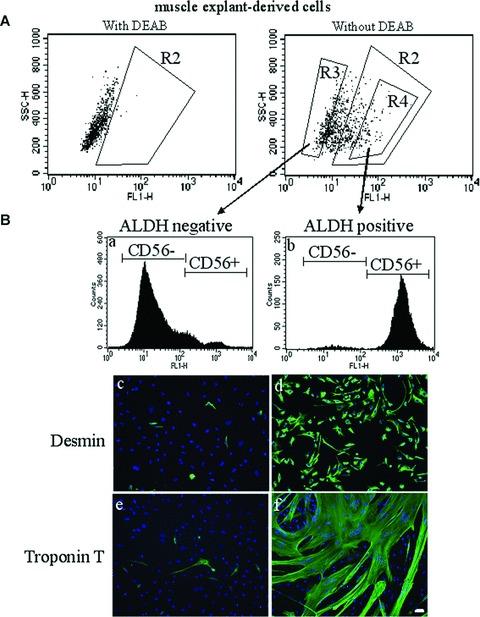
Aldehyde dehydrogenases (ALDH) are a family of enzymes that efficiently detoxify aldehydic products generated by reactive oxygen species and might therefore participate in cell survival. Because ALDH activity has been used to identify normal and malignant cells with stem cell properties, we asked whether human myogenic precursor cells (myoblasts) could be identified and isolated based on their levels of ALDH activity. Human muscle explant-derived cells were incubated with ALDEFLUOR, a fluorescent substrate for ALDH, and we determined by flow cytometry the level of enzyme activity. We found that ALDH activity positively correlated with the myoblast-CD56(+) fraction in those cells, but, we also observed heterogeneity of ALDH activity levels within CD56-purified myoblasts. Using lentiviral mediated expression of shRNA we demonstrated that ALDH activity was associated with expression of Aldh1a1 protein. Surprisingly, ALDH activity and Aldh1a1 expression levels were very low in mouse, rat, rabbit and non-human primate myoblasts. Using different approaches, from pharmacological inhibition of ALDH activity by diethylaminobenzaldehyde, an inhibitor of class I ALDH, to cell fractionation by flow cytometry using the ALDEFLUOR assay, we characterized human myoblasts expressing low or high levels of ALDH. We correlated high ALDH activity ex vivo to resistance to hydrogen peroxide (H(2) O(2) )-induced cytotoxic effect and in vivo to improved cell viability when human myoblasts were transplanted into host muscle of immune deficient scid mice. Therefore detection of ALDH activity, as a purification strategy, could allow non-toxic and efficient isolation of a fraction of human myoblasts resistant to cytotoxic damage.
醛脱氢酶(ALDH)是一类能够有效清除活性氧产生的醛类产物的酶,因此可能参与细胞存活。由于 ALDH 活性已被用于鉴定具有干细胞特性的正常和恶性细胞,我们想知道是否可以根据人肌原细胞(成肌细胞)的 ALDH 活性来识别和分离它们。我们用人肌肉组织块来源的细胞孵育 ALDEFLUOR,一种 ALDH 的荧光底物,并用流式细胞术检测酶活性。我们发现 ALDH 活性与这些细胞中的成肌细胞-CD56(+)部分呈正相关,但我们也观察到 CD56 纯化的成肌细胞内 ALDH 活性水平存在异质性。通过慢病毒介导的 shRNA 表达,我们证明 ALDH 活性与 Aldh1a1 蛋白的表达相关。令人惊讶的是,鼠、大鼠、兔和非人灵长类动物的成肌细胞中 ALDH 活性和 Aldh1a1 表达水平非常低。我们采用不同的方法,从用 class I ALDH 的抑制剂二乙氨基苯甲醛抑制 ALDH 活性到用 ALDEFLUOR assay 通过流式细胞术进行细胞分级,对表达低或高 ALDH 的人成肌细胞进行了特征分析。我们将体外高 ALDH 活性与对过氧化氢(H(2) O(2) )诱导的细胞毒性作用的抗性相关联,并与将人成肌细胞移植到免疫缺陷 scid 小鼠的宿主肌肉中后提高的细胞活力相关联。因此,作为一种纯化策略,ALDH 活性的检测可以允许无毒且高效地分离对细胞毒性损伤具有抗性的人成肌细胞部分。



 Zotero 插件